
What the Four Methods Measure
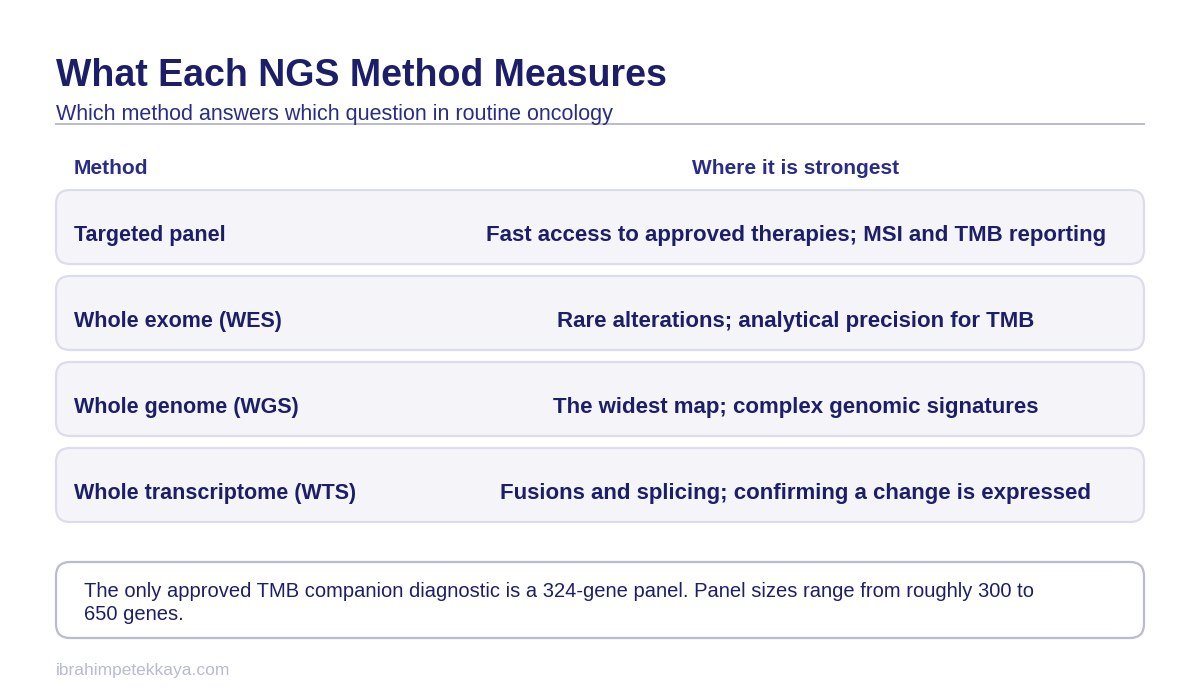
Four methods are in use for tumour sequencing today, and they do not all answer the same question. A targeted panel reads a preselected list of genes at high depth. High depth is what allows low-frequency changes to be caught even in samples containing few tumour cells.
Whole exome sequencing reads the whole of the protein-coding regions of the genome. When an unexpected change is found in a gene outside the panel, or when a genome-wide measurement is needed, that breadth turns into an advantage.
Whole genome sequencing reads the whole of the coding and non-coding regions; it is the method that can see structural changes and non-coding changes most broadly. Whole transcriptome sequencing, by contrast, reads not DNA but expressed RNA: gene expression, the splicing pattern and fusion transcripts come from that layer.
In practice the choice is made against three criteria: which change is being sought, the amount and quality of the sample, and the decision the result will be used for. The route followed when tissue is inadequate is covered in when the tissue biopsy is not enough, and the blood-based approach in liquid biopsy for cancer.
| Method | Region read | Typical use |
|---|---|---|
| Targeted panel | Several hundred genes, at high depth | Routine treatment decisions; approved companion diagnostics |
| Whole exome sequencing | All protein-coding regions | When breadth is needed; measuring mutational burden |
| Whole genome sequencing | All coding and non-coding regions | Research; signature-based classifiers |
| Whole transcriptome sequencing | Expressed RNA | Fusion confirmation; expression-based signatures |

What a Genetic Panel Test Is
Which genes a targeted panel test covers and which questions it answers.
When Whole Exome Sequencing Is Chosen
A wrong range is in circulation about panel size. The statement that standard panels contain between 300 and 500 genes cannot be sourced, and its upper limit is wrong as well. The accurate statement is this: clinical panels cover several hundred genes, and panels of, for example, 324 genes or 648 genes are in use.
What makes those numbers matter is approval status. The 324-gene panel is a test that has been through premarket approval, so its results are accepted as a companion diagnostic for the use of particular drugs. No test working at exome scale holds an approval of that kind.
Whole exome sequencing is therefore the method for questions that need breadth rather than for routine drug selection. Exome scale becomes meaningful when a change is being sought in a gene the panel does not cover, when a genome-wide measurement is to be made, or when a tumour is behaving in an unusual way.
The breadth obtained with whole exome sequencing carries a price as well: the number of changes of uncertain clinical significance rises. How those changes appear on a report is set out in what does VUS mean on an NGS report, and the general reading of a report in how to read an NGS report.
Send Your Reports for Assessment
Share your pathology, imaging and blood results on WhatsApp, or send them by email. Documents are reviewed before the consultation.
Where the 85 Per Cent Figure Comes From
One figure is often used to argue for exome sequencing: the protein-coding regions make up a small part of the genome but carry 85 per cent of mutations. The source of that figure is a study from 2009, and the study has nothing to do with cancer.
The study in question concerns inherited, single-gene disorders. It reported that protein-coding genes make up roughly 1 per cent of the genome while harbouring 85 per cent of the mutations with a large effect on disease-related traits. The subject of the sentence is therefore inherited rare disease.
That figure says nothing about somatic cancer drivers. What is more, the study predates the recognition of non-coding drivers. Carrying the number across to cancer sequencing is a methodological error.
Rather than discard the figure altogether, the more honest course is to tie it to its source. It was produced for inherited rare disease and it holds there; it cannot be moved into oncology. The assessment of inherited predisposition itself is covered on the hereditary cancer risk assessment page.
Exome or Panel for Measuring Mutational Burden
Tumour mutational burden, or TMB, is one of the measurements used in immunotherapy decisions. On this measurement, analytical accuracy and regulatory approval point in two different directions, and both have to be written down.
On the analytical side the exome leads. The harmonisation study reports that TMB is best calculated by whole exome sequencing, and that panels produce estimates that are efficient in terms of time and cost. The same study also shows that variability between panels increases as the true TMB value rises.
On the clinical side the picture is reversed, and that is what settles the matter. The only approved TMB companion diagnostic is a 324-gene panel, not an exome. The measurement can therefore be made with greater analytical precision, while the regulatorily validated form is the panel.
Those two sentences have to be said together: the exome is more analytically precise, the panel is firmer in terms of approval. Which measurement was used in a patient’s immunotherapy decision is therefore judged by looking at which test the report came from. The immunotherapy page sets out the framework for those decisions.
Important: In TMB measurement, analytical superiority and regulatory validation do not come together in the same method. The approved companion diagnostic is a panel; the exome is not approved for that purpose.
Where Whole Genome Sequencing Stands for HRD
Homologous recombination deficiency, or HRD, is a feature that affects the choice of treatment in some tumours. For measuring it, whole genome based mutational signature classifiers are accepted as the reference method, but that acceptance is at research level.
On the approval side the position is different: no approved HRD companion diagnostic uses whole genome sequencing. The clinically validated tests are panel based. HRD can also be calculated by targeted capture and from exome data.
The right adjective for the whole genome method is therefore the most comprehensive, not the most accurate. The method with the widest coverage does not have to be the method validated for a clinical decision; those two criteria are separate from one another.
Whole genome data carry another cost as well, the burden of interpretation. Because the region read is far larger, the data obtained are far larger too, and the load of changes of uncertain clinical significance is markedly heavy. No file size or turnaround figure is given here, because no reliable source could be found for either value.
What Transcriptome Sequencing Adds for Fusions
The role of RNA sequencing in fusion detection is to complement DNA rather than to replace it. That distinction matters, because the generalisation that RNA is wholly superior is not correct.
The contribution of RNA comes from three places. Because it reads the expressed transcript, it confirms that a fusion is genuinely produced and that it is in frame. In fusions whose breakpoint falls in a large or repetitive intronic region, it can see cases that DNA capture misses. And it reads skipping of exon 14 of the MET gene directly, without inference.
That positioning shows up in commercial practice too. One of the large providers presents its RNA test explicitly as a complementary test, for use when additional confidence is needed on fusions. The manufacturer, in other words, does not frame it as a claim to replacement either.
The text in which the RNA side is treated in detail is RNA analysis of tumours. Which biomarkers are sought by which method in lung cancer is set out in biomarker testing in lung cancer.
Should Comprehensive Genomic Profiling Be Done for Everyone
The patients in whom broad genomic testing is meaningful.
Expression-Based Immune Signatures Are Research Grade
There are gene expression signatures that try to predict the immune response from transcriptome data, and their status has to be marked explicitly: these signatures are research grade.
The canonical example in the field is the interferon-gamma related expression profile, and that profile is a defined, published signature. But no immune signature based on gene expression is an approved companion diagnostic.
The approved immunotherapy biomarkers today consist of three headings: PD-L1 expression measured by immunohistochemistry, microsatellite instability or mismatch repair deficiency, and tumour mutational burden. If an expression-based immune signature appears on a report, that result is not given the same weight as those three.
The practical consequence of the distinction is this: a research-grade signature can be a reason to direct a patient towards a suitable clinical trial; on its own it does not change a standard treatment decision. At which board and against which criteria the decision is made is set out on the molecular tumour board page.
How Long the Result Takes
On turnaround there are two values that can be verified. One of the large platforms running exome and transcriptome together reports a period of between 6 and 9 days from receipt of the sample. The 324-gene panel reports a median of 8 days.
Read together, those two values overturn a common assumption. It is not true that sequencing at exome scale is inherently slower than a panel; the reported turnaround times are close to one another.
For whole genome sequencing no turnaround is given here. No reliable source could be found for that value, so writing a number down would be invention. What can be said is this: whole genome data are far larger and the burden of interpretation is markedly heavier.
In practice what usually determines the turnaround is not the sequencing but what comes before and after it: the tissue sample reaching the laboratory, the quality of the block being found adequate, and the report being assessed at the board. Planning those steps affects the result as much as the choice of test does.
What Each Platform Runs Today
Reporting the configurations actually in use grounds the discussion of method. One of the large platforms runs whole exome sequencing together with whole transcriptome sequencing and immunohistochemistry. Another combines a 648-gene DNA panel with whole transcriptome RNA sequencing.
The approved 324-gene panel reads DNA only; a separate test is offered for the RNA side. Looking at those three configurations, the general tendency that emerges is this: in routine solid tumour practice what is preferred is either exome together with transcriptome, or panels, rather than whole genome sequencing.
The share of the coding region is the last heading that needs discussing here. Roughly 1 to 2 per cent of the genome is coding and 98 to 99 per cent is non-coding. That the targeted drugs in use today act on proteins produced by the coding region is a defensible statement.
That statement does not mean the non-coding genome is unimportant, however, and two caveats have to be added. The first is that non-coding changes are clinically meaningful: TERT promoter mutations, intronic fusion breakpoints and splice-region changes such as MET exon 14 skipping are examples. The second is that epigenetic drugs act across the genome.
The correct formulation is this: sequencing at exome scale captures most of the directly actionable changes. That says not that the non-coding genome is unimportant but that today’s drug repertoire is weighted towards the coding region.
- Which change is being sought is established first; the question picks the method, not the other way round.
- If an approved companion diagnostic is needed, a panel-based test is preferred.
- For questions that need breadth, exome scale is considered.
- If a fusion is suspected, the RNA side is added as a complement.
- Expression-based immune signatures are marked as research grade.
- The result is read at the board together with all the findings rather than as a single line.
How the test is chosen for an individual patient is covered on the comprehensive genomic profiling page, the limits of the idea of personalised treatment in what personalised cancer treatment means, and the general framework of the field on the precision oncology page.
Send Your Reports for Assessment
Share your pathology, imaging and blood results on WhatsApp, or send them by email. Documents are reviewed before the consultation.
Frequently Asked Questions
What is the difference between whole exome sequencing and a targeted panel?
A panel reads several hundred preselected genes at high depth; panels of 324 or 648 genes, for example, are in use. Whole exome sequencing reads the whole of the protein-coding regions. Approved companion diagnostics are panel based.
Are 85 per cent of mutations in the coding region?
That figure comes from a study from 2009 concerning inherited single-gene disorders. The study reported this proportion for mutations with a large effect on disease-related traits. It says nothing about somatic cancer drivers and predates the recognition of non-coding drivers.
Which method should be used to measure tumour mutational burden?
Analytically the best measurement is made by whole exome sequencing; panels produce estimates that are efficient in time and cost, and variability between panels increases as the true value rises. The only approved companion diagnostic, however, is a 324-gene panel.
Is whole genome sequencing used to measure HRD?
In research the reference method is whole genome based mutational signature classifiers, but no approved HRD companion diagnostic uses whole genome sequencing. The clinically validated tests are panel based; HRD can also be calculated from targeted capture and from exome data.
Does RNA sequencing replace DNA?
No, it complements it. It confirms that a fusion is genuinely expressed and in frame, can see difficult intronic breakpoints, and reads MET exon 14 skipping directly. One of the large providers presents its RNA test explicitly as a complementary test.
Can gene expression signatures be used in an immunotherapy decision?
These signatures are research grade. The canonical interferon-gamma related profile is defined, but no immune signature based on gene expression is an approved companion diagnostic. The approved biomarkers are PD-L1 immunohistochemistry, microsatellite instability or mismatch repair deficiency, and tumour mutational burden.
Is exome sequencing slower than a panel?
It is not. One of the large platforms running exome and transcriptome together reports 6 to 9 days from receipt of the sample, and the 324-gene panel reports a median of 8 days. No turnaround is given here for whole genome sequencing, because no verifiable source could be found.
Related Articles

Related Pages
Comprehensive Genomic Profiling
Open the Page
Precision Oncology
Open the Page
Molecular Tumour Board
Open the Page
Targeted Therapy
Open the PageSources
- Choi M, Scholl UI, Ji W et al. Genetic diagnosis by whole exome capture and massively parallel DNA sequencing. Proc Natl Acad Sci U S A 2009;106(45):19096-19101. Link
- Merino DM, McShane LM, Fabrizio D et al. Establishing guidelines to harmonize tumor mutational burden (TMB): Friends of Cancer Research TMB Harmonization Project. J Immunother Cancer 2020;8(1):e000147. Link
- Vokes NI, Liu D, Ricciuti B et al. Harmonization of Tumor Mutational Burden Quantification and Association With Response to Immune Checkpoint Blockade in Non-Small-Cell Lung Cancer. JCO Precis Oncol 2019;3:PO.19.00171. Link
- Davies H, Glodzik D, Morganella S et al. HRDetect is a predictor of BRCA1 and BRCA2 deficiency based on mutational signatures. Nat Med 2017;23(4):517-525. Link
- Ju S, Cui Z, Hong Y et al. Detection of multiple types of cancer driver mutations using targeted RNA sequencing in non-small cell lung cancer. Cancer 2023;129(15):2422-2430. Link
- Heydt C, Wölwer CB, Velazquez Camacho O et al. Detection of gene fusions using targeted next-generation sequencing: a comparative evaluation. BMC Med Genomics 2021;14(1):62. Link
- Ayers M, Lunceford J, Nebozhyn M et al. IFN-gamma-related mRNA profile predicts clinical response to PD-1 blockade. J Clin Invest 2017;127(8):2930-2940. Link
- U.S. Food and Drug Administration. FoundationOne CDx - Premarket Approval P170019. Link