
Symptoms and Risk Factors
Ovarian cancer most often causes persistent bloating, pelvic or abdominal pain, feeling full quickly, loss of appetite and needing to pass urine more often; any of these lasting longer than three weeks should be discussed with a doctor. Because the symptoms resemble digestive complaints, diagnosis is frequently delayed and around 70 per cent of patients are diagnosed at stage 3 or 4 (ESMO 2023 guideline). Fluid in the abdomen (ascites), breathlessness and a change in bowel habit are signs of more advanced disease.
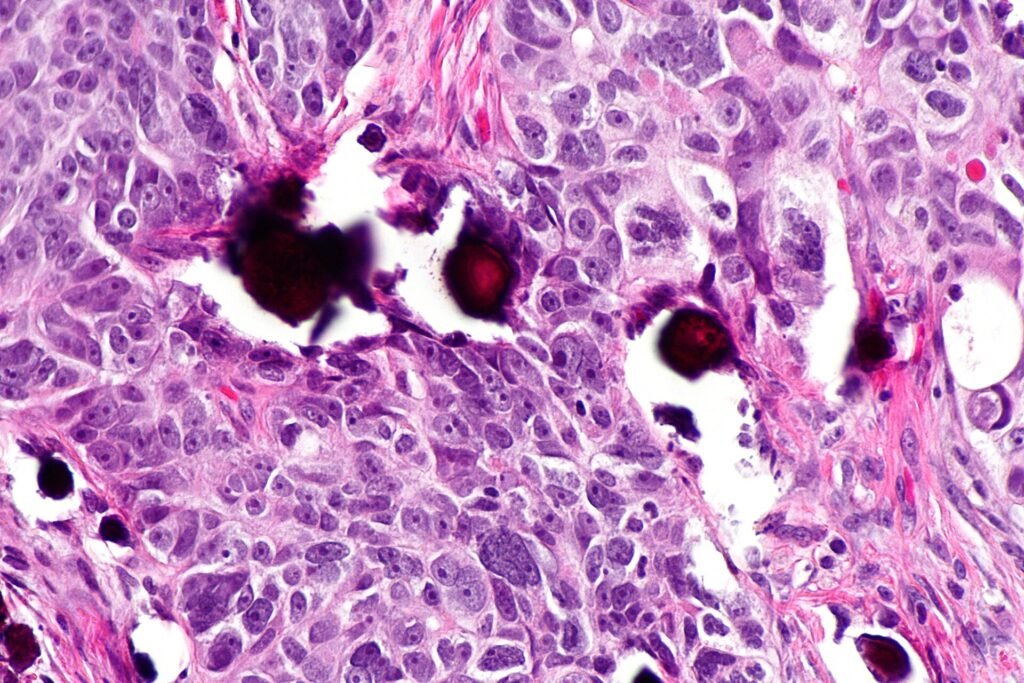
Ovarian cancer is the eighth most common cancer in women worldwide, with about 324,000 new diagnoses each year according to IARC GLOBOCAN 2022. The tumour can start in the ovary, the fallopian tube or the lining of the abdomen (peritoneum); these three origins are treated as one disease. About 90 per cent of cases are epithelial ovarian cancers, and most of these are high-grade serous carcinomas.
Inherited risk is the most important factor: roughly 15 to 20 per cent of high-grade serous ovarian cancers occur in women who carry a germline (inherited) BRCA1 or BRCA2 mutation, and Lynch syndrome or a family history of ovarian or breast cancer also increases risk. Older age, endometriosis and never having given birth are further factors. No population screening test has been shown to reduce deaths from ovarian cancer.
Diagnosis and Staging
Ovarian cancer is diagnosed with transvaginal ultrasound, a CA-125 blood test and computed tomography (CT), followed by pathological examination of tissue from the suspicious mass. Tissue is usually obtained at surgery; if surgery cannot be done first, an image-guided needle biopsy is taken, and PET-CT is requested if spread outside the abdomen is suspected. The pathology report states the tumour type (high-grade serous, low-grade serous, endometrioid, clear cell or mucinous) and the grade; the type changes the treatment.
Staging follows the FIGO 2014 system and is based on surgical findings. The stage describes whether the tumour is confined to the ovary, whether it has reached the peritoneum or lymph nodes, and whether distant metastasis (spread) is present. Surgical staging is performed by a gynaecological oncology surgeon; the medical oncologist plans systemic treatment according to that stage. The choice of treatment is made by the physician on the basis of stage, pathology and molecular findings.
| Stage | Definition | Systemic treatment approach |
|---|---|---|
| Stage 1 | Tumour confined to one or both ovaries | Observation alone for low-grade tumours with an intact capsule; three to six cycles of carboplatin and paclitaxel for high-grade tumours or a ruptured capsule |
| Stage 2 | Spread to neighbouring pelvic organs (uterus, tubes, bladder) | Six cycles of carboplatin and paclitaxel after surgery; PARP inhibitor maintenance considered when a BRCA mutation is present |
| Stage 3 | Spread to the peritoneum or abdominal lymph nodes | Cytoreductive surgery and six cycles of chemotherapy (order depends on extent); then PARP inhibitor or bevacizumab maintenance according to BRCA and HRD results |
| Stage 4 | Metastasis beyond the abdomen (pleura, inside the liver, distant lymph nodes) | Chemotherapy first, interval surgery if there is a response; maintenance planned on the same principles as stage 3 |
International patients can send their CT or PET-CT images (as DICOM files), the pathology report and the operation note for a remote review before travelling; imaging is often enough to decide whether surgery or chemotherapy should come first. Reports in English are preferred, but reports in other languages are accepted with a translation. The steps of a remote review are set out on the treatment pathway page.
Sequence of Surgery and Chemotherapy
The standard approach to ovarian cancer is cytoreductive surgery, which aims to remove all visible tumour, followed by six cycles of carboplatin and paclitaxel chemotherapy given intravenously every three weeks over about four months. Leaving no visible tumour behind is the strongest predictor of outcome, so the operation is performed by a team experienced in gynaecological oncology surgery.

When the tumour is very extensive, has reached the liver or the pleura, or the patient is not fit for a major operation, three cycles of chemotherapy are given first, interval cytoreductive surgery follows once the tumour has shrunk, and the remaining three cycles complete the course. The EORTC 55971 trial showed that this sequence gives similar results with fewer surgical complications in advanced disease. The decision on sequence is taken jointly by the surgeon and the medical oncologist at the tumour board.
Bevacizumab is an antibody that blocks the tumour's blood vessel formation; in stage 3 and 4 disease it is added to chemotherapy and continued after chemotherapy for a total of 15 months (GOG-218 trial). Common side effects of the chemotherapy are hair loss, low blood counts, nausea and numbness in the hands and feet caused by paclitaxel; the dose is reduced if the numbness becomes troublesome. General principles are explained on the chemotherapy page.
A carboplatin and paclitaxel visit usually takes four to six hours in the day unit, with a blood test the day before or on the same morning. Some patients choose to have surgery in their home country and chemotherapy in Izmir, or the reverse; both are workable when the operation note and pathology are shared. Prof. Dr. H. Ibrahim Petekkaya liaises with the home oncologist by e-mail on blood counts, dose adjustments and the timing of cycles when part of the course is given at home.
Important: The information on this page describes general principles and does not replace a consultation or an individual treatment plan. Licensing and reimbursement status differ from drug to drug and, as of 21 September 2026, are discussed in their current form at the consultation.
BRCA and HRD Testing
BRCA1 and BRCA2 are genes that allow cells to repair breaks in their DNA; tumours with a mutation in either gene are particularly sensitive to PARP inhibitors. ESMO, NCCN and the ASCO 2020 guideline all recommend germline BRCA testing from a blood sample at diagnosis in every epithelial ovarian cancer. If no mutation is found in the blood, the test is repeated on tumour tissue (somatic testing), because about a quarter of mutations are present only in the tumour.
Homologous recombination deficiency (HRD) means that the tumour has lost the same DNA repair pathway for reasons other than BRCA; it is found in about half of high-grade serous ovarian cancers. HRD is measured on tumour tissue with a genomic instability score, and the result shows who benefits from combining a PARP inhibitor with bevacizumab (PAOLA-1 trial). Results typically take two to four weeks; chemotherapy starts without waiting, and the maintenance decision is finalised when the result arrives. HRD testing can be performed on a paraffin tumour block sent from abroad, provided the block is recent and contains enough tumour. The process and how to read the report are described on the comprehensive genomic profiling page.
PARP Inhibitor Maintenance
PARP inhibitor maintenance is an oral targeted therapy given to delay the return of stage 3 and 4 ovarian cancer that has responded to chemotherapy; it starts within eight weeks of the last chemotherapy cycle. In the SOLO-1 trial, two years of olaparib in patients with a BRCA mutation markedly increased the proportion who remained free of disease at seven years of follow-up. Which drug is offered to which patient depends on the BRCA and HRD results, as set out below.
- Olaparib
- Given alone for two years after first-line chemotherapy in patients with a BRCA1 or BRCA2 mutation, or together with bevacizumab for two years in HRD-positive patients (PAOLA-1). Taken by mouth twice daily. Common side effects are nausea, fatigue and anaemia; the blood count is checked monthly during the first year.
- Niraparib
- Can be used regardless of BRCA or HRD status, although the benefit is greatest in the HRD-positive group (PRIMA). Taken once daily; the starting dose is set by body weight and platelet count. Common side effects are low platelets, anaemia and raised blood pressure; treatment continues for up to three years or until the disease progresses.
- Bevacizumab maintenance
- In HRD-negative patients, or when a PARP inhibitor is unsuitable, bevacizumab started with chemotherapy is completed to a total of 15 months. Blood pressure, protein in the urine and wound healing are monitored.
| Test result | Recommended maintenance | Duration |
|---|---|---|
| BRCA mutation present | Olaparib alone; olaparib with bevacizumab if bevacizumab was started; niraparib is an alternative | Olaparib two years; niraparib up to three years |
| No BRCA mutation, HRD positive | Olaparib with bevacizumab, or niraparib alone | Olaparib two years; niraparib up to three years |
| No BRCA mutation, HRD negative or unknown | Niraparib or bevacizumab; the benefit is more limited and is weighed at the consultation | Niraparib up to three years; bevacizumab 15 months in total |
A rare but serious side effect of PARP inhibitors is a bone marrow disorder (myelodysplastic syndrome or acute leukaemia) seen in 1 to 2 per cent of patients; unexplained low blood counts therefore lead to the drug being stopped and a haematology opinion being sought. Maintenance treatment can be prescribed in Izmir and continued at home: the prescription is issued for the period covered by the visit, blood counts are shared monthly, and the home oncologist takes over routine monitoring. Common principles of oral targeted drugs are explained on the targeted therapy page.
Options in Recurrent Disease
In most patients diagnosed at an advanced stage, ovarian cancer returns after the first treatment; at recurrence, treatment is planned according to the time between the last platinum chemotherapy and the relapse. If more than six months have passed, the disease is platinum-sensitive: carboplatin combined with paclitaxel, gemcitabine or liposomal doxorubicin is given again, and patients who respond and have not previously received a PARP inhibitor can start PARP maintenance. Selected patients with a single site of recurrence benefit from a second operation, as shown in the DESKTOP III trial.
Disease that progresses within six months is platinum-resistant, and the aim of treatment is to control symptoms and protect quality of life. Weekly paclitaxel, liposomal doxorubicin or topotecan is used as a single agent, with bevacizumab where possible (AURELIA). In tumours with high folate receptor alpha (FRα) expression, the antibody-drug conjugate mirvetuximab soravtansine prolonged survival compared with chemotherapy in the MIRASOL trial. Relacorilant with nab-paclitaxel was studied in platinum-resistant ovarian cancer in the ROSELLA phase 3 trial. Marketing authorisation and reimbursement change over time and differ by country; the position that applies to a given patient in Türkiye is checked at the consultation.
Ascites that causes breathlessness or discomfort is drained with a needle (paracentesis), and bowel obstruction is managed with surgery, a stent or medication. When standard options are exhausted or the subtype is rare, the case is discussed at the molecular tumour board; clinical trials are considered only as a matter for assessment. A plan started at another centre can be reviewed as a second opinion.
Genetic Counselling
Every woman diagnosed with ovarian cancer is offered hereditary testing, because the result determines not only the PARP decision but also the risk to her family. When a germline mutation in BRCA1, BRCA2, RAD51C, RAD51D, BRIP1 or one of the Lynch syndrome genes is found, each first-degree relative has a 50 per cent chance of carrying the same change. These relatives are offered a single-gene test known as cascade testing; carriers are offered earlier breast screening and, once childbearing is complete, risk-reducing removal of the tubes and ovaries.
Before testing, the consultation covers what the test can find, the possibility of a variant of uncertain significance and what the result means for relatives. Genetic data are a special category of personal data under Turkish data protection law (KVKK) and require separate written consent. The process is described on the hereditary cancer risk assessment page. A test result does not always change treatment, but in ovarian cancer the maintenance decision is not made without it. The wider picture of women's cancers is set out on the gynaecological cancers page.
Frequently Asked Questions
How long does ovarian cancer treatment take?
The duration depends on stage and the treatment plan. Surgery and six cycles of carboplatin and paclitaxel are usually completed within four to six months. Depending on the BRCA or HRD result, PARP inhibitor maintenance then lasts two years (olaparib) or up to three years (niraparib), and bevacizumab 15 months in total. In early-stage disease, chemotherapy may be limited to three to six cycles. The overall time varies from person to person according to response and side effects.
What is a PARP inhibitor?
A PARP inhibitor is an oral targeted therapy that blocks PARP, an enzyme cancer cells use to repair DNA damage. Cells with a BRCA mutation or homologous recombination deficiency (HRD) already struggle to repair DNA, so they die when PARP is blocked, while healthy cells are affected less. In ovarian cancer, olaparib and niraparib are used as maintenance treatment after chemotherapy to delay the return of the disease. Common side effects are nausea, fatigue and low blood counts.
Why is BRCA testing essential in ovarian cancer?
Because the result affects both treatment and family. ESMO and NCCN guidelines recommend BRCA1 and BRCA2 testing at diagnosis in every epithelial ovarian cancer; about 15 to 20 per cent of high-grade serous tumours carry an inherited BRCA mutation. When a mutation is present, the benefit of PARP inhibitor maintenance is greatest and the treatment duration is planned accordingly. The result also allows relatives at hereditary risk to be tested and protected. The test uses a blood sample; HRD testing can be added on tumour tissue.
What does platinum-sensitive mean?
Platinum-sensitive means the disease returns at least six months after the last chemotherapy containing carboplatin or cisplatin; in these patients, platinum chemotherapy works again and PARP inhibitor maintenance can follow. Disease that progresses within six months, or grows during chemotherapy, is considered platinum-resistant; here single-agent non-platinum chemotherapy, bevacizumab, mirvetuximab soravtansine in FRα-positive tumours or a clinical trial come into consideration. This interval is the main criterion for planning treatment of a recurrence.
How is CA-125 used in follow-up?
CA-125 is a tumour marker measured in the blood in ovarian cancer. It is commonly checked before each chemotherapy cycle, every three months for the first two years after treatment and every six months thereafter. The MRC OV05 trial showed that starting treatment early on the basis of a rising CA-125 alone, in a patient without symptoms, does not prolong survival, so a rise is assessed together with imaging and examination. CA-125 can also rise with endometriosis, infection or liver disease; a single value does not mean recurrence.
Does hereditary risk affect my family?
Yes. When an inherited BRCA1, BRCA2 or Lynch syndrome mutation is found in a woman with ovarian cancer, each first-degree relative (mother, sister, daughter, brother) has a 50 per cent chance of carrying the same change. These relatives are offered a single-gene test known as cascade testing; women found to be carriers are offered earlier screening for breast and ovarian cancer and, once childbearing is complete, risk-reducing surgery. Genetic counselling and separate written consent under Turkish data protection law are required before testing.
Can HRD testing be done on my tumour block from abroad?
Usually yes. HRD testing is performed on tumour tissue, so a paraffin block or unstained slides from the operation in your home country can be sent for analysis, provided the sample contains enough tumour and is not too old. Results take about two to four weeks and are reported alongside somatic BRCA status. Chemotherapy does not wait for this result; the maintenance decision is finalised once it arrives. The pathology laboratory confirms in advance whether the sample is suitable.
Related Pages

Gynaecological Cancers
Open the Page
Cervical Cancer
Open the Page
Chemotherapy
Open the Page
Targeted Therapy
Open the Page
Hereditary Cancer Risk Assessment
Open the Page
Comprehensive Genomic Profiling
Open the Page
Molecular Tumour Board
Open the Page
International Patients
Open the PageSources and Guidelines
- González-Martín A et al. Newly diagnosed and relapsed epithelial ovarian cancer: ESMO Clinical Practice Guideline. Ann Oncol 2023;34(10):833-848. Link
- National Comprehensive Cancer Network. NCCN Clinical Practice Guidelines in Oncology: Ovarian Cancer Including Fallopian Tube Cancer and Primary Peritoneal Cancer. Link
- Konstantinopoulos PA et al. Germline and somatic tumor testing in epithelial ovarian cancer: ASCO Guideline. J Clin Oncol 2020;38(11):1222-1245. Link
- Moore K et al. Maintenance olaparib in patients with newly diagnosed advanced ovarian cancer (SOLO-1). N Engl J Med 2018;379:2495-2505. Link
- González-Martín A et al. Niraparib in patients with newly diagnosed advanced ovarian cancer (PRIMA). N Engl J Med 2019;381:2391-2402. Link
- Ray-Coquard I et al. Olaparib plus bevacizumab as first-line maintenance in ovarian cancer (PAOLA-1). N Engl J Med 2019;381:2416-2428. Link
- Vergote I et al. Neoadjuvant chemotherapy or primary surgery in stage IIIC or IV ovarian cancer (EORTC 55971). N Engl J Med 2010;363:943-953. Link
- Burger RA et al. Incorporation of bevacizumab in the primary treatment of ovarian cancer (GOG-218). N Engl J Med 2011;365:2473-2483. Link
- Rustin GJ et al. Early versus delayed treatment of relapsed ovarian cancer (MRC OV05/EORTC 55955). Lancet 2010;376(9747):1155-1163. Link
- Moore KN et al. Mirvetuximab soravtansine in FRα-positive, platinum-resistant ovarian cancer (MIRASOL). N Engl J Med 2023;389:2162-2174. Link
- Cancer Research UK. Ovarian cancer: symptoms, diagnosis and treatment. Link
- International Agency for Research on Cancer (WHO). GLOBOCAN 2022, Global Cancer Observatory. Link
- Turkish Society of Medical Oncology. Guidelines and patient information resources. Link