
What Personalised Cancer Treatment Rests On
The phrase cannot be reduced to one test. Four layers of information shape the plan, and unless they are read together the result is not personalised.
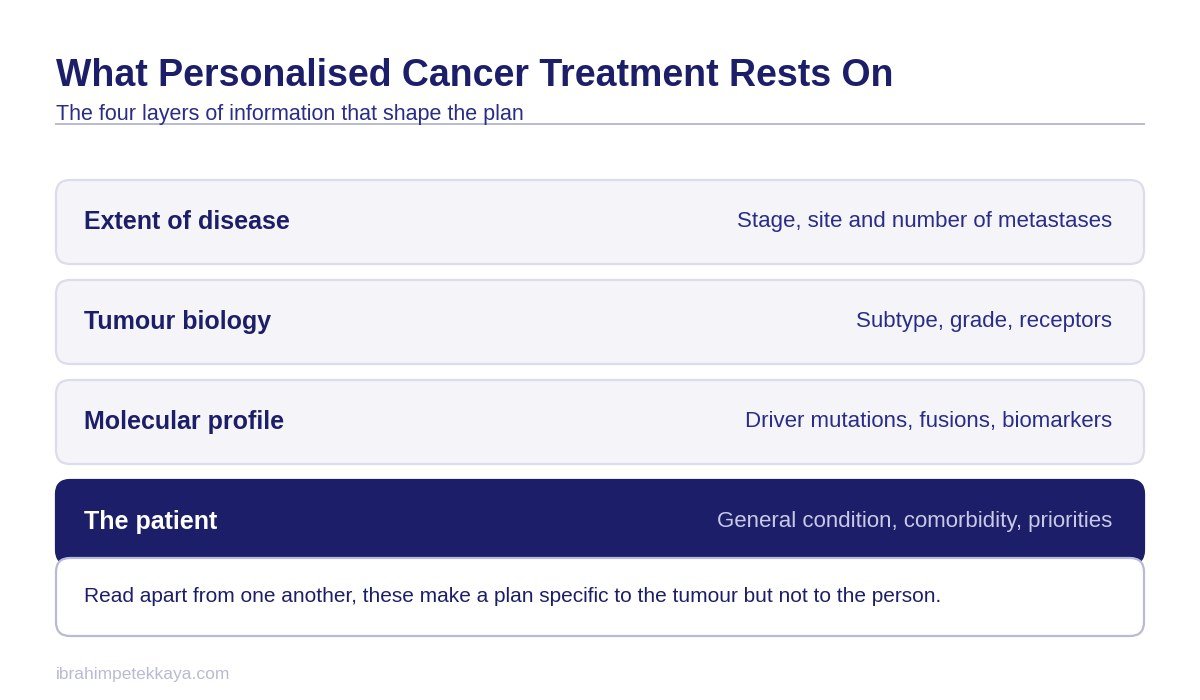
The first three layers concern the tumour: the extent of the disease, its biological subtype and its molecular profile. The fourth is the patient: general condition, other illnesses, circumstances, priorities.
The order matters too. Molecular testing requested before staging is complete cannot be interpreted, because the same finding means different things in early and advanced disease. Testing without knowing the pathological subtype likewise makes it harder to tell which alterations are expected and which surprising.
A common misunderstanding is that the phrase means a new or experimental drug. Adapting a well-evidenced standard treatment to a patient’s kidney function, age and priorities is also personalised. What decides the matter is not the novelty of the drug but the information the decision is built on.
The layer most often skipped is the fourth. A treatment suitable for one of two patients carrying the same mutation may be unsuitable for the other because of kidney function or cardiac disease. A molecular report is not a treatment plan on its own.
What Molecular Profiling Provides
Molecular testing shows the genetic alterations a tumour carries. The aim is to establish which is the driver making it grow, and which has a drug directed at it.
European recommendations define which cancers have this testing routinely. Advanced non-squamous lung cancer, prostate, colorectal, biliary tract and ovarian cancer are on that list, and the scope now extends to advanced breast cancer and rare tumours such as gastrointestinal stromal tumours, sarcoma, thyroid cancer and cancer of unknown primary.
Not every alteration carries the same weight. Scales grade the clinical value of findings: the top tier is benefit demonstrated in a randomised trial in the same cancer type, lower tiers evidence from other tumour types or early-phase data. That grading is explained in how to read an NGS report.
Send Your Reports for Assessment
Share your pathology, imaging and blood results on WhatsApp, or send them by email. Documents are reviewed before the consultation.
How a Biomarker Personalises a Plan
What a biomarker contributes depends on the question it answers. Markers predicting the course of the disease are prognostic; markers showing who benefits from a treatment are predictive, and it is the second group that changes a plan. A high-risk finding does not mean a treatment exists against that risk.
The second determinant is context. The same alteration sits inside a different signalling network in two tumours: in one it may be the sole source of growth, in the other only a contributing factor. That is why the level of evidence is reported with the tumour type. A drug working in one tumour does not show it will work in every tumour carrying it.
The third is the balance between breadth and depth. As breadth increases each region is read less deeply, and alterations in few cells are more easily missed. The limits of reading the whole coding region are covered in whole exome sequencing, and reading expression rather than DNA in RNA analysis of tumours.
Where It Stops
This is where the idea is most often overstated: comprehensive testing does not mean a targeted drug will be found for every patient.
In the German MASTER programme examining 1,310 patients, most with rare cancers, the board issued a recommendation in 88 per cent of cases, yet the treatment could be given to 31.8 per cent. In the Know Your Tumor registry in pancreatic cancer, the proportion with a targetable alteration was 26 per cent.
Access is often the most decisive obstacle. Even where a drug exists against an alteration, it may not be licensed locally, and where licensed it may not be reimbursed for that indication. The routes that then come into play are described in the early access programme article.
Those two figures show the reality of the field: producing a report is easy, turning it into treatment hard. Three obstacles sit in between: the finding must have a drug, the patient must be well enough, and the drug must be obtainable.
Each obstacle has its own answer. Where the finding has no drug, trials and early access routes are assessed. Where the patient is not well enough, supportive treatment comes first. Where the drug cannot be obtained, an application is prepared. The question when a report arrives is which obstacle stands in front.
Important: Finding no targetable alteration is not a bad result. Treatment then continues with well-evidenced standard approaches, which is a personalised plan too.

Can a Limited Response to Chemotherapy Be Improved?
How identifying the genetic alteration driving tumour growth can change the treatment plan and the response expected from it.
The Nature of the Data Reported
The proportions quoted here come from programme and registry data. The proportion of cases in which a board could recommend and the proportion in whom it was delivered are separate measures, and neither measures the outcome. They show how often a molecular approach produces an option, not that the option lengthens life.
Registry studies also offer no comparative design. The groups were not separated at random, and those who received the recommended treatment were generally in better condition, an effect that cannot be fully separated out. The direction of the findings is consistent, but the evidence is not randomised.
The right language in any discussion of personalised cancer treatment is that of probability. Finding a targetable alteration shows an option worth trying has arisen, not that the treatment will work. Deciding at the outset how response will be measured is part of the plan for the same reason.
The Difference From Alternative Medicine
This distinction matters, because the same phrase is used for two very different approaches.
| Criterion | Evidence-based approach | Approach without evidence |
|---|---|---|
| Basis | Randomised trials and guidelines | Personal testimony |
| Testing | Validated laboratory methods | Unvalidated tests |
| Expected benefit | Expressed in numbers | Left vague |
| Side effects | Explained in advance | Said not to exist |
| The decision | At a board and with the patient | By one person |
| Cost | Discussed and written down in advance | Rises afterwards |
The most useful row is side effects. Every effective treatment has them; "no side effects at all" is usually an indirect way of saying there is no effect. A benefit that cannot be put as a number has not been measured.
There is a practical side to this. In an evidence-based plan, what will be done when, and how things continue without a response, are settled at the outset. In approaches without evidence the plan is rewritten continuously, which can cost a line of treatment.
The test is simple: an approach claiming to be personalised should be able to say what data it rests on and how large the expected benefit is.
How the Process Works
- Diagnosis and staging are completed.
- The subtype and core biomarkers are established in pathology.
- Broad panel molecular testing is requested in suitable patients.
- The result is reviewed at a molecular tumour board.
- Findings are graded by clinical value.
- The patient’s general condition and priorities enter the plan.
- The plan is settled with the patient, response criteria defined from the outset.
Timing is part of the plan. Where molecular testing is saved for the last step, the patient may no longer be well enough when the result arrives. In tumours with a high chance of a targetable alteration it is requested at diagnosis or during first-line treatment.
The last step is often skipped. Defining how and when response will be measured before starting prevents the later argument about whether it is working. The board stage is described in how a tumour board works.
How a Treatment Plan Becomes Personal
How assessing the features of the tumour alongside the condition of the patient changes the treatment plan.
Which Questions to Ask
- Which test results is this plan based on?
- What is the level of evidence for the alteration found?
- Are there randomised data for this drug in my cancer type?
- What number describes the expected benefit?
- When and how will response be measured?
- Has this plan been reviewed at a board?
- What were the alternatives, and why this one?
- If this treatment does not work, what comes next?
These are not an audit list; they make visible the information the plan rests on. Where some answers cannot be given at once, what is missing also becomes visible.
That last question is particularly valuable. Having thought about the next step from the outset shows the plan rests on a sequence, not a single drug.
How clearly these are answered shows whether the plan is genuinely personalised. If the answers contain no numbers, the plan is not yet complete.
Where It Is Heading
The direction of the field is clear: testing is cheaper, panels are wider, and blood-based tests are reducing dependence on tissue. The real bottleneck is not technology but access and the decision process.
The spread of blood-based testing means molecular information can be obtained even where tissue cannot be taken. That method has limits too: an alteration not detected in blood is not necessarily absent from the tumour. The two are used as complements rather than substitutes.
For a patient to benefit from personalised treatment today, three things have to come together: a test requested at the right time, a board that interprets it, and access to the treatment recommended. If one is missing, the report stays in the file.
A second direction is the recording of decisions. Writing down which finding was set aside and why makes it easier to reopen the report when a new drug is approved. An old molecular report remains a usable source for a new question.
Two of those conditions are organisational rather than medical. The main obstacle to personalised treatment is therefore more often systemic than scientific.
Frequently Asked Questions
What does personalised cancer treatment mean?
Personalised cancer treatment means building the plan by weighing the extent of the disease, the biological subtype of the tumour, its molecular profile and the condition of the patient together. A genetic test alone does not amount to it.
Is it possible for every patient?
A targetable alteration is not found in every patient. Where none is found the plan can still be personalised, with standard treatment adapted to the individual.
Is having a genetic test enough?
No. In one programme the board could make a recommendation in 88 per cent of cases but the treatment reached 31.8 per cent of patients. What makes the difference is being able to act on the result.
Which cancers have routine molecular testing?
European recommendations name advanced non-squamous lung, prostate, colorectal, biliary tract and ovarian cancer, with the scope extended to advanced breast cancer and some rare tumours.
Is every alteration in the report important?
No. Findings are graded by clinical value. The top tier represents benefit demonstrated in a randomised trial in the same cancer type.
Is personalised treatment more expensive?
Cost depends on the test and the drug. What matters is discussing the expected benefit and the cost in advance; a vague cost is not part of a plan.
Is this alternative medicine?
No. Personalised treatment rests on validated tests and randomised trials, states the expected benefit as a number and explains side effects beforehand.
Related Articles

Related Pages
Comprehensive Genomic Profiling
Open the Page
Targeted Therapy
Open the Page
Molecular Tumour Board
Open the Page
Precision Oncology
Open the PageSources
- Mosele MF, Westphalen CB, Stenzinger A et al. Recommendations for the use of next-generation sequencing for patients with advanced cancer in 2024: ESMO Precision Medicine Working Group. Ann Oncol 2024;35(7):588-606. Link
- Mateo J, Chakravarty D, Dienstmann R et al. A framework to rank genomic alterations as targets for cancer precision medicine: ESMO Scale for Clinical Actionability of molecular Targets (ESCAT). Ann Oncol 2018;29(9):1895-1902. Link
- Horak P, Heining C, Kreutzfeldt S et al. Comprehensive Genomic and Transcriptomic Analysis for Guiding Therapeutic Decisions in Patients with Rare Cancers (MASTER). Cancer Discov 2021;11(11):2780-2795. Link
- Li MM, Datto M, Duncavage EJ et al. Standards and Guidelines for the Interpretation and Reporting of Sequence Variants in Cancer (AMP/ASCO/CAP). J Mol Diagn 2017;19(1):4-23. Link
- Chakravarty D, Gao J, Phillips S et al. OncoKB: A Precision Oncology Knowledge Base. JCO Precis Oncol 2017. Link
- Vasan N, Baselga J, Hyman DM. A view on drug resistance in cancer. Nature 2019;575(7782):299-309. Link
- Pishvaian MJ, Blais EM, Brody JR et al. Overall survival in patients with pancreatic cancer receiving matched therapies following molecular profiling (Know Your Tumor). Lancet Oncol 2020;21(4):508-518. Link
- Hendriks LE, Kerr KM, Menis J et al. Oncogene-addicted metastatic non-small-cell lung cancer: ESMO Clinical Practice Guideline. Ann Oncol 2023;34(4):339-357. Link
- Loibl S, André F, Bachelot T et al. Early breast cancer: ESMO Clinical Practice Guideline for diagnosis, treatment and follow-up. Ann Oncol 2024;35(2):159-182. Link
- ESMO Clinical Practice Guidelines, guidelines by cancer type. Link
- NCCN Clinical Practice Guidelines in Oncology, guidelines by cancer type. Link