
Who Sits on a Tumour Board
The composition varies by tumour type, but the logic is the same: every specialty with a say at some stage of the disease sits at one table.
- Medical oncology: the systemic treatment decision.
- Surgery: whether an operation is feasible and how extensive.
- Radiation oncology: the place and timing of radiotherapy.
- Radiology: re-reading the images.
- Pathology: diagnosis, subtype and biomarkers.
- Nuclear medicine: interpreting metabolic imaging.
- The relevant organ specialty: gastroenterology, respiratory medicine or gynaecology.
- Nursing and supportive care: feasibility and the care plan.
European policy documents expect every new and recurrent case to be discussed at a board, or the plan verified as consistent with the evidence. After staging is complete, board consensus on an evidence-based plan and the patient’s consent are both expected.
Why a Board Rather Than One Physician
A cancer decision contains four or five independent judgements: the diagnosis, the extent of the disease, the feasibility of an operation, the place of radiotherapy and the sequence of systemic treatment. Each is the daily work of a different specialty. One physician combines them from reports; at a board each judgement is made by the specialty that produces it.
The second gain is a return to the raw data. A report is a summary written against the question asked at the time, and re-examining the images and slides allows details absent from it to be discussed. Where interpretation changes this often, high proportions are no surprise.
The third gain is that the decision is recorded. One kept with its reasoning can be reopened months later; where the reason an option was excluded is unwritten, the same discussion is held again. That is the practical case for asking for a summary.
How a Tumour Board Works in the Meeting Room
- The case is presented in a short summary by the lead physician.
- Pathology slides are reviewed together on screen.
- The images are re-read with the radiologist present.
- Stage and risk group are established.
- Treatment options and their sequence are discussed.
- The plan is compared against guideline recommendations.
- The decision is recorded in a form that can go to the patient.
Meeting time is limited and many cases are discussed in one sitting. A complete presentation is therefore decisive: if staging is incomplete, the pathology result has not arrived, or the patient’s condition is undescribed, no decision can be reached.
The two most important steps are the second and third. The contribution of a board is not reading the reports but re-examining the raw data. The molecular side of that decision in pancreatic cancer is covered in the article on KRAS.
The written output carries the assumptions behind the decision as well. If a decision to operate rests on a particular imaging finding, that finding may need reassessing before the procedure. Writing the assumptions down shows where to return when the plan changes.

What Is Discussed at a Board
The headings under which a case is considered at a multidisciplinary board meeting.
What a Board Decision Changes
There is a numerical answer. In the Basta review of 16 studies in gastrointestinal cancer, board review changed the diagnosis made by an individual physician in 18.4 to 26.9 per cent of cases and the treatment plan in 23.0 to 41.7 per cent.
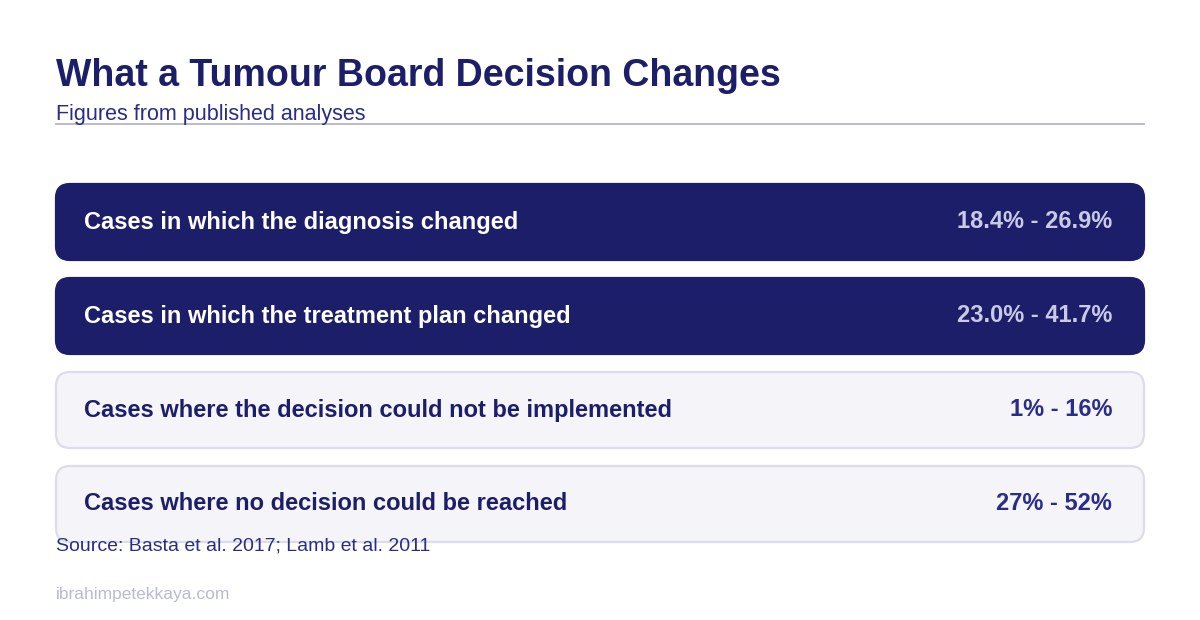
In broader reviews the range widens: an analysis of 37 studies reported that boards changed management in 2 to 52 per cent of cases, so no one can claim a board changes every plan. How large the change is depends on tumour type, the centre’s infrastructure and how change is defined.
How change is defined also moves the proportions. In some studies a change in the order of treatment counts, in others only a change in its type, so two analyses of the same centre over the same period can report different proportions. The definition is read before the figures are compared.
Where the change comes from has been measured too. In the Newman breast cancer study of 149 patients, re-reading the images changed the radiological interpretation in 67 and re-examining the pathology in 43.
Send Your Reports for Assessment
Share your pathology, imaging and blood results on WhatsApp, or send them by email. Documents are reviewed before the consultation.
Does It Affect Survival?
The most-cited study comes from the west of Scotland, where multidisciplinary working was introduced in 1995 in one health board area. In the Kesson study of 13,722 women, breast cancer mortality there had been 11 per cent higher than elsewhere beforehand and was 18 per cent lower afterwards.
The study was not randomised, and although the reversal of direction is a strong finding, other improvements over the same period cannot be excluded. Two major systematic reviews diverge here: one reports that board working improved clinical outcomes, the other that board meetings affect assessment and management but that the evidence for improved outcomes is weak.
The practical upshot is that the case for a board rests not on survival data but on the decision process being auditable. Several specialties looking at the same data raises the chance of catching a missed option, a gain hard to measure but visible in daily working.
Important: There is no randomised trial of board review versus no board review, and there very probably never will be. That does not make boards unnecessary; it means the evidence is observational.
The Known Weaknesses
A board is not a flawless process, and published analyses set out its weak points.
- Between 1 and 16 per cent of decisions cannot be implemented.
- No decision is reached in 27 to 52 per cent of cases.
- Decisions rest mostly on clinical information, without patient preferences.
- The contribution of nursing and supportive services stays limited.
- Time pressure, heavy case lists and poor attendance reduce decision quality.
Some decisions that cannot be implemented are expected. The patient’s preference is not always known at the meeting, and a plan can change once discussed. That does not make the decision wrong; it was made on incomplete information, and completing it is an ordinary part of the process.
The high proportion of cases without a decision is the most criticised feature. The main cause is missing information: where a case is presented before staging is complete, the decision is deferred.
The reasons have been studied too. Of 273 decisions in upper gastrointestinal cancer in the Blazeby study, 15.1 per cent were not carried out, mainly because of comorbidity, patient preference and later information. In the Rajan breast cancer study of 3,230 decisions, 91.5 per cent were implemented.
A known weakness of group decisions is the presentation. A case arrives framed by the physician presenting it, and a detail left out can set the direction of the discussion. A standard template, and not deciding on incomplete data, reduce that risk.
These data point to one conclusion: a board decision is a starting point, not the last word. It can change once discussed with the patient, and that is no failure.
The Molecular Tumour Board
In recent years a second structure has joined the classical board: the molecular tumour board, which reviews genomic results and decides which findings can become treatment.
In a German programme, comprehensive sequencing was performed in 1,310 patients, mostly with rare cancers. The board issued an evidence-based recommendation in 88 per cent of cases, including diagnostic re-evaluation and genetic counselling. The recommended treatment reached 31.8 per cent, and in that group response and disease control rates were markedly better than with previous treatments. That comparison is against the patients’ own earlier lines, not a randomised control, so the advantage may look larger than it is.
What separates a molecular board from the classical structure is the question it asks. A classical board looks at the stage and the treatments that can be delivered; a molecular board debates the evidence attaching an alteration to a treatment. The two do not exclude each other, and the sequence is usually built jointly.
The gap between those figures shows the real bottleneck: producing a recommendation is easier than acting on it. How the process runs is described on the molecular tumour board page.
How the Molecular Board Decides
How genomic test results are turned into a treatment decision, and the role of the board in that process.
How a File Becomes Ready for the Board
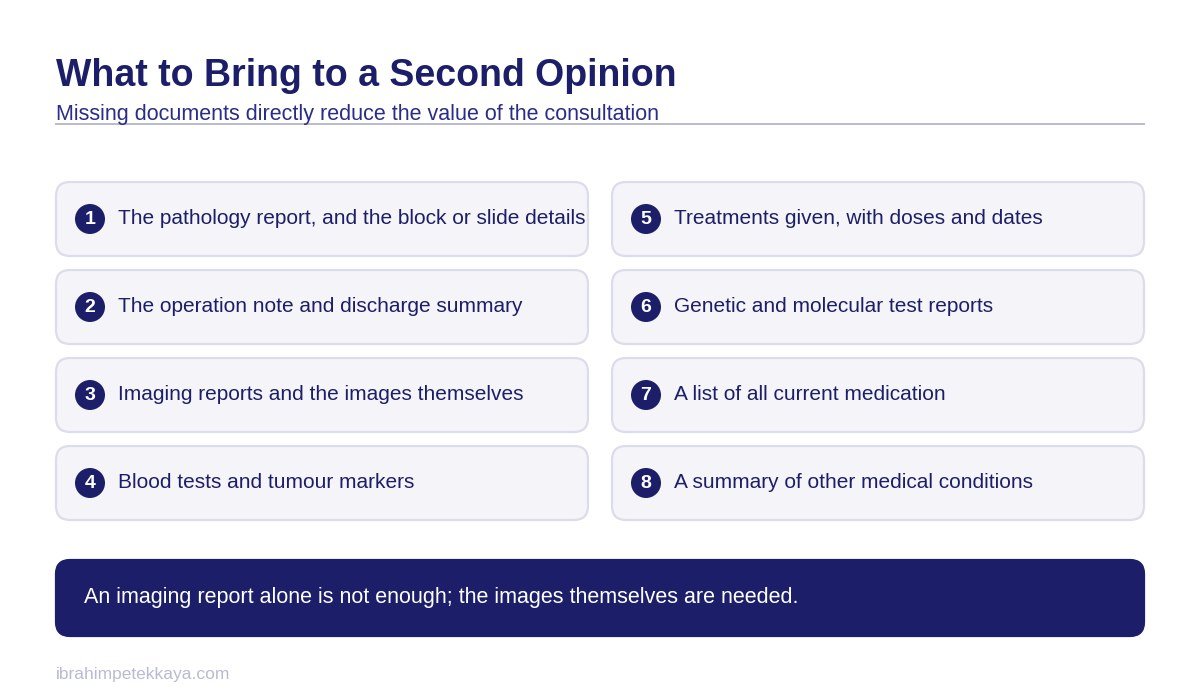
The quality of the decision depends on the file brought to the meeting. A file counts as ready when staging is complete, the pathology result and necessary biomarkers are to hand, the imaging is current and the patient’s condition described. Present a case with one of those missing and the decision is deferred, costing a week.
The patient’s own contribution should not be underrated. Coexisting illnesses, regular medication, previous operations and what the person expects from treatment are part of what the board receives. Preferences not being on the table is a reported reason decisions go unimplemented.
Where treatment began at another centre, which drug was given at what dose and on what dates is passed on in writing. A board cannot decide sequencing without it, because the earlier lines determine the next.
Questions Often Raised About the Board
- Has my case been discussed at a board?
- Which specialties took part?
- Were my images and pathology slides re-examined?
- Which guideline is the decision based on?
- Was any other option discussed?
- Has this been reviewed by a molecular board as well?
- Can I have a written summary of the decision?
Asking for a written summary can look like an extra demand, but it makes things easier. If treatment continues at another centre, if a referral or authorisation is needed, or if the plan changes later, that summary is the starting point.
These questions make the process easier to follow. Having the decision in writing helps when seeking a second opinion and when treatment changes later. That preparation is described in how to get a second opinion.
Frequently Asked Questions
What is a tumour board?
A meeting at which a cancer case is assessed together by every specialty with a say at some stage of the disease. Medical oncology, surgery, radiation oncology, radiology and pathology form the core.
Who makes the decision?
The decision is not one physician’s own; it emerges from board consensus. How it is carried out is then agreed with the patient, and patient preference can change the plan.
How often does a board change the plan?
In the Basta gastrointestinal cancer review the diagnosis changed in 18.4 to 26.9 per cent of cases and the treatment plan in 23.0 to 41.7 per cent. Broader reviews give a range of 2 to 52 per cent.
Does a board improve survival?
Observational data are favourable: in the west Scotland study, breast cancer mortality was 18 per cent lower in the area where multidisciplinary working had been introduced. There is no randomised evidence.
Is a board decision always carried out?
No. Studies report that 1 to 16 per cent of decisions cannot be implemented, mainly because of comorbidity, patient preference and new information.
Is a molecular tumour board different?
Yes. A molecular board reviews genomic results and decides which findings can be translated into targeted treatment.
Does the patient attend?
Usually not. The preferences and general condition of the patient are conveyed during the presentation, and the decision is reviewed with them afterwards.
Related Articles
How to Get a Second Opinion in Cancer
Open the Page
Early Access Programmes and Clinical Trials
Open the PageRelated Pages

Molecular Tumour Board
Open the Page
Treatment Pathway
Open the Page
Second Opinion
Open the Page
Comprehensive Genomic Profiling
Open the PageSources
- Borras JM, Albreht T, Audisio R et al. Policy statement on multidisciplinary cancer care. Eur J Cancer 2014;50(3):475-480. Link
- Basta YL, Bolle S, Fockens P, Tytgat KMAJ. The Value of Multidisciplinary Team Meetings for Patients with Gastrointestinal Malignancies: A Systematic Review. Ann Surg Oncol 2017;24(9):2669-2678. Link
- Lamb BW, Brown KF, Nagpal K et al. Quality of Care Management Decisions by Multidisciplinary Cancer Teams: A Systematic Review. Ann Surg Oncol 2011;18(8):2116-2125. Link
- Newman EA, Guest AB, Helvie MA et al. Changes in surgical management resulting from case review at a breast cancer multidisciplinary tumor board. Cancer 2006;107(10):2346-2351. Link
- Blazeby JM, Wilson L, Metcalfe C et al. Analysis of clinical decision-making in multi-disciplinary cancer teams. Ann Oncol 2006;17(3):457-460. Link
- Rajan S, Foreman J, Wallis MG, Caldas C, Britton P. Multidisciplinary decisions in breast cancer: does the patient receive what the team has recommended? Br J Cancer 2013;108(12):2442-2447. Link
- Kesson EM, Allardice GM, George WD, Burns HJG, Morrison DS. Effects of multidisciplinary team working on breast cancer survival: retrospective, comparative, interventional cohort study of 13 722 women. BMJ 2012;344:e2718. Link
- Prades J, Remue E, van Hoof E, Borras JM. Is it worth reorganising cancer services on the basis of multidisciplinary teams? A systematic review. Health Policy 2015;119(4):464-474. Link
- Pillay B, Wootten AC, Crowe H et al. The impact of multidisciplinary team meetings on patient assessment, management and outcomes in oncology settings: a systematic review. Cancer Treat Rev 2016;42:56-72. Link
- Horak P, Heining C, Kreutzfeldt S et al. Comprehensive Genomic and Transcriptomic Analysis for Guiding Therapeutic Decisions in Patients with Rare Cancers (MASTER). Cancer Discov 2021;11(11):2780-2795. Link
- Mosele MF, Westphalen CB, Stenzinger A et al. Recommendations for the use of next-generation sequencing for patients with advanced cancer in 2024: ESMO Precision Medicine Working Group. Ann Oncol 2024;35(7):588-606. Link