
What Stage 4 Cancer Means: What Staging Measures
Staging is a shared language for describing how far a tumour has spread. The system used worldwide rests on three letters: T for the tumour itself, N for the regional lymph nodes and M for spread to distant organs. Combining the three gives the stage.
| Letter | What it describes | Example |
|---|---|---|
| T | Size of the tumour and growth into nearby tissue | T1: small, confined |
| N | Involvement of regional lymph nodes | N0: no involvement |
| M | Spread to distant organs | M1: distant spread present |
The numbers added to each letter show the degree of the finding. A T2 tumour is larger or deeper than a T1; N2 means more nodes or a wider nodal area is involved. The stage comes from combining these three under defined rules, and the rules differ between cancer types. Stage 3 breast cancer therefore does not mean the same thing as stage 3 stomach cancer.
Stage 4 is the situation where M is 1: the tumour has been found somewhere beyond the organ it arose in and its neighbouring lymph nodes. That definition says nothing about how fast the disease moves, how it will respond to treatment, or how long it will run. It describes spread, and only spread.
How Metastasis Happens
Metastasis begins when tumour cells leave their original tissue and enter the blood or lymphatic circulation. Many cells enter, but most fail to take hold anywhere new. A deposit requires the cell to leave the circulation, find a suitable environment and keep dividing. Those conditions rarely come together, which is why metastasis takes time to become visible.
Where a cell settles is not random either. Blood flow and tissue environment differ between organs, and a tumour seeds more often in organs that suit it. That is why particular cancers tend towards particular organs, and surveillance imaging is planned accordingly.
This also explains why staging measures spread. A distant deposit shows that cells can use the circulation and take hold in new tissue. That is information about the capacity to spread; it says nothing about growth rate, sensitivity to treatment or time.
What Stage 4 Does Not Mean
Stage 4 is not a single picture. Outcomes differ enormously between diseases carrying the same label. In SEER registry data, five-year relative survival in distant-stage disease covers a very wide range depending on the cancer type: 3.4 per cent in pancreatic cancer, 10.5 per cent in lung cancer, 16.9 per cent in colorectal cancer and 33.8 per cent in breast cancer. In germ cell tumours, five-year survival exceeds 90 per cent in the good-risk group even with metastatic disease. The width of that range shows how little the words "stage 4" say on their own.
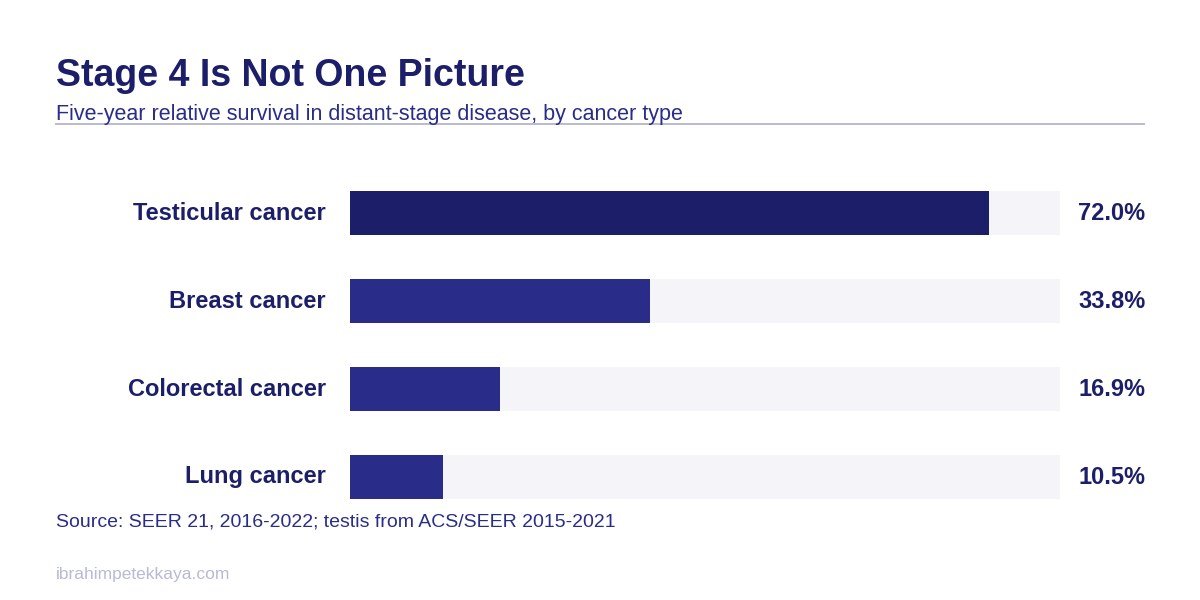
The most striking example is testicular cancer: even when found at distant stage, five-year survival is around 72 per cent and a substantial proportion of patients are cured. In an international analysis of metastatic non-seminomatous germ cell tumours, five-year survival was 96 per cent in the good-prognosis group, 89 per cent in the intermediate group and 67 per cent in the poor-prognosis group. The same analysis showed these figures had risen markedly compared with two decades earlier.
Two misunderstandings need correcting. The first equates stage 4 with end-stage disease; the stage describes spread, not the patient’s condition at that moment. The second is expecting the stage to change with treatment. It is set at diagnosis and stays in the record; marked shrinkage does not move it back, and the response is recorded separately.

Is Stage 4 Breast Cancer Always Hopeless?
Bone metastasis makes the disease stage four, but the course of treatment is not set by stage alone. This post explains the influence of hormone receptor status, HER2 and genetic features.
How Survival Figures Should Be Read
The figures quoted come from cancer registries and are averages over large populations. Relative survival compares a group with the general population of the same age and sex; it does not state what one patient can expect. Registry data are grouped by stage at diagnosis and do not separate subtypes, markers or actionable alterations, so one box can hold patients whose options differ widely.
The second limit is delay. A five-year figure requires patients diagnosed five years ago, so if treatment options changed since, the published figure describes the patient of the past rather than of today.
Individual trials need their scope read too. The randomised phase 2 trial adding radiotherapy to a limited number of metastases was small, so its result is not considered definitive, and that caveat stands. Long-response data from one tumour type cannot be carried to another; each result belongs to its own subgroup.
What Is Considered Alongside the Stage
Stage is the starting point of the plan, not its only determinant. Two patients at the same stage can have entirely different treatments and expectations depending on the biology of the tumour.
- The subtype and grade of the tumour.
- Markers such as hormone receptor status and HER2.
- Driver mutations and targetable alterations.
- Immunotherapy markers such as microsatellite instability.
- The number, site and growth rate of the metastases.
- The general condition of the patient and any comorbidity.
For that reason the first step in advanced disease is usually biological characterisation. The scope of that testing is described on the comprehensive genomic profiling page.
Send Your Reports for Assessment
Share your pathology, imaging and blood results on WhatsApp, or send them by email. Documents are reviewed before the consultation.
Settings Where Long Responses Are Seen
The number of situations in which long-term responses have been demonstrated in metastatic disease keeps growing. A few examples show why stage alone is not enough information.
In HER2-positive metastatic breast cancer, the CLEOPATRA trial, with more than eight years of follow-up, reported median overall survival of 57.1 months with the triple regimen, and 37 per cent of patients alive at eight years. In EGFR-mutated advanced lung cancer, median overall survival with osimertinib was reported as 38.6 months.
In microsatellite instability-high metastatic colorectal cancer, immunotherapy doubled progression-free survival compared with chemotherapy: a median of 16.5 months against 8.2 months. In the final analysis of the same trial, median overall survival had not been reached in the immunotherapy arm; that difference did not cross the prespecified significance threshold, and 60 per cent of patients in the chemotherapy arm had subsequently crossed over to immunotherapy.
Important: These results do not apply to every patient; each belongs to a defined biological subgroup. Their shared message is that the label stage 4 does not by itself determine the outcome of treatment.
Oligometastatic Disease
When the number of metastases is limited, the disease can be approached differently from widespread metastatic disease. A European consensus from radiotherapy and research organisations has defined and classified this situation: cases with a limited number of deposits, each amenable to definitive local treatment, are treated as a separate group.
In the randomised phase 2 SABR-COMET trial adding targeted ablative radiotherapy to a limited number of metastases, five-year overall survival rose from 17.7 per cent with standard care to 42.3 per cent. The trial was small, so the result is not considered definitive, but it supports the logic of the approach.
The definition of oligometastatic disease is itself contested. The threshold number of deposits, whether they appeared at once or on treatment, and whether definitive treatment can reach each one are separate headings in the consensus. Whether a patient falls into this group is decided by reading all the imaging with the course of the disease.
What the distinction changes is the aim. In widespread metastatic disease the aim is control; with a limited number of deposits, removing them can also enter the plan. Which board decides, and how radiation oncology joins the plan, matters here.
Looking Again at the Current Picture
In advanced disease, the plan can change once general condition, treatments used, mutation profile and tumour behaviour are assessed together.
Where Supportive Care Fits
In advanced disease, supportive care is planned as part of treatment rather than as an addition to it. In a randomised trial in metastatic lung cancer, patients whose oncological treatment was accompanied by supportive care from diagnosis had better quality of life and fewer depressive symptoms, and their survival was not shortened — in that trial it was longer. Later trials did not consistently reproduce the survival gain; what has not changed is the improvement in quality of life.
The scope of supportive care is wider than is generally assumed: control of pain with medication and, where needed, interventional methods; prevention of nausea; nutritional support; restoring a sleep pattern; treatment of anxiety and depression; support for relatives; and access to social services. None of this replaces oncological treatment; all of it makes continuing that treatment possible.
This finding shows that supportive care is not something started once nothing else remains. Pain control, nutrition, sleep and psychological support are the conditions that make continued treatment possible. Where molecular testing fits into choosing those treatments is set out in personalised cancer treatment.

Questions Often Raised at the Consultation
- What is the stage 4 definition based on in my case: which imaging or biopsy?
- What is the subtype and which markers are present; has genomic testing been done?
- Do the number and site of the metastases change my treatment options?
- What benefit is expected from this treatment, and how and when will it be measured?
- How will side effects affect my daily life?
- What options exist at the next step?
- Would I like a second opinion on this plan?
These questions help build the plan together with the patient. How that process works is set out on the second opinion page.
Frequently Asked Questions
What does stage 4 cancer mean?
Stage 4 means the tumour has been found beyond the organ it arose in and its neighbouring lymph nodes. The definition describes spread only; it says nothing about the pace of the disease, the response to treatment or the time expected.
Does stage 4 mean the cancer cannot be treated?
No. Five-year survival in distant-stage disease ranges from 3.4 per cent in pancreatic cancer to 33.8 per cent in breast cancer, and is far higher again in germ cell tumours, and in some settings such as metastatic testicular cancer lasting cure is achievable.
Is metastasis the same as stage 4?
Disease is classed as stage 4 when spread to a distant organ is found. Regional lymph node involvement on its own does not make a cancer stage 4.
What is oligometastatic disease?
Oligometastatic disease is the situation where the number of metastases is limited and definitive treatment can be directed at each deposit. European consensus documents define it as a distinct group.
Why do two patients at the same stage get different treatment?
Because stage is not the only determinant. Subtype, hormone receptor and HER2 status, driver mutations, the site of metastases and the general condition of the patient all change the plan.
When does supportive care start?
In advanced disease supportive care is part of treatment from diagnosis. In a randomised trial, early supportive care improved quality of life and did not shorten survival.
What do survival statistics mean for me?
Survival statistics are averages across large groups of patients and do not predict an individual outcome. Subtype, markers and response to treatment are what shape the individual course.
Related Articles

Related Pages

Treatments
Open the Page
Comprehensive Genomic Profiling
Open the Page
Second Opinion
Open the Page
Molecular Tumour Board
Open the PageSources
- Amin MB, Greene FL, Edge SB et al. The Eighth Edition AJCC Cancer Staging Manual. CA Cancer J Clin 2017;67(2):93-99. Link
- National Cancer Institute, SEER Program. Cancer Stat Facts: Female Breast Cancer. Link
- National Cancer Institute, SEER Program. Cancer Stat Facts: Lung and Bronchus Cancer. Link
- National Cancer Institute, SEER Program. Cancer Stat Facts: Colorectal Cancer. Link
- Gillessen S, Sauvé N, Collette L et al. Predicting Outcomes in Men With Metastatic Nonseminomatous Germ Cell Tumors: Results From the IGCCCG Update Consortium. J Clin Oncol 2021;39(14):1563-1574. Link
- Swain SM, Miles D, Kim SB et al. Pertuzumab, trastuzumab, and docetaxel for HER2-positive metastatic breast cancer (CLEOPATRA): end-of-study results. Lancet Oncol 2020;21(4):519-530. Link
- André T, Shiu KK, Kim TW et al. Pembrolizumab in Microsatellite-Instability-High Advanced Colorectal Cancer. N Engl J Med 2020;383(23):2207-2218. Link
- Díaz LA Jr, Shiu KK, Kim TW et al. Pembrolizumab versus chemotherapy for MSI-H or dMMR metastatic colorectal cancer (KEYNOTE-177): final analysis. Lancet Oncol 2022;23(5):659-670. Link
- Guckenberger M, Lievens Y, Bouma AB et al. Characterisation and classification of oligometastatic disease: an ESTRO and EORTC consensus recommendation. Lancet Oncol 2020;21(1):e18-e28. Link
- Palma DA, Olson R, Harrow S et al. Stereotactic Ablative Radiotherapy for the Comprehensive Treatment of Oligometastatic Cancers: Long-Term Results of the SABR-COMET Phase II Randomized Trial. J Clin Oncol 2020;38(25):2830-2838. Link
- Temel JS, Greer JA, Muzikansky A et al. Early palliative care for patients with metastatic non-small-cell lung cancer. N Engl J Med 2010;363(8):733-742. Link
- ESMO Clinical Practice Guidelines, guidelines by cancer type. Link
- National Cancer Institute. SEER Cancer Stat Facts: Pancreatic Cancer (SEER 21, 2016-2022). Link