
What ctDNA Testing Is
ctDNA testing searches for fragments of DNA that tumour cells release into the bloodstream. When these fragments are found after surgery, they suggest that tumour cells remain in the body even though nothing is visible. This situation is called minimal residual disease.
There are two approaches. A tumour-informed assay first reads the mutation signature from the surgical specimen, then looks for exactly that signature in blood; its sensitivity is high. A fixed-panel assay screens a predefined list of genes instead; it needs less preparation time.
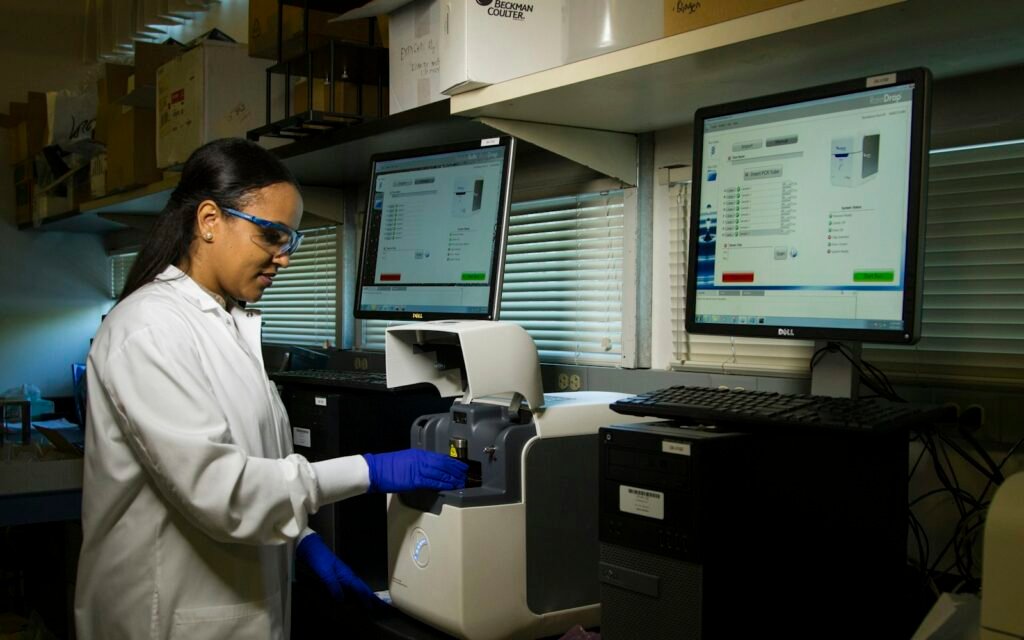
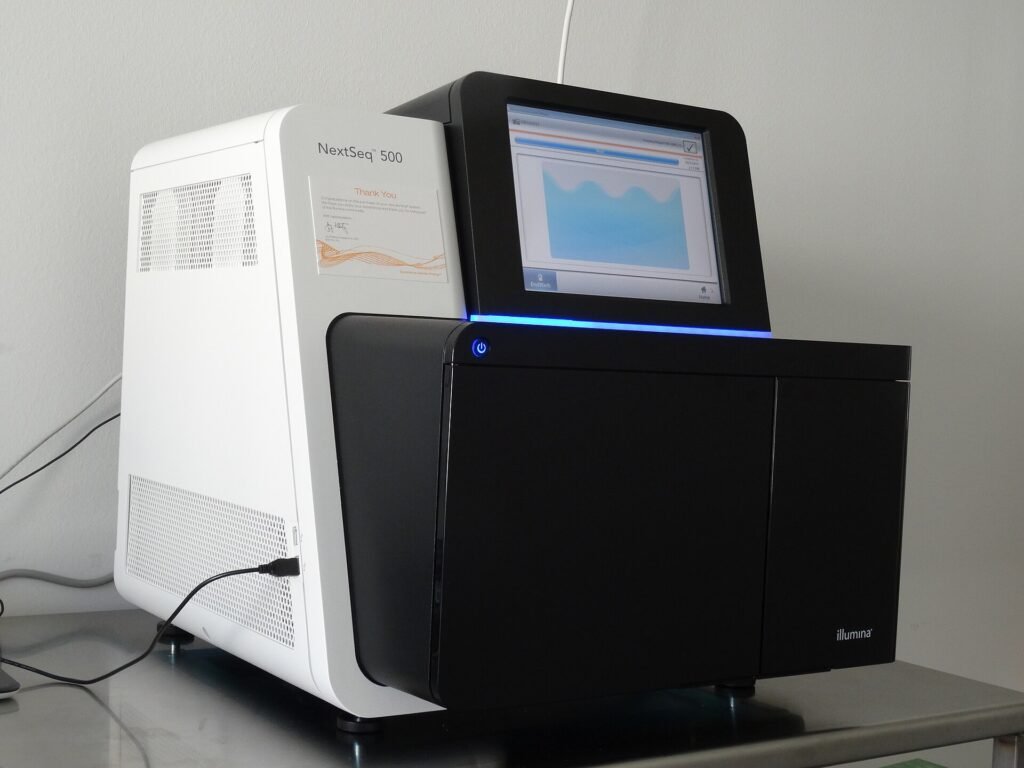
Most of the DNA circulating in blood comes from healthy cells. After surgery, tumour-derived fragments make up a tiny fraction of that pool, in some patients well below one part in a thousand. The laboratory therefore reads the sample far more deeply than an ordinary genetic test, reading each region thousands of times. Reliability depends on every link in the chain, from the collection tube to the sequencing depth.
The test differs in purpose from the liquid biopsy performed before treatment. There, the question is which drug is likely to work. Here, after surgery, the question is whether additional treatment is needed at all. The same blood draw can serve both, but the interpretation is not the same.
What Minimal Residual Disease Means
Minimal residual disease is a population of tumour cells that exists but cannot be seen with standard tests. Imaging shows masses only above a few millimetres; clusters of cells below that threshold remain invisible.
| Method | What it shows | Limit |
|---|---|---|
| Computed tomography | A mass | Roughly above 5 mm |
| PET-CT | Metabolic activity | In practice roughly above 7-10 mm |
| Tumour markers | Secreted protein in blood | Low sensitivity |
| ctDNA | Tumour DNA trace | Detectable at very low fractions |
The tumour-informed approach has a precondition: enough good-quality tumour tissue from the surgical specimen. If the block is old or the tumour cell content is low, no signature can be built and the assay falls back to a fixed panel, lowering sensitivity. That route is covered under when the tissue biopsy is not enough.
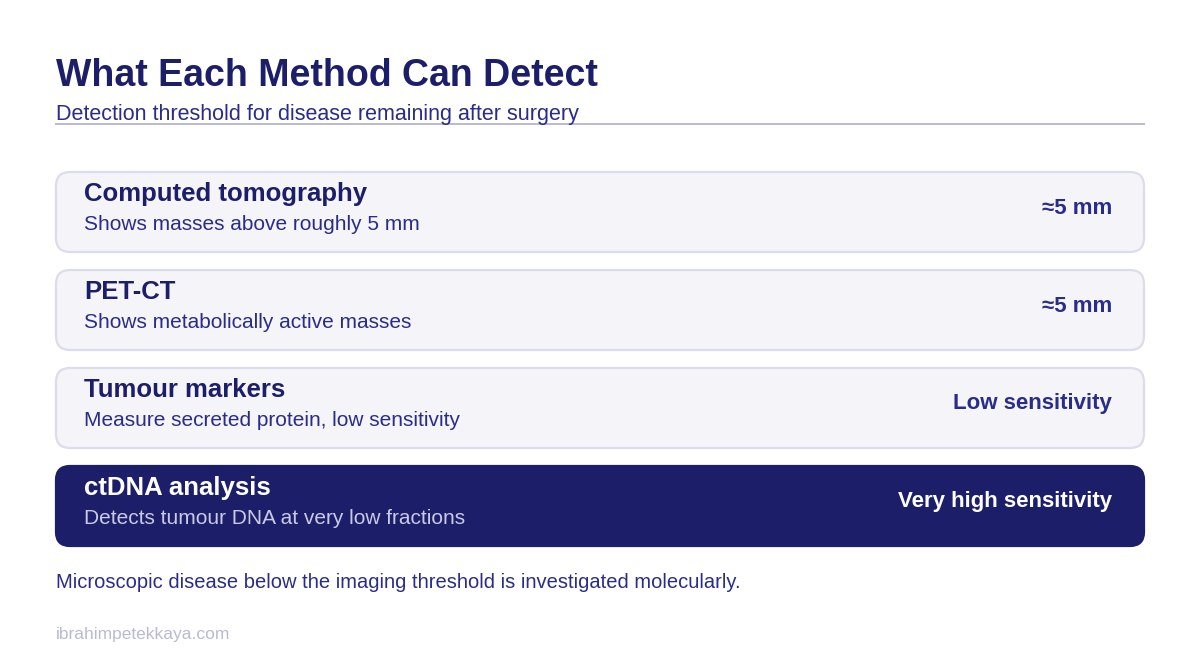
The threshold idea is decisive. Every method has a detection limit, and disease below it is invisible to all of them. What ctDNA adds is information in a range below the limit of imaging: not unlimited sensitivity, but a limit moved further down.
A positive ctDNA result indicates a clearly increased risk of recurrence. A negative result lowers that risk but does not remove it, because some tumours shed little or no DNA into blood.

Is Chemotherapy Necessary After Colon Cancer Surgery?
In stage two and three colon cancer the central question after surgery is whether any tumour trace remains. This post explains how minimal residual disease is investigated through ctDNA analysis in blood.
What the Evidence Shows
The strongest data come from colon cancer. In the DYNAMIC trial in stage II disease, when the adjuvant chemotherapy decision was guided by ctDNA, chemotherapy use fell from 27.9 per cent to 15.3 per cent while two-year recurrence-free survival was non-inferior to standard management. Five-year outcomes maintained that picture.
The Japanese GALAXY observational study reported that patients found ctDNA positive after surgery had a markedly higher risk of recurrence, and that the benefit of adjuvant chemotherapy was clearer in that group. Comparable studies are running in breast, lung and bladder cancer.
The shared message is that the ctDNA result adds information classical risk factors cannot supply on their own. Some patients whose pathology report looks high risk test negative; some who look low risk test positive. The decision changes most at these two extremes, and that is where the test contributes.
The strength of the evidence varies by tumour type. Colon cancer has randomised trial data; in breast and lung cancer the data are largely observational. What counts as routine use in one tumour type may therefore be appropriate only within a clinical trial in another.
Important: None of this means the ctDNA result decides treatment by itself. Guidelines recommend the test in selected patients and preferably within a clinical trial. Decision criteria are set out on the colon cancer treatment page.
Send Your Reports for Assessment
Share your pathology, imaging and blood results on WhatsApp, or send them by email. Documents are reviewed before the consultation.
What These Trials Did Not Show
The DYNAMIC trial compared two strategies. It asked whether taking the chemotherapy decision from the ctDNA result left recurrence-free survival behind standard management, and the answer was that fewer patients had chemotherapy without the outcome falling behind. It did not show that the result determines, patient by patient, whether chemotherapy is needed.
The scope is limited: the data come from stage II colon cancer, and other stages, organs and risk groups are not inside those results. GALAXY is observational: it reports a high recurrence risk in ctDNA-positive patients and a clearer benefit from adjuvant chemotherapy there, but an observational design cannot prove the decision changed the outcome.
The open question is surveillance. Bringing treatment forward when ctDNA turns positive during follow-up has not been shown to improve survival, so a conversion is a warning rather than a reason in itself to start treatment. Use in surveillance stays limited to selected patients.
Who Benefits Most
The test does not contribute equally in every patient. Its value is greatest where the chemotherapy decision is genuinely finely balanced.
- Stage II colon cancer where classical risk factors are borderline.
- Situations where the burden of treatment and the expected benefit are close together.
- Patients who wish to avoid chemotherapy because of age, comorbidity or preference.
- Follow-up where detecting recurrence early would change the plan.
There are also settings where it adds little: in stage III disease, where the indication for chemotherapy is already clear, the result is not expected to change the decision. The decision is made in the molecular tumour board with all of the patient’s data in view.
Follow-Up After Bladder Cancer Surgery
In muscle-invasive bladder cancer the plan after surgery is set by risk. This post explains where liquid biopsy fits into that decision.
How the Decision Is Built
The result is not a diagnosis on its own; the decision weighs the side effects of chemotherapy against the chance of recurrence and the heavier treatment it would bring. The ctDNA result does not sit alone on those scales; pathology risk factors, nodes removed, vascular and perineural involvement, margin status and coexisting illnesses enter the same picture.
A positive result is confirmed first: was the sample timed correctly, has the report excluded non-tumour sources, what does imaging show. The chemotherapy decision is then reopened. Where the result is negative but pathology shows high risk, it is not taken on the test alone; a negative lowers risk without removing it.
Bringing the surgical pathology report, the date of surgery and recent imaging speeds up assessment; so does the date of the blood sample.
Timing and How Often It Is Repeated
The first sample is usually drawn four to eight weeks after surgery. Earlier samples can give false positives, because DNA released into the circulation during the operation is still present.
Collection is no different from a routine blood test; there is no need to fast or stop medication. Blood is drawn into tubes that preserve DNA and must reach the laboratory within a defined window. Turnaround is one to three weeks depending on the method, and a tumour-informed assay takes longer the first time because the tissue must be analysed as well. Planning accounts for this wait, since adjuvant chemotherapy is also meant to start within a certain interval.
- The first sample is drawn 4-8 weeks after surgery.
- If it is positive, the treatment plan is reconsidered.
- If it is negative, it is repeated according to the follow-up schedule.
- Most programmes repeat the test every three months.
- If it turns positive, imaging is brought forward.
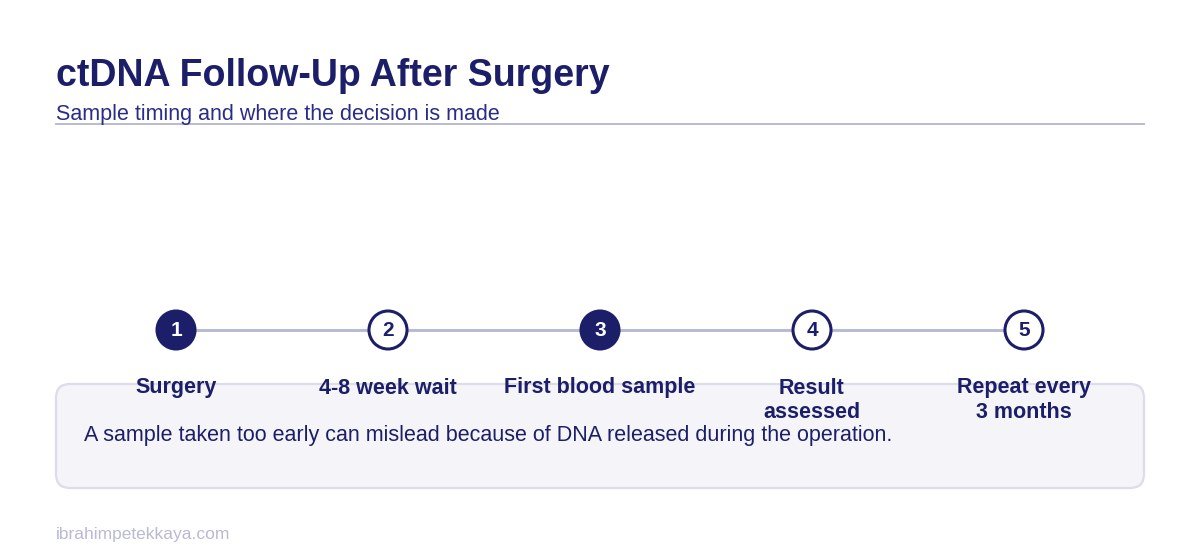
During follow-up, ctDNA can turn positive months before recurrence becomes visible on imaging. Whether acting on that early warning improves survival is still being studied, so the result is interpreted carefully when it changes the follow-up plan.
Where Other Tumours Stand
Follow-up after surgery in muscle-invasive bladder cancer is covered separately. In breast and lung cancer the data are mostly observational, and the test is handled as information within trials, not a criterion that changes a decision.
The Limitations of the Test
What the result means for the patient should be discussed with the physician. A positive result can cause anxiety, and whether that anxiety is matched by a real change in the treatment plan is weighed before the test is ordered. For some patients early information is reassuring; for others it only prolongs uncertainty. The test is therefore requested after talking through what the result would change.
- A negative result does not guarantee that recurrence will not occur; the tumour may shed little DNA.
- A positive result does not mean recurrence is certain; confirmation and follow-up are needed.
- Clonal changes that develop in blood cells with age can produce false positives.
- Sensitivity is not the same across tumour types.
- Reimbursement is limited, so cost should be discussed in advance.
The most common source of false positives is clonal change in blood-forming cells in older patients. These changes leave a mutation trace in blood although they have nothing to do with the tumour. A well-designed assay also reads a white-cell sample from the same patient to distinguish this source; whether the report makes that distinction is worth checking. What happens when resistance develops on treatment is set out in targeted therapy resistance.
Taken together, these limits show that the test contributes to a decision rather than making one. The result is read alongside the pathology report and staging findings, in the process described on the assessment process page.
Frequently Asked Questions
Who should have ctDNA testing?
ctDNA testing contributes most where the decision about adjuvant chemotherapy is finely balanced; stage II colon cancer is the typical example. Where the indication for chemotherapy is already clear, the result is unlikely to change the plan.
How long after surgery is the test performed?
The first sample is usually drawn four to eight weeks after the operation. Earlier samples can give false positives because DNA released during surgery is still circulating.
If the result is negative, can I skip chemotherapy?
The chemotherapy decision does not rest on the test alone. Stage, pathological risk factors, general condition and the patient’s preference are weighed together. A negative result lowers risk but does not remove it.
If the result is positive, is recurrence certain?
No. A positive result indicates a clearly increased risk, but confirmation and imaging follow-up are needed. Some positive results come from sources other than the tumour.
How often is the test repeated?
Most follow-up programmes repeat it every three months. The interval depends on tumour type, stage and whether the result would change the plan.
Does ctDNA testing replace imaging?
No. The two give different information: ctDNA shows a molecular trace, while imaging shows the location and size of a mass. In follow-up they are used together.
Is the test available in every hospital?
ctDNA testing requires specialised laboratory infrastructure and is not available everywhere. Samples collected in the correct tubes can be sent to another centre; turnaround and reimbursement are clarified beforehand.
Related Articles
Liquid Biopsy for Cancer: When It Is Used
Open the Page
Why Treatment Sequencing in Metastatic Colorectal Cancer Starts With Biomarkers
Open the PageRelated Pages

Colon Cancer Treatment
Open the Page
Gastrointestinal Cancers
Open the Page
Chemotherapy
Open the Page
Assessment Process
Open the PageSources
- Tie J, Cohen JD, Lahouel K et al. Circulating tumor DNA analysis guiding adjuvant therapy in stage II colon cancer (DYNAMIC). N Engl J Med 2022;386:2261-2272. Link
- Tie J et al. ctDNA analysis guiding adjuvant therapy in stage II colon cancer: 5-year outcomes of the randomized DYNAMIC trial. Nat Med 2025. Link
- Kotani D, Oki E, Nakamura Y et al. Molecular residual disease and efficacy of adjuvant chemotherapy in patients with colorectal cancer (GALAXY/CIRCULATE-Japan). Nat Med 2023;29:127-134. Link
- Argilés G, Tabernero J, Labianca R et al. Localised colon cancer: ESMO Clinical Practice Guidelines. Ann Oncol 2020;31(10):1291-1305. Link
- Cervantes A, Adam R, Roselló S et al. Metastatic colorectal cancer: ESMO Clinical Practice Guideline. Ann Oncol 2023;34(1):10-32. Link
- ESMO Clinical Practice Guidelines, guidelines by cancer type. Link
- NCCN Clinical Practice Guidelines in Oncology, guidelines by cancer type. Link