
Mouth Sores Are Not the Same Thing on Every Targeted Drug
The scope of the evidence in this article has to be stated at the outset, because the subject is frequently generalised. What we have applies to mTOR inhibitors, and to everolimus in particular. It is not evidence covering targeted drugs as a class.
The mouth sores caused by an mTOR inhibitor make a picture of their own. It appears as sores resembling aphthous ulcers, sharply bordered, white in the centre and reddened around the edge; unlike classical chemotherapy mucositis it is not a picture of widespread shedding of the mucosa. Its timing is early as well.
The grading of the side effect is read from pain and from the effect on eating. Mild mouth sores merely trouble the patient, while a moderate one makes eating difficult; at the severe end, feeding by mouth is seriously restricted. The rates reported in trials are given against that scale, which is why the grade being discussed should always be specified.
Mucositis seen with antibody-drug conjugates is a different problem again and has a management literature of its own. Treating the two pictures under one heading leads to a measure valid in one being carried over to the other. The behaviour of that drug class is covered in trastuzumab deruxtecan in early breast cancer.
A similar mouthwash method is used in practice for certain other drugs as well. That needs stating plainly, however: for those drugs there is no trial evidence validating the method. The general framework of these drugs is set out on the targeted therapy page.

How Targeted Treatment Progresses
How targeted treatments are planned and the headings under which follow-up is carried out.
How Often They Occur in Patients on Everolimus
The frequency data come from an older phase 3 trial in which everolimus was examined in metastatic breast cancer. In that trial 724 patients were randomised 2:1, which is where the figure of 482 patients in the everolimus arm comes from.
Grade 2 or higher stomatitis occurred in 159 of the 482 patients in the everolimus arm, which corresponds to 33 per cent. Grade 3 and 4 stomatitis occurred in 8 per cent of the arm receiving everolimus with exemestane and in 1 per cent of the arm receiving placebo with exemestane.
The clinical meaning of those rates is larger than the side effect itself. When a mouth sore is painful the patient cannot eat properly; in a patient who cannot eat, a dose reduction or a break in treatment comes onto the agenda. The problem matters, in other words, because it can lead to a drug that is working being given up.
The general logic of choosing treatment in hormone receptor-positive, HER2-negative metastatic disease is covered in hormone receptor-positive breast cancer, and the framework of the disease on the breast cancer page.
How the SWISH Trial Was Designed
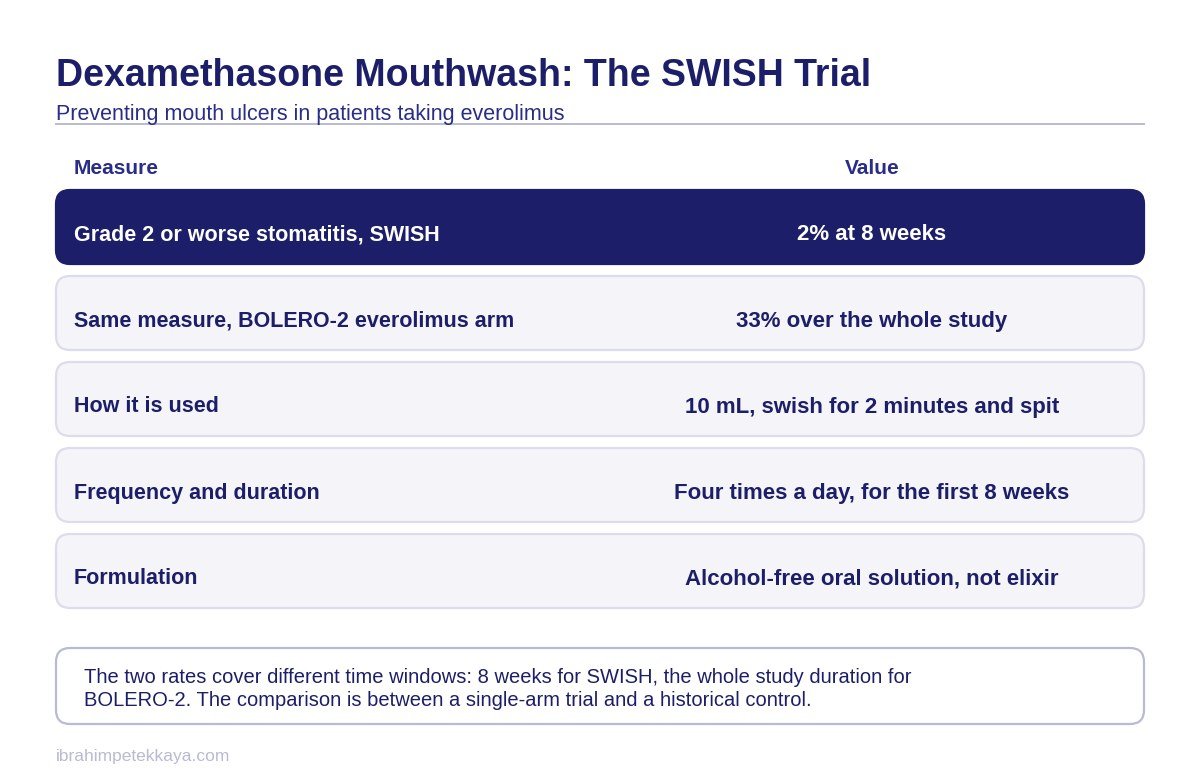
SWISH is a single-arm phase 2 trial. There is no comparison arm; every patient received the same measure. The trial enrolled postmenopausal patients with hormone receptor-positive, HER2-negative metastatic breast cancer who were starting treatment with everolimus and exemestane.
Ninety-two women were enrolled and the number of evaluable patients is 85. The preparation used was an alcohol-free oral solution containing 0.5 mg of dexamethasone in 5 millilitres.
- 10 millilitres of the solution is taken into the mouth.
- It is swished around the mouth for two minutes.
- It is not swallowed; it is spat out.
- The procedure is repeated four times a day.
- It is continued through the first 8 weeks of treatment, and may be extended by a further 8 weeks by joint decision of the doctor and the patient.
The instruction to take nothing by mouth for an hour afterwards does not appear in the publication of this trial. That instruction appears in practice-level guidance and is reported here only with that status; it cannot be presented as part of the trial protocol.
Send Your Reports for Assessment
Share your pathology, imaging and blood results on WhatsApp, or send them by email. Documents are reviewed before the consultation.
The Result and the Limit of the Comparison
Up to the eighth week, grade 2 or higher stomatitis occurred in 2 of the 85 patients, which corresponds to 2 per cent. The rate used as the comparator is the 33 per cent in the everolimus arm of the older phase 3 trial, that is 159 of 482 patients.
The grade threshold is the same in both: each reports grade 2 and above. In that respect the comparison is consistent.
The time windows, on the other hand, are not the same, and this has to be said explicitly. The figure of 2 per cent reports the position at the eighth week, while the 33 per cent is the rate accumulated across the whole duration of the older trial. Longer exposure means a higher cumulative rate.
To that must be added a difference of design: SWISH is a single-arm trial and the comparison was made against a historical control. Comparing a single-arm result against a historical control with longer follow-up makes the size of the effect look wider than it is. The difference may be real, but it has not been shown to be of the size reported.
That limit does not render the result worthless. What a single-arm trial can say is that the procedure is feasible and that the rate of mouth sores observed in patients who kept it up remained low. What it cannot say is how much of that low rate came from the rinsing and how much from shorter follow-up and patient selection.
Important: The 2 per cent and the 33 per cent cannot be compared directly. The first belongs to the eighth week and the second to the whole duration of the older trial, and the comparison is historical rather than randomised.
The Randomised Question: Is Preventive Use Superior
The trial that addressed this question in randomised form is MIST, and two of its details are frequently misreported. The trial is a phase 3 trial, not a phase 2 trial. The number of patients is 39: 19 were allocated initially to placebo and 20 initially to dexamethasone.
The trial was closed early because of slow accrual. That is a circumstance which limits the power of the result directly; a trial of 39 patients is not powered to detect a difference of moderate size.
There were two co-primary endpoints: the incidence of stomatitis and the area under the curve of stomatitis-related pain over eight weeks. No significant difference was found in either.
The conclusion the authors themselves draw is this: the results do not suggest that prophylactic dexamethasone mouthwash is superior to therapeutic use started at the first sign of oral pain. The authors also state that the trial was limited by inadequate accrual.
| Trial | Design | Result |
|---|---|---|
| SWISH | Single-arm phase 2; 85 evaluable patients | Grade 2 or higher stomatitis 2 per cent at the eighth week |
| Phase 3 everolimus trial | Randomised; 482 patients in the everolimus arm | Grade 2 or higher stomatitis 33 per cent; grade 3 to 4 8 per cent against 1 per cent |
| MIST | Randomised phase 3; 39 patients, closed early | No significant difference in either co-primary endpoint |
What the Guidelines Say and Do Not Say
A misreport needs correcting here. There is no verifiable guideline recommendation for prophylactic dexamethasone mouthwash in stomatitis caused by an mTOR inhibitor. No such recommendation could be identified in the supportive care guidelines or in the European or the American oncology guidelines.
The document that does exist is a clinical practice statement and it addresses the oral side effects of targeted treatments. That statement says treatment is determined by the severity of the symptoms, and notes that topical corticosteroids and immunomodulators are frequently used as first-line treatment in oral mucosal toxicities.
The point to watch is this: that is a statement about treatment, not a recommendation for preventive use. When the two are conflated, a guideline recommendation we do not have ends up being reported as though we did.
The approach adopted in practice can be summarised as follows: preventive use may be preferred in patients with a previous history of stomatitis, and treatment may be started at the first sign of pain in others. That approach is expert opinion and is consistent with the result of the randomised trial; it cannot be presented as a guideline recommendation.
Can Disease Progress Despite Hormone Treatment
How the plan is changed if the disease progresses while hormone-based treatment is under way.
What to Watch in the Prescription and in Daily Care
The formulation matters in the prescription, and this is a genuine detail of the wording. Dexamethasone elixir contains roughly 5 per cent alcohol and also propylene glycol; both irritate an inflamed oral mucosa. That is why an alcohol-free oral solution was used in the trial.
The prescription should therefore read alcohol-free oral solution and not elixir. The alcohol-containing form of the same active substance can worsen the very picture it is meant to prevent.
Informing the patient about the appearance and the timing of the mouth sores is useful. They usually emerge in the first weeks of treatment, appear singly or as a few foci inside the mouth, and are painful on eating. This picture is not an unexpected development; reported early, it can be managed.
- Toothbrushing continues with a soft brush, after every meal.
- Mouthwashes containing alcohol are not used.
- Very hot, acidic, spicy and hard-textured foods are avoided.
- Water is drunk frequently through the day to reduce dryness of the mouth.
- If dentures are worn, their fit is checked; a denture that rubs deepens a sore.
The circumstances in which the clinic should be called are these: pain that prevents eating or drinking, a temperature above 38 degrees, sores spreading inside the mouth, and any mouth sore lasting longer than two weeks. Waiting under any of those headings increases the risk of a dose reduction.
The real gain in managing mouth sores lies less in the side effect itself than in treatment being able to continue. Once the pain is under control the patient goes on eating, the dose is not cut and treatment is not interrupted. An effective drug being continued at a reduced dose, or abandoned early, is an outcome that affects control of the disease directly.
The daily-care advice in this section consists of general oral care practices for which there is no trial evidence, and it is given here with that status. The general framework of side-effect monitoring is set out on the patient guide and treatment pathway pages, and other side effects during treatment are covered in why fatigue after chemotherapy does not go away.
Send Your Reports for Assessment
Share your pathology, imaging and blood results on WhatsApp, or send them by email. Documents are reviewed before the consultation.
Frequently Asked Questions
How often do mouth sores occur in patients on everolimus?
In an older phase 3 trial, grade 2 or higher stomatitis occurred in 159 of the 482 patients in the everolimus arm, which is 33 per cent. Grade 3 and 4 stomatitis occurred in 8 per cent of the everolimus with exemestane arm and 1 per cent of the placebo with exemestane arm.
How is dexamethasone mouthwash used?
In the SWISH trial, 10 millilitres of an alcohol-free oral solution containing 0.5 mg of dexamethasone in 5 millilitres was taken into the mouth, swished for two minutes and spat out. It was done four times a day through the first 8 weeks, extendable by a further 8 weeks by joint decision.
What was the result of the SWISH trial?
Up to the eighth week, grade 2 or higher stomatitis occurred in 2 of the 85 evaluable patients, which is 2 per cent. The trial is single-arm, and the comparison was made against a historical control rather than a randomised one.
Can the 2 per cent and the 33 per cent be compared directly?
No. The grade threshold is the same but the time windows differ: the 2 per cent reports the position at the eighth week and the 33 per cent the rate accumulated over the whole duration of the older trial. The comparison therefore makes the size of the effect look wider than it is.
Was preventive use found superior in a randomised trial?
It was not. The randomised phase 3 trial MIST was conducted with 39 patients and closed early because of slow accrual. No significant difference was seen in either co-primary endpoint, and the authors state that the results do not suggest preventive use is superior to treatment started at the first pain.
Do the guidelines recommend preventive mouthwash?
No such recommendation could be verified. The clinical practice statement that exists says treatment is determined by the severity of the symptoms and that topical corticosteroids are frequently used as first-line treatment in oral mucosal toxicities; that is a statement about treatment, not a recommendation for preventive use.
Should the prescription say elixir or oral solution?
It should say alcohol-free oral solution. The elixir contains roughly 5 per cent alcohol and propylene glycol, both of which irritate an inflamed oral mucosa, which is why the alcohol-free form was used in the trial.
Related Articles
Why Fatigue After Chemotherapy Does Not Go Away
Open the Page
Hormone Receptor-Positive Breast Cancer
Open the PageRelated Pages
Breast Cancer
Open the Page
Targeted Therapy
Open the Page
Treatment Pathway
Open the Page
Patient Guide
Open the PageSources
- Rugo HS, Seneviratne L, Beck JT et al. Prevention of everolimus-related stomatitis in women with hormone receptor-positive, HER2-negative metastatic breast cancer using dexamethasone mouthwash (SWISH): a single-arm, phase 2 trial. Lancet Oncol 2017;18(5):654-662. Link
- Baselga J, Campone M, Piccart M et al. Everolimus in postmenopausal hormone-receptor-positive advanced breast cancer (BOLERO-2). N Engl J Med 2012;366(6):520-529. Link
- Ruddy KJ, Zahrieh D, He J et al. Dexamethasone to prevent everolimus-induced stomatitis (Alliance MIST Trial: A221701). Semin Oncol 2023;50(1-2):7-10. Link
- Villa A, Epstein JB, Yarom N et al. MASCC/ISOO Clinical Practice Statement: Management of oral complications of targeted therapy. Support Care Cancer 2024;32(8):549. Link