
Why Residual Disease Matters So Much
In HER2-positive breast cancer, treatment often begins before surgery. This neoadjuvant treatment contains pertuzumab, trastuzumab and a taxane. Shrinking the tumour is not the only aim; the tissue removed at surgery shows how the tumour actually answered the drugs.
If no live tumour cells remain in the surgical specimen, that is a pathological complete response, and those patients do markedly well. If invasive tumour is still present, the picture changes: this is residual disease, and the risk of recurrence is high. Residual disease is therefore the point at which treatment after surgery is rethought.
The KATHERINE trial set the standard here. In patients with residual invasive disease, giving trastuzumab emtansine, or T-DM1, after surgery lowered the risk of recurrence substantially compared with trastuzumab. That is why T-DM1 has been used in this group for years. The HER2-positive breast cancer page sets out the wider treatment framework for this subtype.
Important: Residual disease is not a failure; it is information. It shows the tumour partly resisted the drugs, and that information changes the plan after surgery directly.
How Much Difference Trastuzumab Deruxtecan Made
DESTINY-Breast05 is the phase 3 trial that compared T-DM1 with trastuzumab deruxtecan in exactly this group. Trastuzumab deruxtecan is an antibody-drug conjugate: a powerful chemotherapy molecule is chemically attached to an antibody that binds HER2. The antibody finds the target and the drug it carries is released inside the cell.
Both drugs bind the same target. The difference lies in the payload and in how that payload behaves. What T-DM1 carries disrupts the skeleton a cell needs in order to divide, and largely stays inside the cell it entered. What trastuzumab deruxtecan carries is a topoisomerase I inhibitor, which attacks DNA repair, and more molecules are attached to each antibody.
That payload has one further property: once released inside a cell it can cross into neighbouring cells. The literature treats this not as a side effect but as a deliberate design feature, because it allows neighbouring tumour cells with low HER2 expression to be reached as well. Part of the difference in efficacy is thought to come from this, and the same property helps explain why lung toxicity is more frequent.
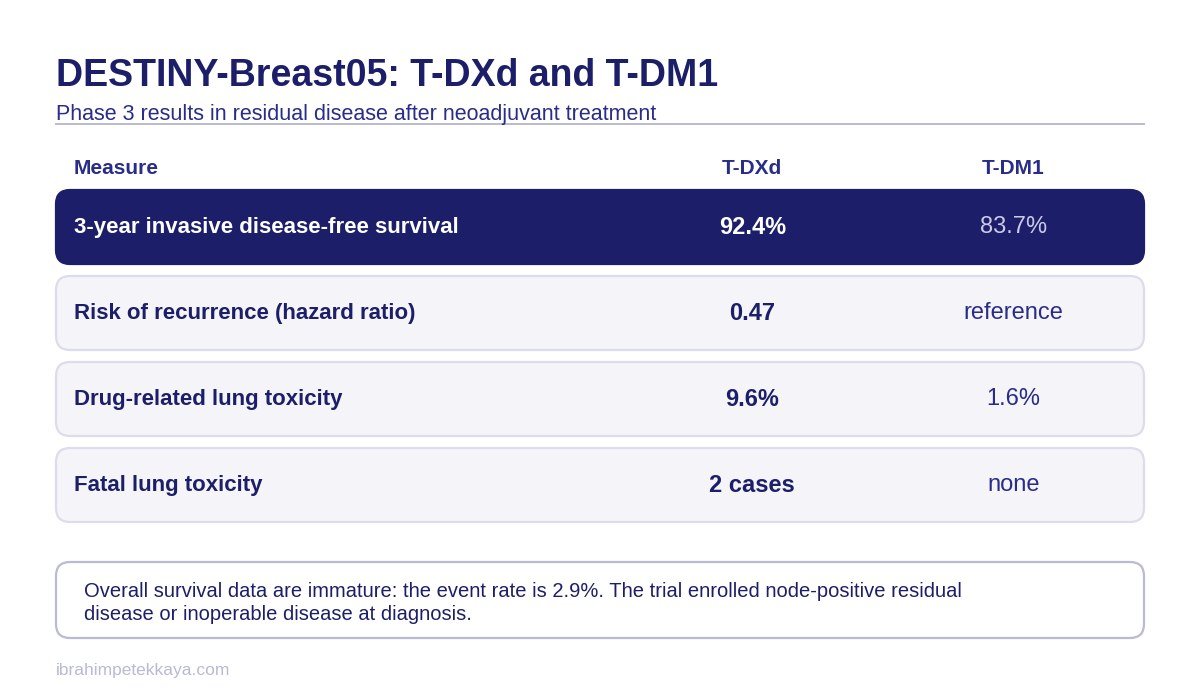
The results are unambiguous. The risk of recurrence was 53 per cent lower in the T-DXd arm, with a hazard ratio of 0.47. Three-year invasive disease-free survival was 92.4 per cent with T-DXd and 83.7 per cent with T-DM1. In this group of patients, a gap of roughly nine percentage points is not a small one.
First recurrence events pointed the same way: both distant and locoregional recurrences were less frequent in the T-DXd arm. Three-year distant recurrence-free interval was 93.9 per cent against 86.1 per cent.

Treatment Decisions in Early Breast Cancer
What the decision on treatment before and after surgery in early breast cancer actually rests on.
Send Your Reports for Assessment
Share your pathology, imaging and blood results on WhatsApp, or send them by email. Documents are reviewed before the consultation.
Who Was Enrolled in the Trial
Care is needed here, because a result applies only as far as the trial population extends. DESTINY-Breast05 did not enrol everyone with residual invasive disease.
- Patients who also had tumour in the axillary lymph nodes at surgery, that is node-positive residual disease.
- Or patients whose disease was not operable at the time of diagnosis.
- All patients had to have received a taxane and HER2-directed treatment as neoadjuvant therapy.
That distinction is not a detail. A patient with residual disease whose lymph nodes came back clear, and whose risk is therefore lower, falls outside this trial. For such a patient T-DM1 remains a reasonable option. Describing the result as a new standard for all residual disease claims more than the trial supports.
Important: A phase 3 result is valid only as far as the patient definition it was built on. Whether your own situation fits that definition is a conversation to have with the doctor who has your file.
Lung Toxicity Cannot Be Set Aside
Trastuzumab deruxtecan has one well-recognised side effect that has to be taken seriously: drug-related inflammation of lung tissue, known as interstitial lung disease or pneumonitis.
In DESTINY-Breast05, lung toxicity adjudicated as drug-related occurred in 9.6 per cent of the T-DXd arm and 1.6 per cent of the T-DM1 arm. Most events were mild or moderate and resolved when the drug was interrupted and corticosteroids given. But two patients in the T-DXd arm died of it; there were no fatal cases with T-DM1.
- A new or worsening cough should never be dismissed.
- Breathlessness, particularly if it becomes noticeable on exertion, should be reported.
- Fever and malaise should be assessed if they come with chest symptoms.
- When these symptoms appear the drug is stopped and imaging is arranged.
- Early recognition and corticosteroid treatment are what keep the picture from worsening.
Managing this side effect is part of the treatment decision, not an afterthought. A patient who recognises these symptoms and reports them without delay is taking the single most important step in using the drug safely. The side-effect profile also differs in kind from T-DM1, where raised liver enzymes and low platelets predominate, against nausea, constipation and low neutrophils with T-DXd.
Where Overall Survival Stands
Honesty is needed here. In the published analysis of DESTINY-Breast05, the overall survival data were immature: deaths had occurred in about 2.9 per cent of patients. Three-year overall survival was above 95 per cent in both arms and the difference between them was not demonstrated statistically.
That does not mean the drug fails to extend life; it means too few events have accrued to say so. The trial itself rests its conclusion on superiority in invasive disease-free survival and claims no survival benefit. Delaying recurrence is a worthwhile result in its own right, but the two must be kept apart.
| Result | Status |
|---|---|
| Invasive disease-free survival | Primary endpoint, superiority shown |
| Distant recurrence-free interval | Same direction, supportive |
| Overall survival | Immature, superiority not shown |
| Lung toxicity | Markedly more frequent, two fatal cases |
How the Decision Is Made
In practice the question becomes this: is the expected risk of recurrence in this patient high enough to be worth the risk of lung toxicity? In a patient with node-positive residual disease the balance usually falls towards trastuzumab deruxtecan. In a lower-risk picture, T-DM1 is still worth discussing.
- The pathology report after neoadjuvant treatment is read again; the size of the residual tumour and the nodal status are established.
- The patient’s lung status, any existing lung disease and respiratory reserve are assessed.
- The expected benefit and the risk of lung toxicity are discussed openly with the patient.
- Once treatment starts, regular monitoring for respiratory symptoms is planned.
- The decision is shared at the molecular tumour board or the breast board.
This decision is not made by looking at one number. As the treatment pathway page describes, pathology, imaging and the patient’s general condition are read together. The same logic runs through treatment decisions in hormone receptor-positive breast cancer: what settles the plan is not a single result but how the results read together.
Does Stage 4 Breast Cancer Always Mean Hopelessness
What advanced-stage breast cancer actually means and how treatment options are planned.
Send Your Reports for Assessment
Share your pathology, imaging and blood results on WhatsApp, or send them by email. Documents are reviewed before the consultation.
Frequently Asked Questions
What is trastuzumab deruxtecan?
It is an antibody-drug conjugate: a powerful chemotherapy molecule chemically attached to an antibody that binds the HER2 protein. The antibody finds the target and the drug it carries is released inside the tumour cell.
Who is trastuzumab deruxtecan given to?
In DESTINY-Breast05 it was used in HER2-positive patients who, after neoadjuvant treatment, still had tumour in the axillary lymph nodes, or whose disease had not been operable at diagnosis. Not every patient with residual disease fits that definition.
Is T-DM1 no longer used?
It is. DESTINY-Breast05 showed trastuzumab deruxtecan to be superior in high-risk residual disease; lower-risk patients with clear lymph nodes were outside the trial, and T-DM1 remains a reasonable option for them.
What is the most important side effect?
Drug-related inflammation of the lung tissue. In DESTINY-Breast05 it occurred in 9.6 per cent of the T-DXd arm against 1.6 per cent with T-DM1, and two patients in the T-DXd arm died of it. A new cough or breathlessness must be reported without delay.
Does this drug extend life?
In the published analysis the overall survival data were immature, with deaths in about 2.9 per cent of patients, and no superiority was demonstrated between the arms. What was shown is a marked reduction in recurrence.
How large is the reduction in recurrence?
The hazard ratio was 0.47, which corresponds to a relative reduction of roughly 53 per cent. In absolute terms, three-year invasive disease-free survival rose from 83.7 per cent to 92.4 per cent.
What should I watch for during treatment?
A new or worsening cough, breathlessness and fever should be reported without delay. When these appear the drug is stopped and lung imaging is arranged; recognising it early is what prevents the picture from worsening.
Related Articles
Hormone Receptor-Positive Breast Cancer
Open the Page
Targeted Therapy Resistance: Why It Happens
Open the PageRelated Pages
HER2-Positive Breast Cancer
Open the Page
Breast Cancer
Open the Page
Chemotherapy
Open the Page
Targeted Therapy
Open the PageSources
- Loibl S, Park YH, Shao Z et al. Trastuzumab Deruxtecan in Residual HER2-Positive Early Breast Cancer (DESTINY-Breast05). N Engl J Med 2026;394(9):845-857. Link
- von Minckwitz G, Huang CS, Mano MS et al. Trastuzumab Emtansine for Residual Invasive HER2-Positive Breast Cancer (KATHERINE). N Engl J Med 2019;380(7):617-628. Link
- Loibl S, André F, Bachelot T et al. Early breast cancer: ESMO Clinical Practice Guideline for diagnosis, treatment and follow-up. Ann Oncol 2024;35(2):159-182. Link
- Swain SM, Miles D, Kim SB et al. Pertuzumab, trastuzumab, and docetaxel for HER2-positive metastatic breast cancer (CLEOPATRA): end-of-study results. Lancet Oncol 2020;21(4):519-530. Link
- Johnston S, Martin M, O’Shaughnessy J et al. Overall survival with abemaciclib in early breast cancer (monarchE). Ann Oncol 2026;37(2):155-165. Link
- National Cancer Institute, SEER Program. Cancer Stat Facts: Female Breast Cancer. Link