
Fatigue After Chemotherapy Is Not Ordinary Tiredness
Cancer-related fatigue is an exhaustion out of proportion to effort that does not lift with rest. That is what separates it from the tiredness of a short night or a long day: it stays at the same level whether or not you sleep.
Guidelines report that 80 to 90 per cent of patients receiving chemotherapy or radiotherapy experience it, and that up to 40 per cent already have fatigue at the time of diagnosis. So it is not always a side effect of treatment; it is also bound up with the disease itself.

When the Blood Tests Are Fine but the Tiredness Stays
Fatigue does not always show up in blood tests. This post explains the cellular reasons behind the tiredness seen after chemotherapy and during targeted therapy.
How Long It Lasts
This is the most common question and the answer is uncomfortable: in a proportion of patients it lasts months, and in some, years. Guidelines report that around a third of patients have fatigue that continues for years after treatment ends.
The Abrahams meta-analysis of 12,327 patients treated for breast cancer found a pooled prevalence of severe fatigue after treatment of 26.9 per cent. The same analysis showed that the sharpest fall happens in the first six months after treatment ends, after which rates plateau and stay elevated out to five years. Having received chemotherapy stood out as an independent risk factor.
| Period | What to expect |
|---|---|
| During treatment | Present in most patients |
| First 6 months after treatment | The fastest improvement occurs here |
| 6 months to 2 years | Improvement slows; it persists in some |
| Beyond 2 years | May continue in roughly a third |
Duration also has a personal side. Group data are an average: of two patients on the same treatment, one may see the complaint fade within months while in the other it stretches over years. The determinants are treatment intensity, coexisting illness, sleep patterns and prior activity habits.
These numbers are not a foregone conclusion. There are approaches that reduce fatigue and their effects have been measured. What matters is not waiting it out on the assumption that it will simply pass.
Why It Persists
There is no single cause. Research points to inflammation playing a role before, during and after treatment: the severity of fatigue correlates with levels of certain inflammatory markers in blood. Disruption of the stress-hormone axis, autonomic imbalance and a shifted sleep-wake rhythm are added to that.
Alongside these there are correctable causes, and these are the first things to look for. Guidelines ask that these be screened before anything else.
- Fatigue is recorded at follow-up on a 0 to 10 scale; a symptom that is not measured cannot be followed.
- Anaemia, thyroid dysfunction and other correctable causes are screened for with blood tests.
- Sleep and pain control are reviewed as separate headings.
- An exercise programme is adapted with the treating team before it starts: bone metastases, a low platelet count, balance problems or neuropathy all change what is appropriate.
- The programme is usually built as a walk rising gradually towards 150 minutes a week.
- The day is arranged so that demanding tasks fall in the hours when the patient feels best.
- Short, regular breaks are advised; long daytime naps are avoided because they disturb sleep at night.
- Supplements are not started without medical advice, because of the risk of interaction with treatment.
Important: Most items on this list are treatable. Fatigue deserves to be taken as seriously as pain, and if it is not asked about at follow-up visits, the patient should raise it.
Send Your Reports for Assessment
Share your pathology, imaging and blood results on WhatsApp, or send them by email. Documents are reviewed before the consultation.
How Inactivity Makes Fatigue Worse
Fatigue has a self-feeding quality. Exhaustion reduces movement; as movement falls, muscle mass and stamina decline. Less stamina means the same task takes more effort and starts to feel more tiring. Fatigue can therefore continue on its own after its first cause has gone, which is part of why it persists after treatment finishes.
This is also why exercise helps. Regular movement restores stamina, preserves muscle mass and settles sleep. The aim is not performance but breaking the cycle, so continuity matters more than the intensity at which someone starts. How exercise is approached after colon cancer surgery is described under exercise in colon cancer.
Breaking the cycle has to be gradual. Starting at high intensity after a long inactive period leads to a day in bed and the programme abandoned in its first week. Increases are planned to sit a little above what can be managed that day.
What Actually Works
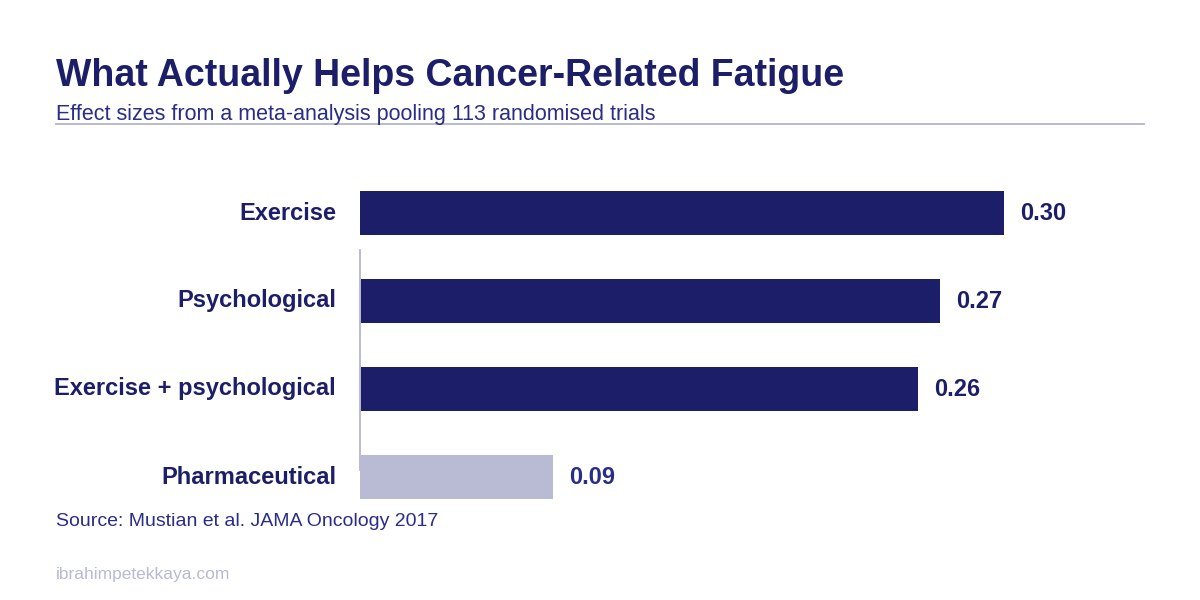
The clearest answer comes from the Mustian meta-analysis pooling 113 randomised trials and 11,525 participants. Four approaches were compared and the measured effect sizes were: exercise 0.30, psychological interventions 0.27, the two combined 0.26, and pharmaceutical treatment 0.09. The difference achieved with drug treatment was both very small and statistically borderline, and fell clearly behind exercise and psychological support.
A Cochrane review points the same way: across 56 studies and 4,068 participants, exercise was superior to control for fatigue. Benefit was demonstrable in breast and prostate cancer; aerobic exercise reached significance while resistance training did not. The benefit was seen both during and after treatment.
The dose usually recommended is 150 minutes of moderate aerobic exercise a week plus two or three strength sessions. The current ASCO update declines to prescribe an optimal type, duration or frequency, because the evidence does not support one. In practice that means: whichever movement you can manage, do it regularly. The part played by sleep and psychological support is taken separately in stress, sleep and immunity.
How Far These Numbers Go
The effect sizes quoted are standardised measures and fall between small and moderate. That does not mean exercise removes fatigue; it means a measurable improvement in the group average. How much benefit one patient will see cannot be read from that figure.
The scope is limited too: in the Cochrane review the benefit of exercise could be demonstrated in breast and prostate cancer, while data in other tumour types do not reach that level. In the same review aerobic exercise gave a significant result while resistance work did not. The current ASCO update states plainly that the evidence is not sufficient to define the best type, duration or frequency, so the weekly figure is a consensus rather than a proven threshold.
The negative drug result has its own scope. The methylphenidate comparison was run in patients with advanced disease and assessed fatigue at six weeks. It did not show that the drug fails in every patient under every condition; it showed that the superiority needed for routine use was not demonstrated. Hence the guideline language of not recommending routine use.
Psychological and Integrative Approaches
The current joint ASCO and Society for Integrative Oncology update recommends, alongside exercise, cognitive behavioural therapy, mindfulness-based programmes and tai chi or qigong to reduce fatigue during and after treatment. Psychoeducation is recommended during treatment, while cognitive behavioural therapy and mindfulness stand out particularly for moderate to severe fatigue afterwards.
What these approaches have in common is that rather than trying to abolish fatigue directly, they rebuild the daily structure, the sleep pattern and the distribution of activity. Spreading energy evenly across the day prevents the collapse that follows spending it all at once.
Sleep, Hormone Balance and Cell Renewal
Sleep regulates biological rhythm, hormone balance and cell renewal. This post explains the effects of short sleep through melatonin and stress hormones.
Where Drug Treatment Stands
For years it was thought that stimulants might reduce fatigue. A 2010 Cochrane review reported a small but statistically significant advantage for methylphenidate and called for a large trial.
That trial was done. In the randomised, double-blind MePFAC study of 162 patients with advanced cancer, methylphenidate was not superior to placebo at six weeks, and the difference fell below the threshold considered clinically meaningful. The drug was safe and well tolerated, but it did not improve fatigue.
The current ASCO update therefore recommends against the routine use of L-carnitine, antidepressants, wakefulness-promoting agents and psychostimulants for fatigue. Dietary supplements were likewise found not to improve it. The ESMO panel is split: some members hold that stimulants could be considered in carefully selected patients, while the majority conclude they cannot be recommended.
A common misunderstanding is that recommending against a drug means the complaint is not taken seriously. The opposite holds: no drug is recommended because drugs have been tried and measured and the expected advantage was not demonstrated. Approaches that answer the complaint exist, and they are delivered as a programme rather than a prescription.
Important: Where anaemia is found it is treated on its own merits. Erythropoiesis-stimulating agents, however, are not used to correct fatigue, because of safety concerns.
How Fatigue Is Handled in Practice
- Fatigue is recorded at follow-up on a 0 to 10 scale; a symptom that is not measured cannot be followed.
- Anaemia, thyroid dysfunction and other correctable causes are screened for with blood tests.
- Sleep and pain control are reviewed as separate headings.
- An exercise programme is adapted with the treating team before it starts: bone metastases, a low platelet count, balance problems or neuropathy all change what is appropriate.
- The programme is usually built as a walk rising gradually towards 150 minutes a week.
- The day is arranged so that demanding tasks fall in the hours when the patient feels best.
- Short, regular breaks are advised; long daytime naps are avoided because they disturb sleep at night.
- Supplements are not started without medical advice, because of the risk of interaction with treatment.
Tracking the fatigue score is what makes improvement visible. Most patients only notice progress when they look back. Other aspects of daily life during treatment are covered on the patient guide page.
Frequently Asked Questions
How long does fatigue after chemotherapy last?
The fastest improvement usually happens in the first six months after treatment ends. In around a third of patients it lasts longer; in breast cancer the prevalence of severe fatigue after treatment reported in the Abrahams meta-analysis is 26.9 per cent.
My blood tests are normal, so why am I still tired?
Cancer-related fatigue does not always show in blood tests. Inflammation, the stress-hormone axis, sleep rhythm and inactivity all play a part. Correctable causes such as anaemia and thyroid problems should still be excluded first.
Will resting make it go away?
Cancer-related fatigue does not improve in proportion to rest, and long daytime naps can worsen it by disrupting night-time sleep. The best-evidenced approach is regular exercise rather than rest.
How much exercise should I do?
Guidelines suggest 150 minutes of moderate aerobic exercise a week plus two or three strength sessions. The current ASCO update sets no specific type or duration; regularity is what matters.
Is there a drug for fatigue?
Current guidelines do not recommend stimulants, antidepressants or L-carnitine routinely for fatigue. In a randomised trial in advanced cancer, methylphenidate was not superior to placebo.
Do vitamins and supplements help?
Current evidence indicates that dietary supplements do not improve fatigue. Supplements are not recommended unless a deficiency is found, and any product should be discussed with your physician.
Does fatigue mean the cancer is progressing?
Fatigue on its own is not a sign of progression and is very common after treatment. New or rapidly worsening fatigue should still be assessed alongside other findings.
Related Articles
Vaccines During Chemotherapy: Flu and Pneumonia Vaccine Timing
Open the Page
How Many Chemotherapy Cycles Are Given?
Open the PageRelated Pages
Chemotherapy
Open the Page
Patient Guide
Open the Page
Treatment Pathway
Open the Page
Treatments
Open the PageSources
- Fabi A, Bhargava R, Fatigoni S et al. Cancer-related fatigue: ESMO Clinical Practice Guidelines for diagnosis and treatment. Ann Oncol 2020;31(6):713-723. Link
- Bower JE, Bak K, Berger A et al. Screening, Assessment, and Management of Fatigue in Adult Survivors of Cancer: An ASCO Clinical Practice Guideline Adaptation. J Clin Oncol 2014;32(17):1840-1850. Link
- Bower JE, Lacchetti C, Alici Y et al. Management of Fatigue in Adult Survivors of Cancer: ASCO-Society for Integrative Oncology Guideline Update. J Clin Oncol 2024;42(20):2456-2487. Link
- Cramp F, Byron-Daniel J. Exercise for the management of cancer-related fatigue in adults. Cochrane Database Syst Rev 2012;(11):CD006145. Link
- Mustian KM, Alfano CM, Heckler C et al. Comparison of Pharmaceutical, Psychological, and Exercise Treatments for Cancer-Related Fatigue: A Meta-analysis. JAMA Oncol 2017;3(7):961-968. Link
- Minton O, Richardson A, Sharpe M, Hotopf M, Stone P. Drug therapy for the management of cancer-related fatigue. Cochrane Database Syst Rev 2010;(7):CD006704. Link
- Stone P, Minton O, Richardson A et al. Methylphenidate Versus Placebo for Treating Fatigue in Patients With Advanced Cancer: Randomized, Double-Blind, Multicenter, Placebo-Controlled Trial. J Clin Oncol 2024;42(20):2382-2392. Link
- Abrahams HJG, Gielissen MFM, Schmits IC et al. Risk factors, prevalence, and course of severe fatigue after breast cancer treatment: a meta-analysis involving 12 327 breast cancer survivors. Ann Oncol 2016;27(6):965-974. Link
- Bower JE, Ganz PA, Desmond KA et al. Fatigue in long-term breast carcinoma survivors: a longitudinal investigation. Cancer 2006;106(4):751-758. Link
- Bower JE. Cancer-related fatigue — mechanisms, risk factors, and treatments. Nat Rev Clin Oncol 2014;11(10):597-609. Link
- National Comprehensive Cancer Network. NCCN Clinical Practice Guidelines in Oncology: Cancer-Related Fatigue. Link