
What Hormone Receptor-Positive Breast Cancer Means
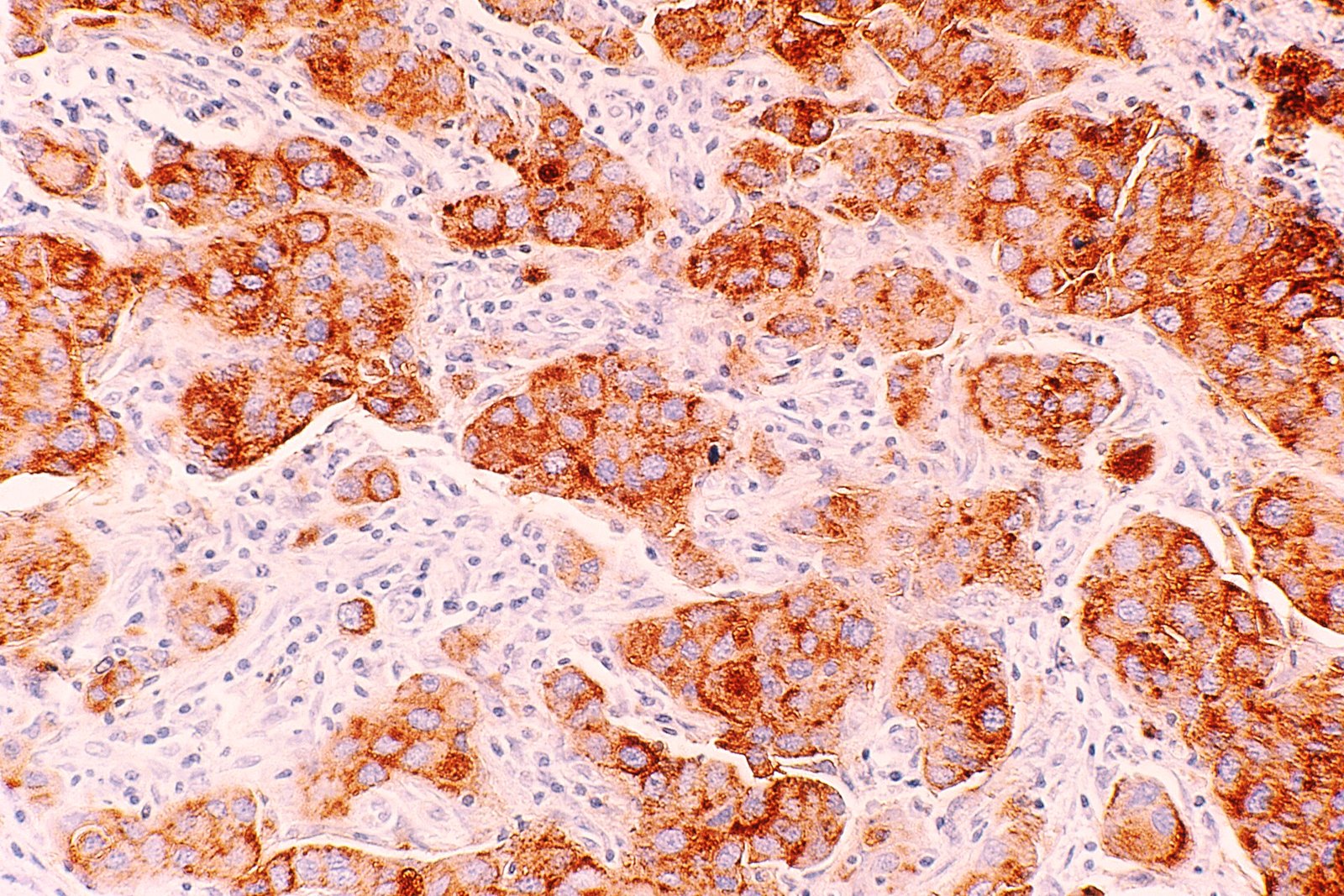
A pathology report showing a positive oestrogen or progesterone receptor means the tumour cells use hormone signalling to grow. That finding defines the strongest arm of treatment: endocrine therapy, which interrupts the signal.
The second determinant in this group is HER2 status. When HER2 is negative, the debate turns on whether chemotherapy is needed; when HER2 is positive the plan changes entirely and targeted agents come in. That distinction is set out on the HER2-positive breast cancer page.
Endocrine Therapy: The Backbone of the Plan
Endocrine therapy is the backbone of treatment in hormone-driven disease. Tamoxifen is used before the menopause and aromatase inhibitors mostly after it. In higher-risk premenopausal women, adding ovarian function suppression gives better results than tamoxifen alone. A large patient-level meta-analysis showed that in postmenopausal women aromatase inhibitors reduce recurrence more than tamoxifen.
The two work in different ways. Tamoxifen binds the receptor inside the cell and blocks the signal; aromatase inhibitors lower the hormone itself, by reducing oestrogen production in fat tissue after the menopause. An aromatase inhibitor is therefore not sufficient on its own in a woman with functioning ovaries, and can only be used if ovarian function is suppressed.
Suppressing ovarian function is a decision in its own right before the menopause. Who it is offered to depends on age, the risk profile of the tumour and whether chemotherapy was given.
Why endocrine therapy runs for years lies in the course of the disease. In hormone-driven breast cancer, cells can stay quiet for a long time and start dividing again years later. Treatment keeps the hormone signal cut during that quiet period, so shortening it reduces the gain.
Important: Endocrine therapy usually runs for five years and can be extended where risk is high. Stopping it early is one of the most important modifiable factors that increase the risk of recurrence.
Is Chemotherapy Really Necessary?
The answer to this has changed over the past decade. Genomic assays express a tumour’s tendency to recur as a number, which makes it possible to identify patients who will not benefit from chemotherapy.
In TAILORx, which used the 21-gene assay, patients without nodal involvement and with a recurrence score of 11 to 25 did no worse on endocrine therapy alone than with chemotherapy added: nine-year invasive disease-free survival was 83.3 per cent against 84.3 per cent. The same trial also set an important limit: in patients aged 50 or under with a score of 16 to 25, some chemotherapy benefit was seen.
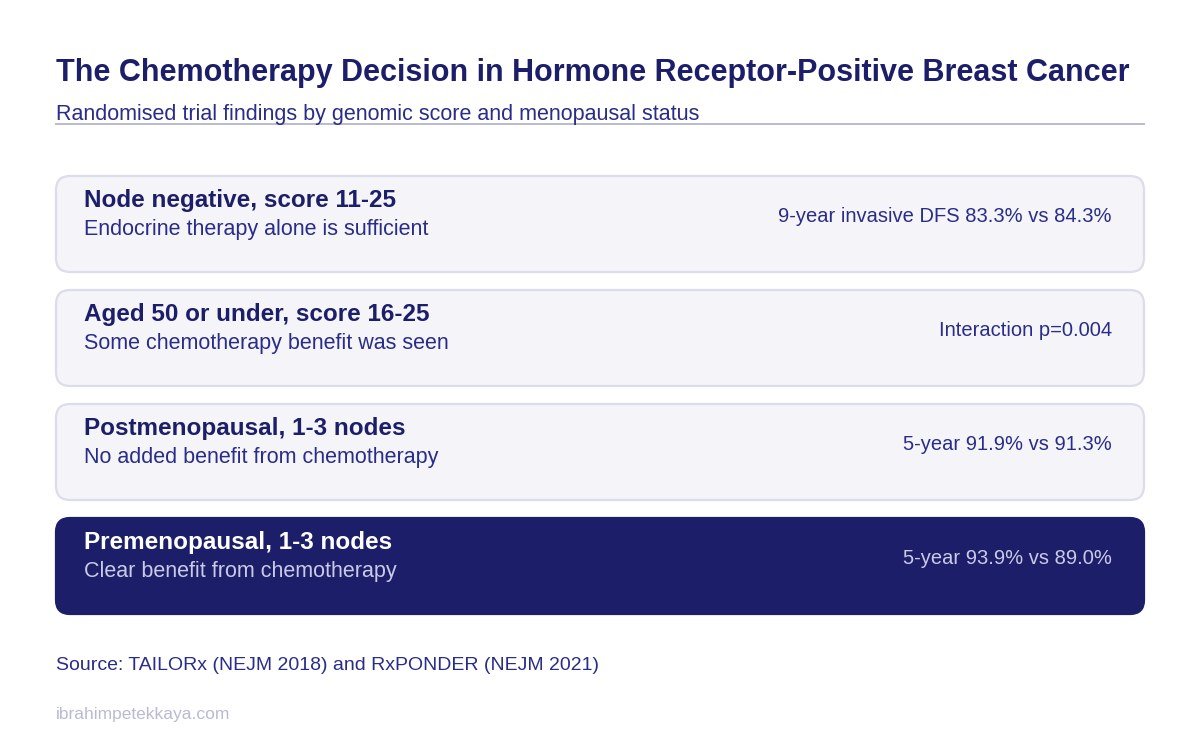
RxPONDER, in patients with nodal involvement, produced an even more interesting result. In postmenopausal women with one to three involved nodes and a score below 25, chemotherapy added nothing. In premenopausal women it clearly did: five-year invasive disease-free survival was 93.9 per cent against 89.0 per cent. What stands out is that this benefit did not grow as the score rose. In other words, the assay itself could not identify which premenopausal patients would benefit.
The shared conclusion of these trials is that the chemotherapy decision is no longer reduced to tumour size and the number of involved nodes. A patient who looks clinically high risk can prove genomically low risk, and the reverse happens too. The decision is built where the two meet.
In MINDACT, which used the 70-gene signature, patients who looked clinically high risk but were genomically low risk had five-year distant metastasis-free survival of 94.7 per cent without chemotherapy. The trial concluded that roughly half of clinically high-risk women might not require chemotherapy.
Send Your Reports for Assessment
Share your pathology, imaging and blood results on WhatsApp, or send them by email. Documents are reviewed before the consultation.
What a Genomic Assay Measures
Genomic assays do not read the DNA sequence of the tumour; they read how actively certain genes are working. The genes measured are mainly those of cell proliferation and the hormone pathway, and high proliferation activity is taken to mean a greater tendency to recur. A formula reduces those levels to one number, so the score summarises how the tumour is likely to behave.
Two ideas need separating. A marker that predicts the course of the disease is prognostic; one that shows who will benefit from a treatment is predictive. Genomic scores were developed first to predict the course. That they can be used in the chemotherapy decision rests on their having been tested separately in randomised trials; a high score is not by itself proof of chemotherapy benefit.
The clearest illustration came in premenopausal patients with nodal involvement: chemotherapy benefit was evident there, but it did not grow as the score rose. The number predicted the course while failing to identify who within the group would benefit, which is why the use of a score is defined by patient group.
CDK4/6 Inhibitors
These drugs halt the cell division cycle and are added to endocrine therapy in hormone-driven disease. Their effect in advanced disease has been known for some time: in the first-line MONALEESA-2 trial adding ribociclib, median overall survival was 63.9 months against 51.4 months.
In early disease they came into play for high-risk patients. In the long-term follow-up of the monarchE abemaciclib trial, seven-year invasive disease-free survival was 77.4 per cent against 70.9 per cent, and overall survival 86.8 per cent against 85.0 per cent; that difference was statistically significant (hazard ratio 0.84). The absolute gain is smaller than the one in disease-free survival. In the NATALEE trial testing ribociclib in a broader population, three-year invasive disease-free survival was reported as 90.4 per cent against 87.1 per cent.
Important: The gain in disease-free survival and the gain in overall survival are not the same size. That difference belongs in the conversation alongside the burden of side effects and the duration of treatment.

The Features That Drive the Treatment Decision in Breast Cancer
Subtype and receptor status lead to different treatment plans even among patients at the same stage.
Scope of the Trials and Open Questions
Every result belongs to a patient group. The 21-gene finding in the intermediate score range belongs to patients without nodal involvement; those with involved nodes were examined separately. The chemotherapy benefit seen in patients aged 50 or under with upper intermediate scores is part of the same distinction. Carrying a result outside its group removes the basis for the decision.
How much of the chemotherapy benefit in premenopausal patients comes from direct cell kill and how much from the effect of chemotherapy on ovarian function is a disputed question. The trial concerned was not designed to answer it, and the distinction remains open. The practical consequence is unchanged: chemotherapy is discussed in that group.
The third limit is length of follow-up. The result reported with the 70-gene signature is at five years. Because recurrences in hormone-driven breast cancer can occur years later, a five-year figure does not show the whole consequence of the decision. For the same reason disease-free survival and overall survival are read separately when a CDK4/6 inhibitor is added in early disease.
The Order in Which the Decision Is Made
- Hormone receptor and HER2 status are confirmed on the pathology report.
- Tumour size, grade and nodal involvement are assessed.
- A genomic assay is requested where it will change the decision.
- Menopausal status and age are treated as a separate criterion for the chemotherapy decision.
- The type and duration of endocrine therapy are set.
- Adding a CDK4/6 inhibitor is discussed in high-risk patients.
- The plan is finalised together with the patient’s priorities and expected side effects.
The step most often skipped in practice is the fourth. Read on its own, a genomic score can lead to chemotherapy being dropped in a premenopausal patient, where randomised data show a benefit. The result of the assay should not be read apart from the age and menopausal status of the patient.
These steps may not all be completed at one visit, because the genomic result takes time to come back. The whole process is set out on the breast cancer page.
When resistance to endocrine therapy develops in advanced disease, molecular testing comes into play; how alterations found downstream in the hormone pathway affect the choice of treatment is discussed under PIK3CA mutation.
Chemotherapy or Immunotherapy?
In breast cancer caught at an early stage the tumour can be removed completely by surgery, and the treatment plan follows the features of the tumour.
Side Effects and Adherence
The side effects of endocrine therapy differ from those of chemotherapy and, because the treatment runs for years, they affect daily life more. Hot flushes, joint pain, loss of bone density and changes in mood are the most commonly reported.
- Joint pain is usually most noticeable in the first months and eases with time.
- Bone density is monitored regularly in patients on aromatase inhibitors.
- The severity of hot flushes can often be reduced by switching to another drug.
- Mood changes and disturbed sleep are easily overlooked, yet they directly affect adherence.
- Stopping the drug without discussing it is the most common and most preventable problem.
Bone health is the point most often missed. Monitoring bone density in patients on an aromatase inhibitor, and adding supportive treatment where needed, is part of the plan. Joint pain is the second: switching drug or a short break is considered before pain leads to treatment being abandoned.
The commonest reason for poor adherence is not side effects but not understanding why the treatment runs so long. Because recurrences in hormone-driven breast cancer can appear years later, endocrine therapy continues long after surgery and chemotherapy have finished. Explaining that long tail at the outset markedly reduces the tendency to stop at year five.
When side effects are discussed, a solution is usually found. What matters is raising the problem rather than quietly abandoning treatment.
Frequently Asked Questions
Is chemotherapy always needed in hormone receptor positive breast cancer?
No. In patients without nodal involvement and with a mid-range genomic recurrence score, endocrine therapy alone was found sufficient. The decision combines the score with nodal status, age and menopausal status.
Who should have a genomic assay?
A genomic assay helps in early-stage, hormone receptor-positive, HER2-negative disease where the chemotherapy decision is finely balanced. Where the decision is already clear, the result is unlikely to change the plan.
Why does the decision differ before and after the menopause?
In RxPONDER, premenopausal women with nodal involvement gained a clear benefit from chemotherapy while postmenopausal women gained none. Menopausal status is therefore a criterion in its own right.
How long does endocrine therapy last?
Usually five years, extended in patients at higher risk of recurrence. The duration depends on tumour features and on how well the treatment is tolerated.
Is a CDK4/6 inhibitor given to everyone?
No. In early disease it applies to patients meeting high-risk criteria. In advanced disease, adding it to endocrine therapy is a common approach.
Tamoxifen or an aromatase inhibitor?
In postmenopausal patients, patient-level analysis showed aromatase inhibitors reduce recurrence more. Before the menopause the choice depends on whether ovarian suppression is used.
Can I stop the drug because of side effects?
Always discuss it first. Most side effects can be managed with a dose change, a switch of drug or supportive treatment, whereas stopping early raises the risk of recurrence.
Related Articles
Related Pages
Breast Cancer
Open the Page
HER2-Positive Breast Cancer
Open the Page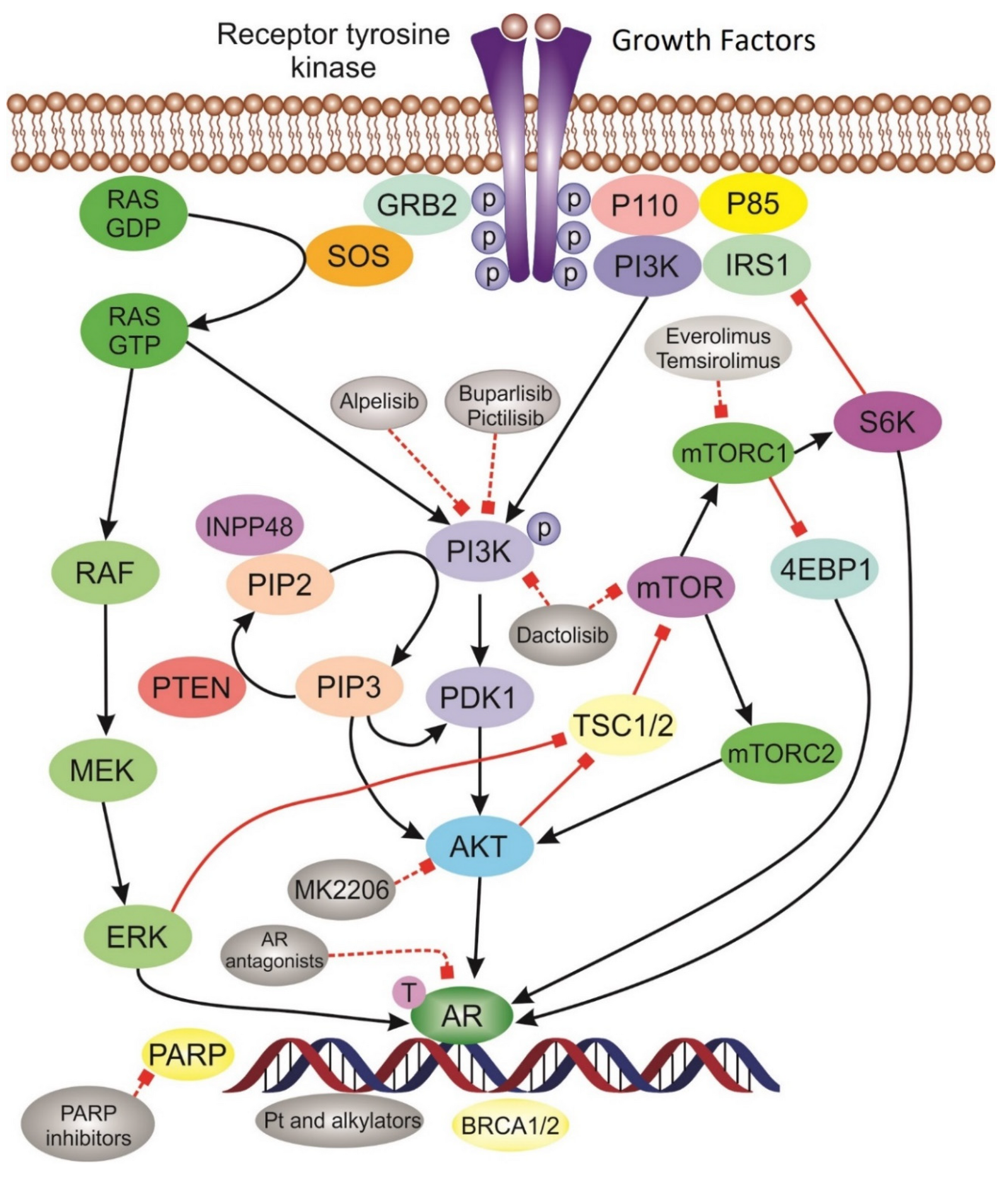
Triple-Negative Breast Cancer
Open the Page
Comprehensive Genomic Profiling
Open the PageSources
- Sparano JA, Gray RJ, Makower DF et al. Adjuvant Chemotherapy Guided by a 21-Gene Expression Assay in Breast Cancer (TAILORx). N Engl J Med 2018;379(2):111-121. Link
- Kalinsky K, Barlow WE, Gralow JR et al. 21-Gene Assay to Inform Chemotherapy Benefit in Node-Positive Breast Cancer (RxPONDER). N Engl J Med 2021;385(25):2336-2347. Link
- Cardoso F, van ’t Veer LJ, Bogaerts J et al. 70-Gene Signature as an Aid to Treatment Decisions in Early-Stage Breast Cancer (MINDACT). N Engl J Med 2016;375(8):717-729. Link
- Piccart M, van ’t Veer LJ, Poncet C et al. 70-gene signature as an aid for treatment decisions in early breast cancer: updated results of the phase 3 randomised MINDACT trial. Lancet Oncol 2021;22(4):476-488. Link
- Johnston S, Martin M, O’Shaughnessy J et al. Overall survival with abemaciclib in early breast cancer (monarchE). Ann Oncol 2026;37(2):155-165. Link
- Slamon D, Lipatov O, Nowecki Z et al. Ribociclib plus Endocrine Therapy in Early Breast Cancer (NATALEE). N Engl J Med 2024;390(12):1080-1091. Link
- Francis PA, Pagani O, Fleming GF et al. Tailoring Adjuvant Endocrine Therapy for Premenopausal Breast Cancer (SOFT/TEXT). N Engl J Med 2018;379(2):122-137. Link
- Early Breast Cancer Trialists’ Collaborative Group. Aromatase inhibitors versus tamoxifen in early breast cancer: patient-level meta-analysis of the randomised trials. Lancet 2015;386(10001):1341-1352. Link
- Loibl S, André F, Bachelot T et al. Early breast cancer: ESMO Clinical Practice Guideline for diagnosis, treatment and follow-up. Ann Oncol 2024;35(2):159-182. Link
- Hortobagyi GN, Stemmer SM, Burris HA et al. Overall Survival with Ribociclib plus Letrozole in Advanced Breast Cancer (MONALEESA-2). N Engl J Med 2022;386(10):942-950. Link
- Johnston SRD, Toi M, O’Shaughnessy J et al. Overall survival with abemaciclib in early breast cancer. Ann Oncol 2026;37(2):155-165. Link