
PIK3CA Mutation and the PI3K Pathway
One of the signalling routes that governs a cell’s decisions about growth and survival is the PI3K pathway. In normal circumstances it is switched on by a signal arriving from outside the cell and switched off once its work is done. Changes in the genes of the pathway break that order, and the cell can be left receiving a standing instruction to divide.
PIK3CA is one of the most frequently altered genes in this pathway. PIK3R1 and PTEN play a part in the same route; PTEN is the gene that applies the brake, and when it loses function the pathway again stays open. For this reason, when oncologists speak of a PI3K pathway alteration, these three genes are considered together rather than one at a time.
These alterations are found by sequencing the tumour tissue. They are not inherited: they are somatic, meaning they belong to the tumour and are not passed on within a family. How such a report is read is described in how to read an NGS report, and the testing process itself on the comprehensive genomic profiling page.

Not Every Mutation Carries the Same Clinical Weight
How the alterations listed in a genetic report are classified according to their clinical importance.
Why Aspirin Came Into the Question
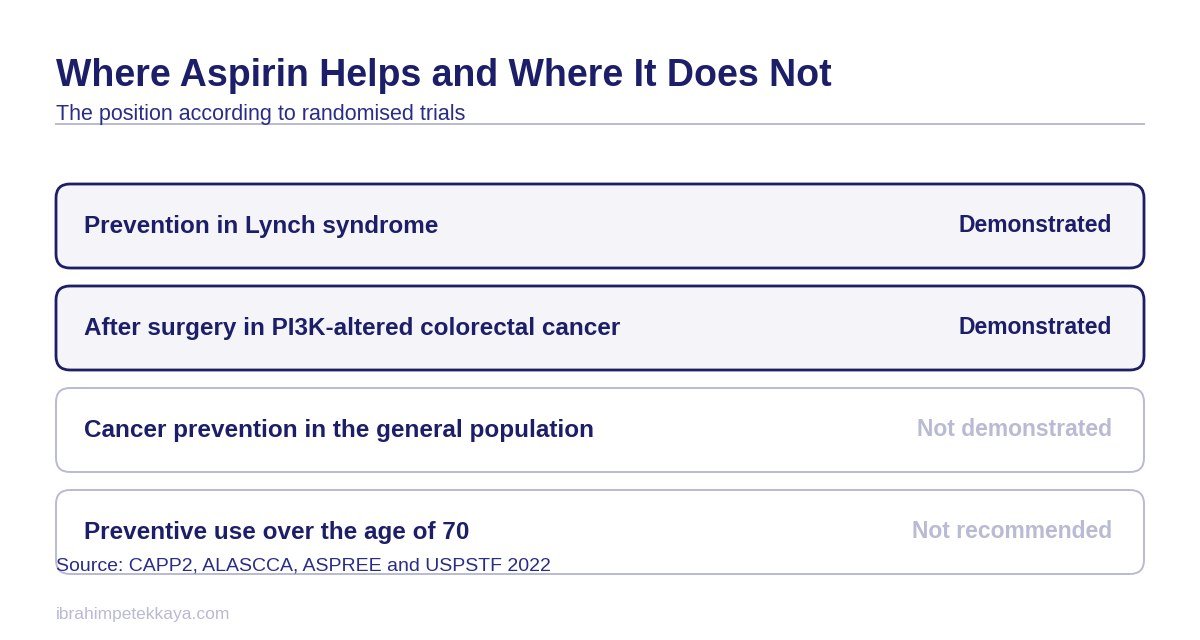
That aspirin reduces the risk of colorectal polyps and cancer in people at high risk has been known for a long time. Trials conducted in Lynch syndrome also showed aspirin to lower cancer risk in carriers.
Alongside this, observational studies suggested that patients whose colorectal tumour carried a PIK3CA mutation did better if they were taking aspirin. Observational data, however, do not establish causation: patients who take aspirin may differ in other ways that also affect outcome. Until now there was no randomised trial confirming the association.
The mechanism was plausible as well. Aspirin suppresses inflammatory pathways and may affect signals that intersect the PI3K pathway. A plausible mechanism is not the same as a demonstrated clinical benefit. The wider picture of aspirin and cancer risk is taken up in aspirin and cancer.
What the ALASCCA Trial Did
ALASCCA is a double-blind, randomised, placebo-controlled trial. It enrolled patients with stage I to III rectal cancer or stage II to III colon cancer in whose tumour a somatic mutation had been found in the genes of the PI3K pathway. Patients received 160 mg of aspirin or placebo daily for three years.
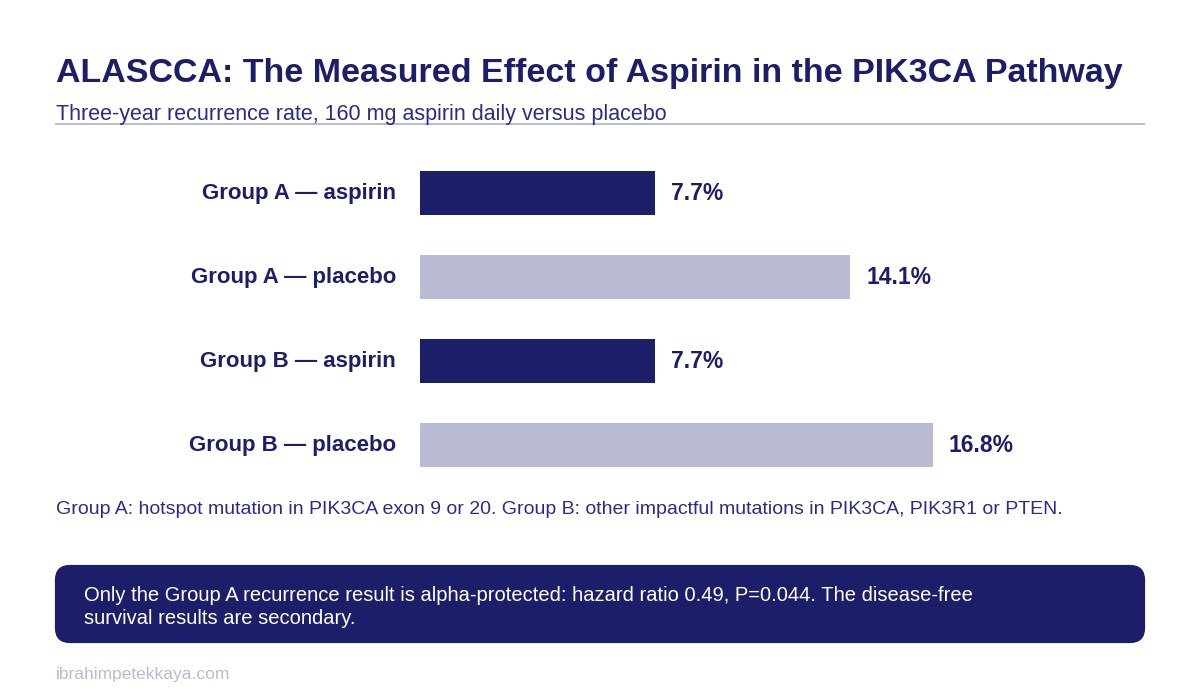
The trial divided the patients into two genetic subgroups. Group A comprised those carrying a hotspot mutation in exon 9 or exon 20 of PIK3CA. Group B comprised those carrying other alterations of moderate or high functional impact in PIK3CA, PIK3R1 or PTEN.
The screening burden is worth noting. Of 2,980 patients with complete genomic data, 1,103, or 37 per cent, were found to have a PI3K pathway alteration, and 626 of those could be randomised. That proportion shows what such an approach requires in practice: every patient has to go through tumour sequencing before anyone knows whether the question even applies to them.
Send Your Reports for Assessment
Share your pathology, imaging and blood results on WhatsApp, or send them by email. Documents are reviewed before the consultation.
What the Results Showed
In Group A the three-year recurrence rate was 7.7 per cent in the aspirin arm and 14.1 per cent in the placebo arm. The hazard ratio was 0.49 with a p value of 0.044. This is the primary endpoint of the trial and the only result that is statistically protected.
In Group B the recurrence rate was 7.7 per cent against 16.8 per cent, with a reported hazard ratio of 0.42. A similar benefit was therefore seen with PI3K pathway alterations other than a PIK3CA mutation, although this comparison was not the trial’s protected endpoint.
The disease-free survival results need reading more cautiously. In Group A three-year disease-free survival was 88.5 per cent against 81.4 per cent, but the hazard ratio for that result was 0.61 with a confidence interval crossing 1, so it was not statistically significant. In Group B the hazard ratio of 0.51 was significant.
That the two subgroups gave results so close to one another is notable. No clear separation in benefit emerged between patients carrying a PIK3CA mutation and patients carrying alterations in other genes of the same pathway. That raises the possibility that the effect depends on the pathway rather than on a single gene, but the trial was not designed to answer that question.
| Result | Group | Status |
|---|---|---|
| Three-year recurrence | Group A | Primary endpoint; hazard ratio 0.49, p value 0.044 |
| Three-year recurrence | Group B | Secondary; hazard ratio 0.42 |
| Disease-free survival | Group A | Secondary; not significant |
| Disease-free survival | Group B | Secondary; hazard ratio 0.51 |
Important: Only the Group A recurrence result is protected against multiple comparisons, and at 0.044 that result is borderline. Every other finding is supportive in nature.
What Aspirin Costs
Aspirin is not a harmless drug. In the trial, serious adverse events were reported in 16.8 per cent of the aspirin arm and 11.6 per cent of the placebo arm. Non-serious adverse events were 43.4 per cent against 35.4 per cent.
The most frequent category of serious event involved the digestive tract: 6.5 per cent in the aspirin arm against 3.9 per cent in the placebo arm. The main publication groups adverse events at this level and gives no detailed bleeding classification, so no specific bleeding percentage is quoted here.
The role aspirin plays in this trial is different from that of a cancer drug. It was not given to shrink a tumour or to treat disease that is present, but to make it harder for any cells left behind after surgery to start growing again. That is why the benefit is measured as a recurrence rate rather than a response rate.
The three-year duration was not chosen at random either. Most recurrences in colorectal cancer appear within the first three years, and the trial aimed at that window. Whether aspirin should be continued beyond three years is a question on which this trial produces no data at all.
- Bleeding from the stomach and bowel is the known and most important risk of aspirin.
- A history of ulcer, the use of blood-thinning drugs and older age all raise that risk.
- The decision cannot be taken without assessing the patient’s bleeding risk separately.
- Blood in the stool, black stools and unexplained weakness must be reported without delay.
The Limits of the Result
The trial’s own limits have to be stated plainly, because this result will be read as a proposal to change practice.
- The primary endpoint is the Group A recurrence rate alone, and at 0.044 it is borderline.
- None of the disease-free survival results is protected against multiple comparisons.
- Of the 1,103 patients found to have a PI3K alteration, only 626 were randomised.
- The trial was conducted in a Scandinavian population, so generalisability is open to question.
- Follow-up runs to three years; longer-term results are not yet available.
These limits do not make the result worthless. Discussing aspirin with a patient who carries a PIK3CA mutation now rests on randomised data rather than on observation. What it does not mean is that every patient with colorectal cancer should be given aspirin; it means the decision cannot be taken without tumour sequencing first.
How such a decision is reached is described on the molecular tumour board page, and the general framework of the disease on the colorectal cancer page. The diet and lifestyle side is taken up in diet and colorectal cancer.
The Aspirin Trial in Colon Cancer
The results of the trial examining what aspirin does to the risk of recurrence in colon cancer.
Send Your Reports for Assessment
Share your pathology, imaging and blood results on WhatsApp, or send them by email. Documents are reviewed before the consultation.
Frequently Asked Questions
What is a PIK3CA mutation?
PIK3CA is one of the most frequently altered genes in the PI3K pathway, which governs a cell’s growth and survival signals. The alteration is found by sequencing the tumour tissue; it is somatic, belonging to the tumour, and is not inherited.
Is a PIK3CA mutation inherited?
No. The alterations considered in this trial are somatic changes that arise in the tumour tissue and are not passed on within a family. Inherited predisposition is assessed by a separate test.
By how much did aspirin reduce the risk of recurrence?
In patients carrying a hotspot mutation in exon 9 or 20 of PIK3CA, the three-year recurrence rate fell from 14.1 per cent to 7.7 per cent, with a reported hazard ratio of 0.49 and a p value of 0.044.
What dose was used?
One hundred and sixty milligrams of aspirin daily, given for three years after surgery. The trial was double-blind and placebo-controlled.
Should every patient with colorectal cancer take aspirin?
No. The benefit was shown only in patients whose tumour carried a PI3K pathway alteration. The presence of that alteration is established by tumour sequencing, and the decision cannot be made without it.
What are the risks of aspirin?
The most important is bleeding from the stomach and bowel. In the trial, serious adverse events were reported in 16.8 per cent of the aspirin arm and 11.6 per cent of the placebo arm, with serious digestive events at 6.5 per cent against 3.9 per cent.
How strong is this result?
The primary endpoint, the Group A recurrence rate, is the only statistically protected result, and at 0.044 it is borderline. The disease-free survival results are secondary, and the difference in Group A was not significant.
Related Articles
Related Pages
Colorectal Cancer
Open the Page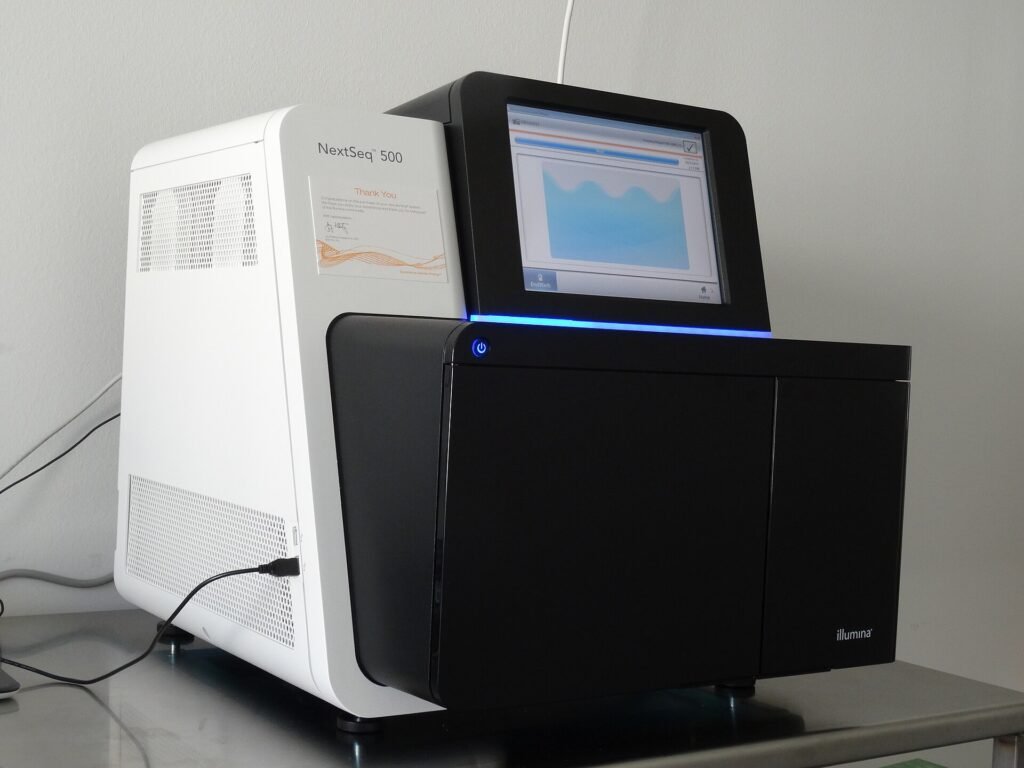
Comprehensive Genomic Profiling
Open the Page
Precision Oncology
Open the Page
Molecular Tumour Board
Open the PageSources
- Martling A, Hed Myrberg I, Nilbert M et al. Low-Dose Aspirin for PI3K-Altered Localized Colorectal Cancer (ALASCCA). N Engl J Med 2025;393(11):1051-1064. Link
- Liao X, Lochhead P, Nishihara R et al. Aspirin Use, Tumor PIK3CA Mutation, and Colorectal-Cancer Survival. N Engl J Med 2012;367(17):1596-1606. Link
- Burn J, Borthwick GM, Elliott F et al. Aspirin for cancer prevention in individuals with Lynch syndrome: first results from the CaPP3 multicentre, randomised, double-blind, non-inferiority trial. Lancet Gastroenterol Hepatol 2026;11(9):760-774. Link
- Rothwell PM, Fowkes FGR, Belch JFF et al. Effect of daily aspirin on long-term risk of death due to cancer: analysis of individual patient data from randomised trials. Lancet 2011;377(9759):31-41. Link
- McNeil JJ, Gibbs P, Orchard SG et al. Effect of Aspirin on Cancer Incidence and Mortality in Older Adults (ASPREE). J Natl Cancer Inst 2021;113(3):258-265. Link
- Ness RM, Llor X, Abbass MA et al. NCCN Guidelines Insights: Colorectal Cancer Screening, Version 1.2024. J Natl Compr Canc Netw 2024;22(7):438-446. Link