
Why Natural Cannot Be Taken to Mean Safe
One of the most frequent and most damaging assumptions in oncology practice is that whatever is natural must be harmless. That a product comes from a plant says nothing about whether it works and nothing about whether it is safe. Plants manufacture powerful chemical compounds, some of them therapeutic and some of them directly poisonous. Making that distinction in a patient on cancer treatment means looking at the evidence rather than at the wording on the packet.
One line has to be drawn clearly at the outset. The cytotoxic drugs developed by purifying plant compounds, among them paclitaxel, vincristine, etoposide and irinotecan, are cornerstones of modern chemotherapy and are genuinely curative in some diseases. They are given at a known dose, with known pharmacokinetics and under medical supervision. They are not what is in dispute.
What is in dispute are the raw botanical products and non-standardised extracts bought from a herbalist, a supplement shelf or the internet. Not one of them has been shown in controlled clinical trials to eliminate a tumour on its own. The weight of the literature sits in cell culture and animal work; randomised human data are either absent or uninterpretable because of problems with method.
None of that means the subject of herbal supplements should simply be closed. There are supportive approaches that can be used for symptom control, but the level of evidence behind each one has to be read separately rather than in bulk. The chemotherapy page sets out how these drugs are chosen, and the patient guide describes the framework followed through treatment.

Chemotherapy or Immunotherapy
The difference between chemotherapy and immunotherapy, and which patient each is chosen for.
What Risks Do Herbal Supplements Carry
Three headings dominate when herbal supplements are taken without supervision. The first is liver toxicity: rises in liver enzymes, tissue damage and, in severe cases, a picture progressing to cirrhosis have all been reported. Because the liver is the organ in which both botanical compounds and cytotoxic drugs are broken down, that load can compound during treatment.
The second is cardiovascular toxicity, with disturbances of rhythm and swings in blood pressure among the reported effects. Several chemotherapy regimens already place a load on the heart, so effects that stack on top of one another can be the reason treatment has to be stopped.
The third, and the most critical from an oncology point of view, is drug interaction. A botanical product can lower the effectiveness of chemotherapy, of a targeted drug or of immunotherapy; or it can raise the blood level of the same drug and with it the toxicity. Both directions harm the patient: one renders the treatment useless, the other makes the burden of side effects heavier.
- A rise in liver enzymes usually produces no symptoms at all and shows up only on a blood test.
- Malaise, nausea, darkening of the urine and yellowing of the skin should be reported without delay.
- Palpitations and swings in blood pressure may mean treatment has to be interrupted.
- Because of the interaction risk, every product in use should be given to the doctor in writing, with its dose.
- Nothing new should be added during treatment without asking the team running it.
Send Your Reports for Assessment
Share your pathology, imaging and blood results on WhatsApp, or send them by email. Documents are reviewed before the consultation.
Does Ginger Help With Nausea
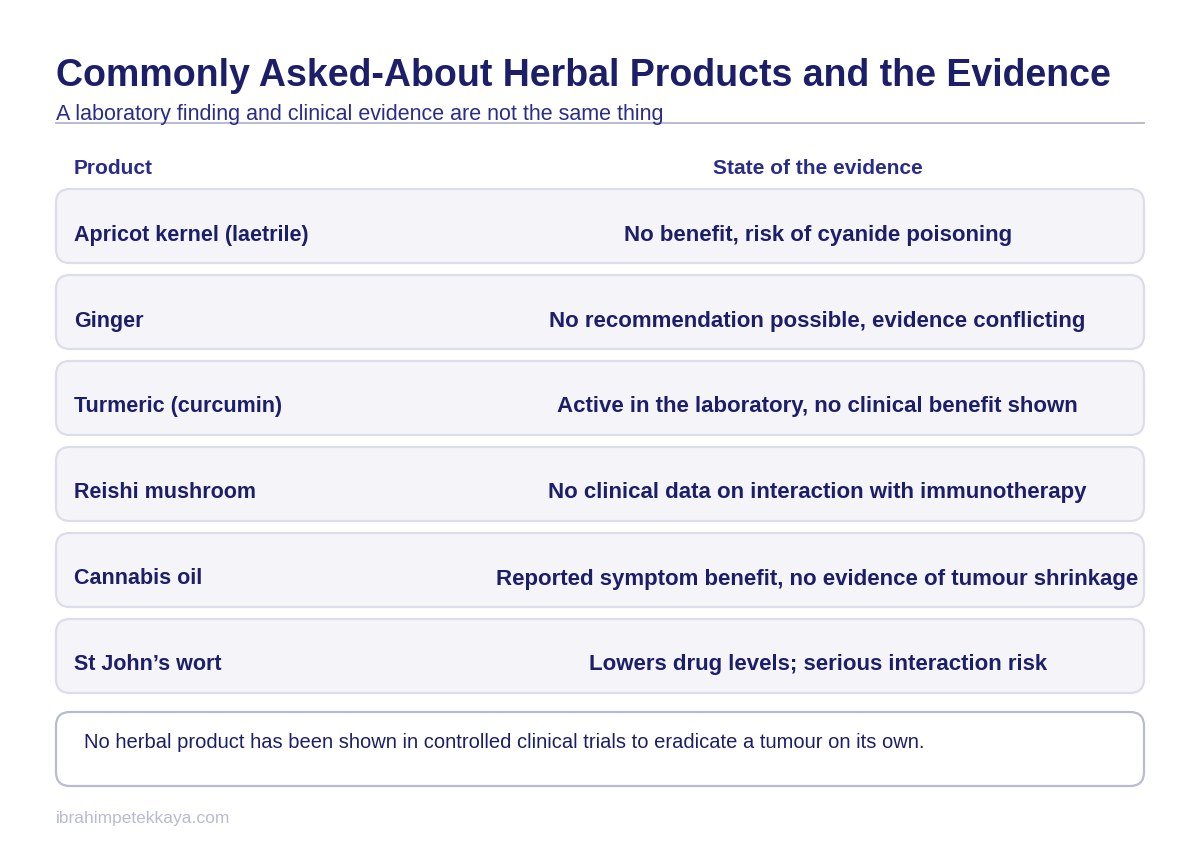
This is the question patients ask most often and the one on which sources are most often misreported. The accurate answer is that ginger has not been shown to work for chemotherapy-induced nausea.
The 2023 MASCC/ESMO consensus guideline uses plain wording here: because the evidence is conflicting, no recommendation could be made for oral ginger. The guideline also states separately that most of the available trials carry serious problems of method. There is no SIO-ASCO recommendation for ginger either.
A meta-analysis published in 2025 pooling 35 randomised trials did report benefit, but 13 of those 35 trials were moxibustion performed with ginger. That is an entirely different intervention from taking ginger by mouth. The result of the meta-analysis therefore cannot be read as evidence that a ginger capsule stops nausea.
Important: Ginger has not been shown to be effective for nausea. The guideline states that no recommendation could be made for oral ginger because the evidence is conflicting, and that wording cannot be softened.
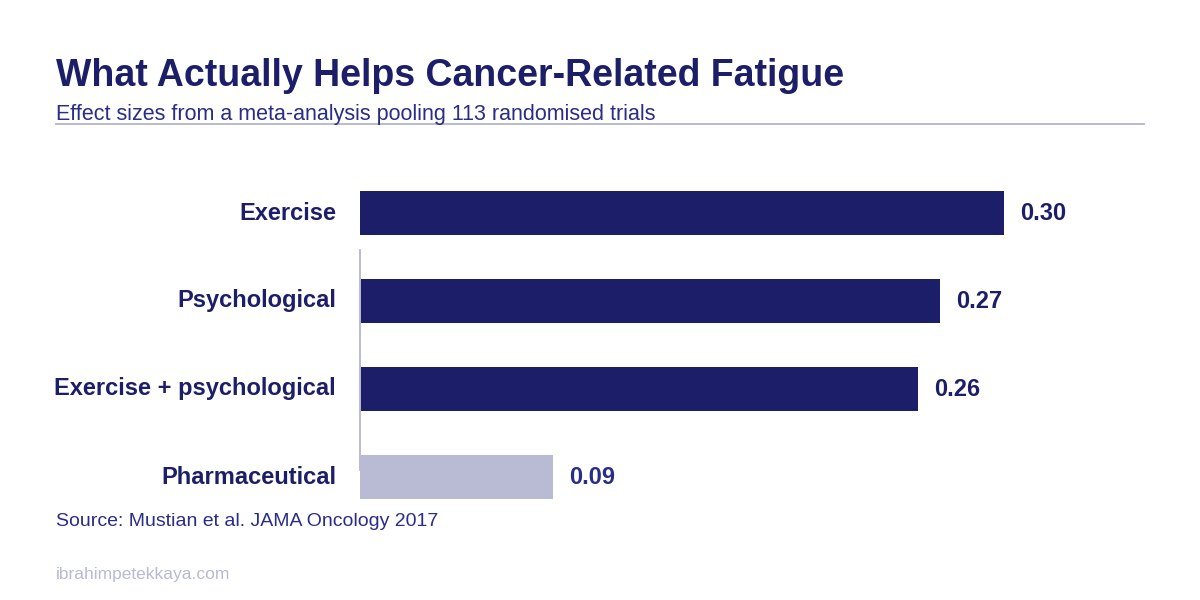
The practical consequence is straightforward. What prevents chemotherapy-induced nausea is the antiemetic drug schedule set out in the guidelines. If nausea persists, the thing to do is to review that schedule rather than add a supplement to it. How symptoms after treatment are approached is covered in why fatigue after chemotherapy does not go away.
Does Reishi Mushroom Affect Immunotherapy
Reishi, or Ganoderma lucidum, is among the most widely used of the products claimed to stimulate the immune system. On whether it interacts with checkpoint inhibitors, however, there is no clinical evidence at all. The question can only be discussed at a theoretical level.
The theoretical case runs as follows. Reishi shows immunomodulatory activity in preclinical models, and because checkpoint inhibitors are drugs that open up the immune response, the possibility of an interaction cannot be excluded. Not being able to exclude something is not the same as having shown it: there are no clinical data in either direction.
For that reason the advice to give is disclosure rather than prohibition. A patient on immunotherapy who is taking reishi should say so to the team running the treatment, which then takes that information into account when assessing immune-related adverse events. How those events are managed is described on the immunotherapy page.
On whether reishi itself treats cancer there is a Cochrane review. It reported that the product is generally well tolerated, but that the evidence is insufficient to justify using it as a first-line treatment. The safety side is therefore comparatively reassuring; the efficacy side is empty.
What Is Known About Cannabis and Curcumin
For cannabis, the PDQ summary of the national cancer institute lists the possible benefits: a reduction in nausea, an effect on appetite, relief of pain and improvement in the quality of sleep. These are benefits reported at the level of symptoms.
Any tumour-shrinking effect, by contrast, has been seen only in laboratory and animal studies. There is no sound clinical evidence of tumour shrinkage in humans. The same summary also states that the data are insufficient to grade cannabis for chemotherapy-induced nausea, so the word proven cannot be used of it for that indication either.
For curcumin the picture is similar. A broad range of activity has been described in preclinical studies, but clinical benefit against cancer in humans has not been proven. The standard criticism is that its bioavailability is low when taken by mouth: only a limited proportion of what is swallowed reaches the bloodstream.
There is a contradiction here that needs saying plainly. Although curcumin is a product with no demonstrated clinical benefit, it stands out as the most used of the six botanical products in the liver exposure study discussed below. Use is heaviest exactly where the evidence is weakest.
When the Blood Tests Are Fine but the Fatigue Continues
How persistent fatigue is assessed when the blood results themselves look normal.
How Widespread Is Exposure From the Liver Point of View
One study is frequently misreported under this heading, and the figure needs putting in its proper frame. In the data of the United States national nutrition and health survey covering 2017 to March 2020, 9,685 adults were examined.
The study estimated the number of adults who had used at least one of six botanical products in the previous 30 days at approximately 15.6 million. The six were turmeric or curcumin, green tea extract, Garcinia cambogia, black cohosh, red yeast rice and ashwagandha.
That level was found to be comparable with two widely used classes of medicine: 14.0 million for simvastatin and 14.8 million for non-steroidal painkillers. In other words these products are used on the same order of magnitude as common prescription drugs.
Important: This is an exposure prevalence study, not an incidence study. Reading it as “15.6 million people are at risk of liver failure” is not what the source says.
What the study means for oncology is this: herbal supplements are used widely enough that the doctor has to ask. Patients do not volunteer them, so they do not appear on the medication list; because they do not appear, interaction and liver load are not taken into account. Asking about supplements should therefore be part of asking about medicines at the first consultation.
| Product | Status of the evidence |
|---|---|
| Ginger | Conflicting evidence; the guideline could make no recommendation |
| Reishi | No clinical evidence of interaction; a theoretical possibility only |
| Cannabis | Benefit reported at symptom level; no sound evidence of tumour shrinkage |
| Curcumin | Broad preclinical activity; clinical benefit not proven |
| Laetrile | Risk-benefit balance clearly unfavourable |
| St John’s wort | Serious drug interaction documented |
Why Laetrile and Apricot Kernels Are Dangerous
Laetrile, amygdalin and apricot kernels are different names for the same subject. The 2015 Cochrane review concluded that the risk-benefit balance for this treatment is clearly unfavourable. The defining study in the field is the clinical trial published in 1982.
The toxicity overlaps with cyanide poisoning. Reported effects include nausea and vomiting, headache, dizziness, bruising of the skin, liver damage, low blood pressure, drooping of the eyelid, nerve involvement with loss of balance, fever, confusion, coma and death.
A separate warning is needed here: laetrile taken by mouth is more toxic than the same agent given intravenously. Among the factors that increase toxicity are raw almonds, crushed fruit kernels, foods containing beta-glucosidase such as celery, peaches, bean sprouts and carrots, and high-dose vitamin C taken by mouth.
The harm here is therefore not theoretical and it is fatal. The risk is defined under the headings of liver damage and fatal cyanide poisoning. The evidence needed to consider this product as a cancer treatment does not exist; what does exist is evidence of harm.
St John’s Wort: The Textbook Example
The textbook example of a herb-drug interaction in oncology is St John’s wort. Hyperforin, one of the compounds the plant contains, induces both the CYP3A4 enzyme and the P-glycoprotein transporter. Accelerating those two routes together lowers the level in the body of the drugs carried and broken down by them.
The interaction has been documented with two drugs: irinotecan and imatinib. Both are widely used in oncology, and in both a fall in blood level means a direct loss of effect. No specific percentage reduction is given here; what is reported is that the interaction is documented.
This example shows why the mechanism matters. Even a product that looks harmless on its own can render a treatment useless by altering how a drug is absorbed and broken down. Because most targeted drugs are metabolised through these enzyme routes, the risk is particularly high in that group. How these drugs work is set out on the targeted therapy page.
St John’s wort is not the only example. Grapefruit juice, certain fruit extracts and various botanical mixtures can act through the same enzyme routes. Asking should therefore not stop at “are you taking any medicines” but should cover every product in the form of a tea, a powder, a capsule or drops.
Stress, Cortisol and the Immune System
The limits within which the effect of stress on hormone balance and immunity can be discussed.
Three Questions to Ask About Herbal Supplements
The right question is not whether a given plant is good for cancer. The right questions are three, and each one needs an answer of its own.
- Is this supplement appropriate to my symptom? There are guideline approaches for nausea, fatigue and pain, and a supplement does not take their place.
- At what dose is it safe? For botanical products a standard dose is often undefined, and the amount printed on the packet does not guarantee the active substance inside it.
- Most important of all: does it interact with the cancer treatment I am on? The answer varies from product to product and from drug to drug, and only the team running the treatment can give it.
What the three questions have in common is that the answer lies in the treatment file rather than in the patient. Which drug is broken down by which enzyme route, what level liver and kidney function are at, and which side effect is being monitored all have to be known before a decision about a supplement can be made.
In practice the single most useful thing a patient can do is to bring the name, the dose and the duration of use of every product in writing to the consultation. A photograph of the box is enough. That list is then assessed alongside the medication list, and stopped before treatment if need be.
The only consequence of not telling the doctor about herbal supplements is that an interaction goes unnoticed. When treatment goes worse than expected and the reason is being looked for, a product that does not appear on the list is never taken into account. An honest list is worth as much to the safety of treatment as a laboratory result.
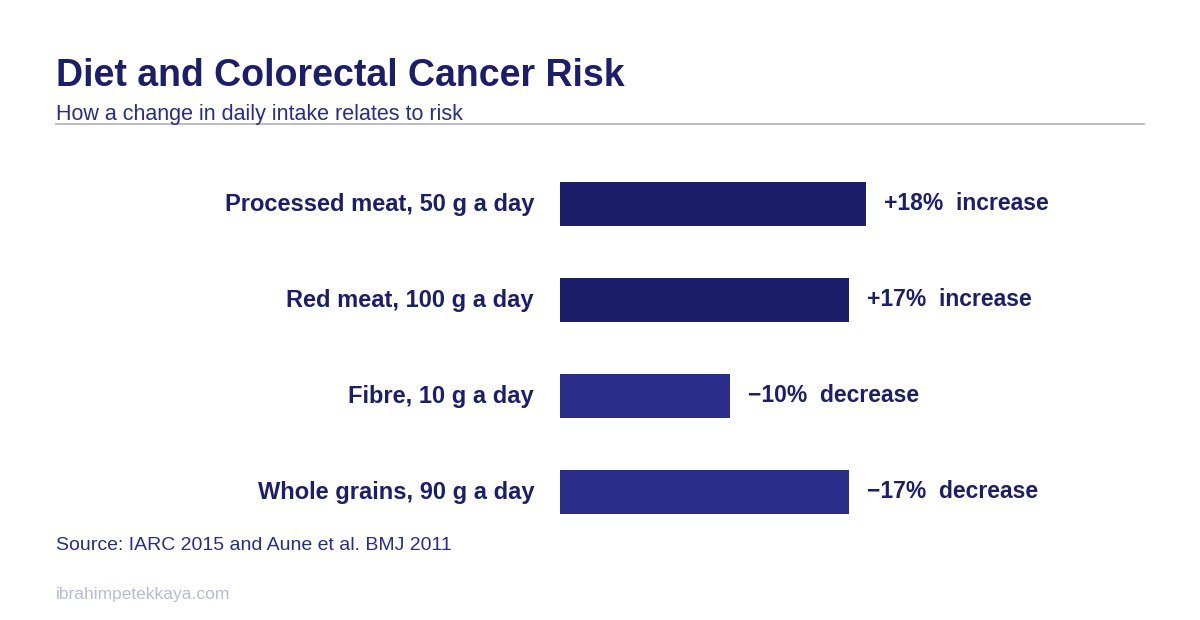
The general framework of the decision is set out on the treatment pathway page. For questions on the nutrition side, diet and colorectal cancer is the relevant article, and for sleep and stress, stress and cancer.
Send Your Reports for Assessment
Share your pathology, imaging and blood results on WhatsApp, or send them by email. Documents are reviewed before the consultation.
Frequently Asked Questions
Do herbal supplements treat cancer?
No. No raw botanical product has been shown in controlled clinical trials to eliminate a tumour on its own. The cytotoxic drugs developed by purifying plant compounds, among them paclitaxel, vincristine, etoposide and irinotecan, are a separate matter and are genuinely curative in some diseases.
Does ginger help with chemotherapy nausea?
It has not been shown to. The 2023 MASCC/ESMO consensus states that no recommendation could be made for oral ginger because the evidence is conflicting. Of the 35 trials in the 2025 meta-analysis that reported benefit, 13 were moxibustion performed with ginger, which is a different intervention.
Does reishi mushroom interact with immunotherapy?
There is no clinical evidence on this at all. Because reishi shows immunomodulatory activity in preclinical models an interaction cannot be excluded, but there are no clinical data in either direction. A patient on immunotherapy should always disclose that they are taking it.
Does curcumin work in cancer?
A broad range of activity has been described in preclinical studies, but clinical benefit against cancer in humans has not been proven. The standard criticism is that its bioavailability is low when it is taken by mouth.
Can apricot kernels or laetrile be used?
They should not be. The 2015 Cochrane review found the risk-benefit balance clearly unfavourable. The toxicity overlaps with cyanide poisoning, and liver damage and fatal cyanide poisoning have been reported. The oral form is more toxic than the intravenous one.
Which herbal product interacts with chemotherapy?
The best documented example is St John’s wort. The hyperforin it contains induces the CYP3A4 enzyme and the P-glycoprotein transporter, so the blood level of drugs carried by those routes falls. The interaction is documented with irinotecan and imatinib.
What do I need to tell my doctor?
The name, the dose and the duration of use of every product. That includes everything in the form of a tea, a powder, a capsule or drops. A photograph of the box is enough; the list is then assessed alongside the medication list.
Related Articles
Related Pages
Chemotherapy
Open the Page
Immunotherapy
Open the Page
Targeted Therapy
Open the Page
Patient Guide
Open the PageSources
- Carlson LE, Ismaila N, Addington EL et al. Integrative Oncology Care of Symptoms of Anxiety and Depression in Adults With Cancer: SIO-ASCO Guideline. J Clin Oncol 2023;41(28):4562-4591. Link
- Bower JE, Lacchetti C, Alici Y et al. Management of Fatigue in Adult Survivors of Cancer: ASCO-Society for Integrative Oncology Guideline Update. J Clin Oncol 2024;42(20):2456-2487. Link
- Lin CY, Huang SH, Tam KW et al. Efficacy and Safety of Ginger on Chemotherapy-Induced Nausea and Vomiting: A Systematic Review and Meta-analysis of Randomized Controlled Trials. Cancer Nurs 2025;48(6):455-466. Link
- Molassiotis A, Affronti ML, Fleury M et al. 2023 MASCC/ESMO consensus antiemetic guidelines related to integrative and non-pharmacological therapies. Support Care Cancer 2023;32(1):30. Link
- National Cancer Institute. Cannabis and Cannabinoids (PDQ) - Health Professional Version, 13 Mayıs 2025. Link
- National Cancer Institute. Laetrile/Amygdalin (PDQ) - Health Professional Version, 14 Haziran 2022. Link
- Milazzo S, Horneber M. Laetrile treatment for cancer. Cochrane Database Syst Rev 2015;2015(4):CD005476. Link
- Moertel CG, Fleming TR, Rubin J et al. A clinical trial of amygdalin (Laetrile) in the treatment of human cancer. N Engl J Med 1982;306(4):201-206. Link
- Likhitsup A, Chen VL, Fontana RJ. Estimated Exposure to 6 Potentially Hepatotoxic Botanicals in US Adults. JAMA Netw Open 2024;7(8):e2425822. Link
- Jin X, Ruiz Beguerie J, Sze DM, Chan GC. Ganoderma lucidum (Reishi mushroom) for cancer treatment. Cochrane Database Syst Rev 2016;4(4):CD007731. Link
- Mathijssen RH, Verweij J, de Bruijn P et al. Effects of St. John's wort on irinotecan metabolism. J Natl Cancer Inst 2002;94(16):1247-1249. Link
- Frye RF, Fitzgerald SM, Lagattuta TF et al. Effect of St John's wort on imatinib mesylate pharmacokinetics. Clin Pharmacol Ther 2004;76(4):323-329. Link