
Fibre and Whole Grains
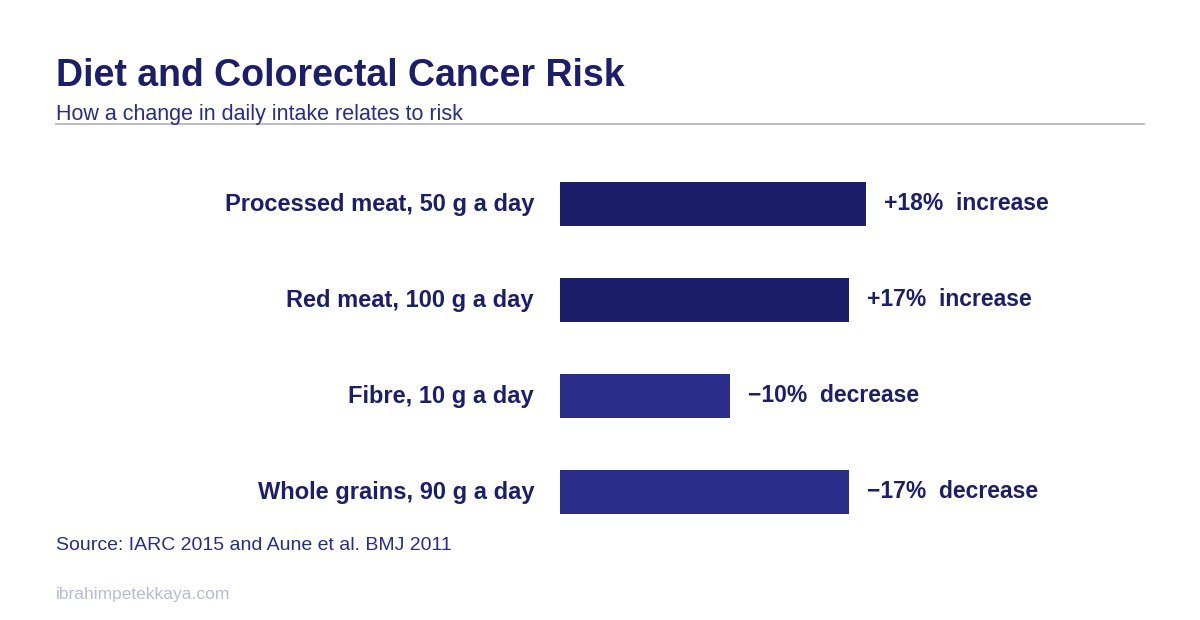
The protective effect of fibre is the most consistent finding in this field. In the Aune pooled analysis of prospective studies, every additional 10 grams of total dietary fibre a day was associated with roughly a 10 per cent lower risk of colorectal cancer. The same association held for cereal fibre, while fibre from fruit and vegetables showed no significant relationship.
The effect is even clearer for whole grains: three servings a day, about 90 grams, were associated with a 17 per cent lower risk. International expert reports list both fibre and whole grains among the factors that reduce risk.

Where Fibre Fits in Bowel Health
This post explains the effects of daily fibre intake on bowel function and the gut microbiome.
What Fibre Does in the Bowel
Fibre does not act through a single route. The first is mechanical: it increases stool bulk and shortens transit time, so harmful compounds spend less time against the mucosa. The second is dilution, since greater bulk spreads the same quantity through a larger volume.
The third route is bacterial fermentation. Bacteria in the large bowel break fibre down into short-chain fatty acids, the main energy source for the cells lining the colon and part of what keeps the bowel barrier intact. Fibre is therefore not bulk alone but an input that changes the bowel environment.
This offers one explanation for the difference between cereal fibre and fibre from fruit and vegetables. Solubility, fermentability and the amount taken each day all vary by source, and the association holding for cereal fibre while not reaching significance for the others may follow from that. Observational data cannot separate the reason with certainty.
Red and Processed Meat
In 2015 the International Agency for Research on Cancer classified processed meat as carcinogenic to humans. In the same evaluation, red meat was classified as probably carcinogenic to humans.
Put in figures, eating 50 grams of processed meat a day was associated with 18 per cent higher colorectal cancer risk, and 100 grams of red meat a day with about 17 per cent higher risk. Fifty grams is roughly two thin slices of cured meat or one sausage.
Important: A carcinogen classification describes the strength of the evidence, not the size of the risk. Processed meat sitting in the same category as tobacco does not mean it carries the same level of risk.
Where the risk comes from has also been studied. The nitrite and nitrate compounds used in processed meat can be converted in the gut into substances capable of damaging cell DNA, and cooking at high temperature or over a direct flame produces similar compounds. So how it is cooked also counts: boiling and baking generate fewer of them than grilling and frying.
A common misunderstanding is that the increase applies to every individual equally. The figures are relative increases at population level, while a person’s own risk is set alongside age, family history, bowel disease and other habits. Diet and colorectal cancer is read within the whole risk picture, not on its own.
In practice this means taking processed meat out of the daily routine and limiting red meat across the week, with pulses, fish and whole grains in its place.
The Gut Microbiome
The relationship between the organisms living in the bowel and colorectal cancer is among the most studied subjects of recent years, and the bacterium that has drawn most attention is Fusobacterium nucleatum.
In the Mima study examining 1,069 colorectal cancer specimens, DNA from this bacterium was found in 13 per cent of tumours, and patients with high amounts had a higher risk of death from the cancer. Animal studies showed that the bacterium increases the number of tumours and alters the immune cells around them.
These findings should be read carefully: what has been shown in humans is an association, and what has been shown in animals is a mechanism. Together they are not yet enough to say "fix the microbiome and prevent cancer". What is true today is that the microbiome is shaped by diet, with fibre at the centre of that.
What sets the direction of that shaping is the everyday pattern, so expectations built on a single product are misplaced and the target is the diet as a whole.
Send Your Reports for Assessment
Share your pathology, imaging and blood results on WhatsApp, or send them by email. Documents are reviewed before the consultation.
Alcohol and Body Weight
Alcohol is among the risk factors for colorectal cancer with the strongest evidence, the relationship being clearly defined from about 30 grams of ethanol a day. Worldwide, an estimated 4.1 per cent of new cancer cases in 2020 were attributable to alcohol.
The effect does not depend on the type of drink; what matters is the amount of ethanol, so distinctions such as wine being less harmful have no counterpart in cancer risk. In patients already diagnosed, alcohol is a separate conversation, because it can interact with treatment drugs and add to the load on the liver.
Excess body weight is also a risk factor with strong evidence, and weight management is the third leg of dietary change after fibre and meat.
Diet and Colorectal Cancer After Diagnosis
This is different from prevention and much less well known. In the Song study following 1,575 patients diagnosed with colorectal cancer, every additional 5 grams of fibre a day was associated with roughly a fifth lower risk of death from the cancer, and patients who increased their intake after diagnosis did better than those who did not.
It is one of the stronger pieces of evidence that diet can still change something after a diagnosis, but it is not a treatment in itself and does not replace oncological treatment.
After diagnosis the first job of diet is not to lower risk but to keep treatment sustainable. Loss of appetite, altered taste and nausea can occur together during chemotherapy, and meeting the daily energy and protein target then comes before the fibre target. Once weight loss begins it is hard to reverse.
| Item | Recommendation |
|---|---|
| Energy | About 25-30 kcal per kilogram a day |
| Protein | At least 1 g per kilogram a day, up to 1.5 g where possible (this target changes in kidney failure, liver disease and on dialysis) |
| Fibre | Increased gradually, with cereal fibre prioritised |
| Processed meat | Removed from regular consumption |
| Alcohol | Limited |
| Activity | Regular and sustainable |
Bowel habits can change after surgery, which is why fibre is increased gradually. The whole treatment process is described on the colorectal cancer page.
Where Physical Activity Fits
Alongside diet sits a subject with even stronger evidence: physical activity. In the randomised CHALLENGE trial, in patients who had completed surgery and chemotherapy, a three-year structured exercise programme produced markedly better disease-free survival, 80.3 per cent against 73.9 per cent at five years. A difference in overall survival was seen as well.
This is one of the first examples in colon cancer of a lifestyle change translating into survival in a randomised trial. The programme itself is nothing extraordinary: a walking-based plan, done regularly, with intensity built up over time.
How the programme is built and the scope of the trial are set out in exercise in colon cancer.
The Importance of Movement During Treatment
This post explains where regular physical activity fits during treatment and how to build it into daily life.
Which Studies These Figures Come From
The figures for fibre, whole grains, red meat and alcohol all come from pooled observational studies. Participants are not assigned a diet; they are followed with the habits they already have. People with a high fibre intake also tend to eat fewer processed products, move more and manage their weight better, and analyses adjust for those factors without separating them completely.
What follows is that the quoted figures are association figures: no randomised trial shows that raising fibre intake lowers risk by that amount. The recommendation is still strong, because the association is consistent, dose-dependent and fits a known mechanism, but the language has to keep that limit visible.
The finding on fibre intake after diagnosis also comes from a follow-up study, and patients who increased their intake doing better is not proof that the increase produced the difference. The same limit applies to the microbiome: an association in humans and a mechanism in an animal model do not show that changing the microbiome prevents cancer.
Claims That Are Not Supported
Most questions in this area are about approaches that do not work, and clinical nutrition guidelines are clear about them.
- Diets that restrict energy intake are not recommended in patients who are malnourished or at risk of it.
- There are no clinical trials demonstrating a benefit of a ketogenic diet in patients with cancer.
- Fasting before, during or after anticancer treatment is not recommended.
- High-dose vitamins and minerals are discouraged in the absence of a specific deficiency.
- Sugar does not feed cancer in a way that cutting it out would starve a tumour; restriction can instead accelerate weight loss.
Another common claim is that a single food is protective on its own. Rather than loading up on one item, what works is changing the pattern as a whole: more plant foods on the plate, fewer processed products and controlled portions.
Herbal products and supplements are the most asked part of this subject. Natural does not mean safe, and some products can change the blood levels of chemotherapy drugs. The evidence and the interaction risk are covered in herbal supplements in cancer.
What these share is the risk of damaging a nutritional state that is already fragile, and weight loss during treatment directly affects the ability to continue it. The drug side of prevention is covered in aspirin and cancer.
Frequently Asked Questions
Does diet really change the risk of colorectal cancer?
Yes. Every additional 10 grams of fibre a day is associated with roughly 10 per cent lower risk, and 90 grams of whole grains a day with 17 per cent lower risk. Processed meat and alcohol increase risk.
How much fibre should I eat a day?
The general aim is to increase fibre gradually and prioritise cereal sources. A sudden increase can cause bloating, so after surgery in particular it should be built up slowly.
Should I give up red meat completely?
No. Red meat is limited across the week; the habit worth removing is regular consumption of processed meat.
Does sugar feed cancer?
All cells use glucose, and cutting sugar does not starve a tumour. Excess sugar can raise risk through weight gain, but restrictive diets can be harmful during treatment.
Should I take probiotics?
The relationship between the gut microbiome and colorectal cancer is under study, but no data show that a particular probiotic prevents or treats cancer. What most shapes the microbiome is the everyday diet.
Is there a benefit to changing diet after diagnosis?
In a follow-up study, patients who increased their fibre intake after diagnosis had a lower risk of death from the cancer. Dietary change runs alongside treatment rather than replacing it.
Is exercise more important than diet?
Diet and exercise complement each other, but the evidence for exercise in colon cancer is stronger: in a randomised trial a structured exercise programme improved both disease-free and overall survival.
Related Articles
Why Fatigue After Chemotherapy Does Not Go Away
Open the Page
ctDNA Testing After Surgery
Open the PageRelated Pages
Colorectal Cancer
Open the Page
Gastrointestinal Cancers
Open the Page
Patient Guide
Open the Page
Chemotherapy
Open the PageSources
- Aune D, Chan DSM, Lau R et al. Dietary fibre, whole grains, and risk of colorectal cancer: systematic review and dose-response meta-analysis of prospective studies. BMJ 2011;343:d6617. Link
- World Cancer Research Fund / American Institute for Cancer Research. Diet, Nutrition, Physical Activity and Colorectal Cancer. Continuous Update Project Expert Report, 2018. Link
- Bouvard V, Loomis D, Guyton KZ et al. Carcinogenicity of consumption of red and processed meat. Lancet Oncol 2015;16(16):1599-1600. Link
- International Agency for Research on Cancer. IARC Monographs evaluate consumption of red meat and processed meat. Press Release N° 240, 2015. Link
- Song M, Wu K, Meyerhardt JA et al. Fiber Intake and Survival After Colorectal Cancer Diagnosis. JAMA Oncol 2018;4(1):71-79. Link
- Mima K, Nishihara R, Qian ZR et al. Fusobacterium nucleatum in colorectal carcinoma tissue and patient prognosis. Gut 2016;65(12):1973-1980. Link
- Kostic AD, Chun E, Robertson L et al. Fusobacterium nucleatum Potentiates Intestinal Tumorigenesis and Modulates the Tumor-Immune Microenvironment. Cell Host Microbe 2013;14(2):207-215. Link
- Muscaritoli M, Arends J, Bachmann P et al. ESPEN practical guideline: Clinical Nutrition in cancer. Clin Nutr 2021;40(5):2898-2913. Link
- Courneya KS, Vardy JL, O’Callaghan CJ et al. Structured Exercise after Adjuvant Chemotherapy for Colon Cancer (CHALLENGE). N Engl J Med 2025;393(1):13-25. Link
- Rock CL, Thomson CA, Sullivan KR et al. American Cancer Society nutrition and physical activity guideline for cancer survivors. CA Cancer J Clin 2022;72(3):230-262. Link
- Lauby-Secretan B, Scoccianti C, Loomis D et al. Body Fatness and Cancer — Viewpoint of the IARC Working Group. N Engl J Med 2016;375(8):794-798. Link
- Rumgay H, Shield K, Charvat H et al. Global burden of cancer in 2020 attributable to alcohol consumption: a population-based study. Lancet Oncol 2021;22(8):1071-1080. Link