
Stress and Cancer: Does Stress Cause Cancer?
The honest answer here is short: well-designed studies have not shown that stress causes cancer.
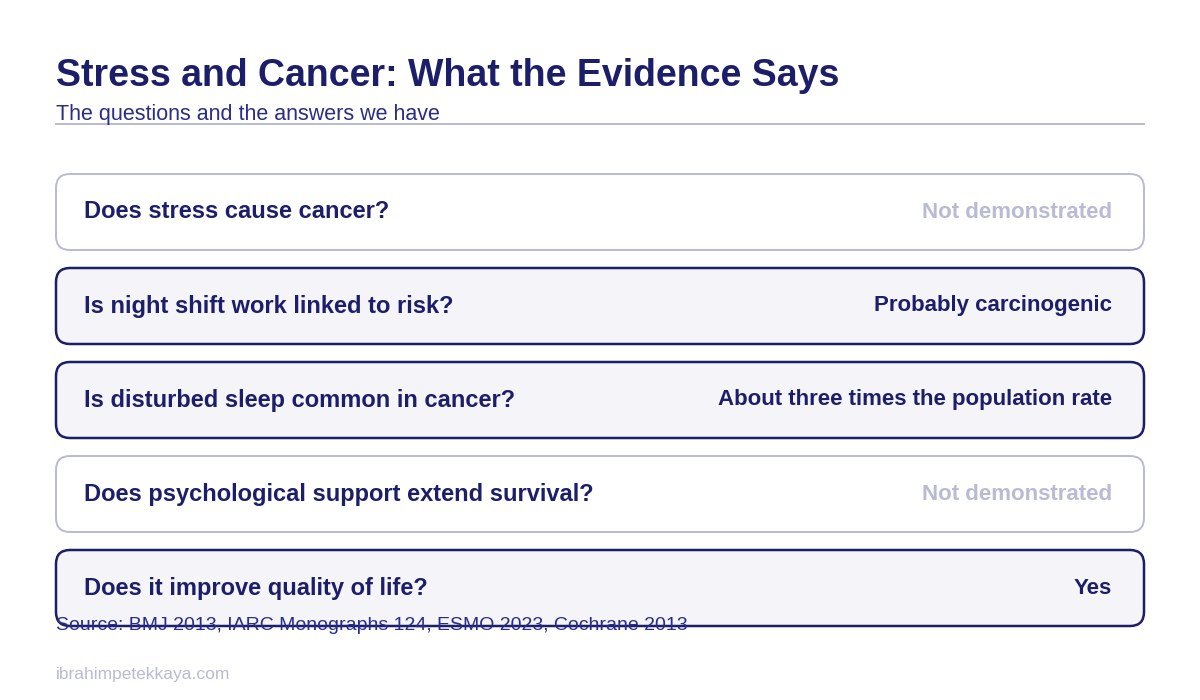
In the Heikkilä European analysis following 116,000 people, in whom 5,765 new cancers occurred, there was no association between work stress and overall cancer risk, and looking separately at colorectal, lung, breast and prostate cancer produced no significant association either.
In the Schoemaker United Kingdom study following 106,000 women, neither self-reported frequency of stress nor adverse life events in the preceding five years showed a consistent association with breast cancer risk. Isolated subgroup signals pointed in opposite directions, which is what many comparisons produce.
Important: Telling a patient their cancer was caused by stress is not evidence-based and it causes harm. Blaming a person’s emotions for the disease helps no one and changes no outcome.
Does Stress Affect the Course of the Disease?
There is a widespread belief here too: that a fighting spirit produces better outcomes. In the Petticrew systematic review of 26 studies, most of the ten on fighting spirit and the twelve on helplessness found no significant association with survival or recurrence, and the positive findings came from smaller, methodologically weaker studies.
The conclusion of that review is explicit: there is no consistent evidence that psychological coping styles are related to survival or recurrence in cancer, and patients should not be pressured into adopting one.
The largest review pointing the other way did report that stress-related psychosocial factors were associated with poorer survival. The same review noted that stressful life events did not increase cancer incidence, that the association ran through personality traits and depression, and that publication bias was present.
Send Your Reports for Assessment
Share your pathology, imaging and blood results on WhatsApp, or send them by email. Documents are reviewed before the consultation.
Send Your Reports for Assessment
Share your pathology, imaging and blood results on WhatsApp, or send them by email. Documents are reviewed before the consultation.
The Pathways Stress Uses in the Body
The stress response runs along two main routes: the hormonal axis ending in cortisol release from the adrenal gland, and the sympathetic nervous system, working through adrenaline and noradrenaline. Against a short-lived threat these prepare the body, with heart rate, blood sugar and attention all rising. As long as the response is temporary it causes no harm.
When it lasts, the picture changes. Cortisol that stays persistently high affects the number and function of immune cells, disturbs sleep and shifts the balance of the inflammatory response, and sustained sympathetic activity acts on blood vessels and the tissue environment. The effect seen in laboratory animals running through the sympathetic system, and disappearing with a beta blocker, fits that frame.
A plausible mechanism is not the same as one demonstrated in people. In an animal model the severity and duration of stress are set by the experimenter; in humans stress is measured by self-report, and the same event imposes very different loads on two people. That is why mechanism and clinical finding are kept apart in the stress and cancer debate.
What Is Seen in the Laboratory
In animals the picture is different. In a breast cancer model, chronic stress increased spread to distant organs thirty-fold without changing the size of the primary tumour. The effect ran through the sympathetic nervous system and was abolished by a beta blocker.
| Question | What the evidence shows |
|---|---|
| Does stress cause cancer? | Not demonstrated |
| Does coping style change the course? | No consistent evidence |
| Is night shift work linked to risk? | Classified as probably carcinogenic |
| Is disturbed sleep common? | About three times the population rate |
| Does psychological support improve quality of life? | Yes |
| Does psychological support extend survival? | Not demonstrated |
These findings matter but are easy to misread. Current reviews treat stress as a factor that may accelerate progression rather than initiate cancer, and note that the clinical findings in humans are inconsistent.
A mechanism shown in mice is not enough to say stress causes cancer in people, and the use of beta blockers in cancer remains investigational.

Stress, Cortisol and Immunity
Under prolonged stress cortisol rises and the regular functioning of the immune system can be suppressed. This post explains the biology behind that.
How Stress Is Measured
The largest limitation in this field is measurement. In follow-up studies stress is usually captured by self-report questionnaire at a single point in time, and a question asked once cannot represent all the years of a long follow-up. The same workload is also a different load for two people: what is measured is not the event but how the person reports it.
The second limitation is retrospective recall. Someone looking back after a diagnosis remembers adverse events more vividly, and that makes the association look stronger than it is. Studies built on data collected before diagnosis are therefore regarded as more reliable.
The third is the number of comparisons made. Where dozens of subgroups are examined, some results appear significant by chance, and subgroup signals pointing in opposite directions is the mark of that. Publication bias works the same way, since positive studies are published more readily. These three limits are why the evidence on stress and cancer is read cautiously.
Night Shift Work
The International Agency for Research on Cancer classified night shift work as probably carcinogenic to humans. That classification was re-evaluated in 2019 and retained.
The rationale can be summarised as follows: the evidence in humans was limited, though positive associations were observed for cancers of the breast, prostate, colon and rectum; there was sufficient evidence in animals that disrupting the light-dark schedule is carcinogenic; and mechanistic evidence in experimental systems was strong.
For shift workers the practical point is not removing the risk but protecting the sleep schedule: fixed sleep times, daytime sleep in a dark room, and keeping to the screening calendar. These measures have not been shown to lower cancer risk; they are general sleep advice.
Important: This classification concerns hazard identification. It does not describe the size of the risk to an individual worker. Working night shifts does not mean you will develop cancer.
Sleep
Sleep problems are very common in patients with cancer and are usually assumed to be temporary. In the Savard study following 962 patients, 59 per cent had insomnia around the time of surgery; eighteen months later that had fallen to 36 per cent, still around three times the population rate.
Insomnia tended to persist: in 37.6 per cent of patients meeting the diagnostic criteria the problem continued through all eighteen months. The European guideline likewise reports insomnia in cancer patients at roughly three times the population rate.
One explanation for insomnia persisting is that what starts the problem and what sustains it differ. At the outset, pain, steroid-containing treatments, hospital routine and anxiety break sleep; once those pass, long periods lying awake and daytime naps sustain the pattern on their own. The second group is what a cognitive behavioural approach targets.
The relationship between sleep duration and outcome should be read carefully. In a pooled analysis of 32 studies, long sleep duration was associated with cancer-specific mortality, while the association for short sleep was borderline. The likeliest explanation is that long sleep is a marker of advanced disease, weight loss or treatment burden, a consequence rather than a cause.
Where Sleep Fits During Treatment
The effects of disturbed sleep on daily life and on the treatment process, and what can be done about it.
What Helps
The best-evidenced approach to insomnia is not a drug. The European guideline recommends cognitive behavioural therapy as the standard of care for insomnia in cancer survivors, at the highest level of evidence.
Behind that recommendation sits the Nissen analysis pooling 61 randomised trials and 6,528 patients, also discussed under fatigue. Cognitive behavioural therapy produced a marked improvement in insomnia severity that persisted at follow-up, with improvements in fatigue, depressive symptoms and anxiety. In the same analysis it outperformed bright light therapy, sleep medication, melatonin and exercise.
The overall effect of psychological support has also been measured. In the Faller analysis of 198 randomised trials and 22,238 patients, individual psychotherapy, group therapy and psychoeducation all had significant effects on emotional distress and quality of life.
Saying together what psychological support changes and what it does not sets the expectation correctly: a measurable improvement in quality of life is expected, a gain in length of life is not.
Important: What has not been shown is that psychological support extends survival. In a review in metastatic breast cancer, a signal at one year disappeared by five years and the data were limited. The accurate statement is that psychological support improves quality of life; it has not been shown to lengthen life.
How Sleep and Support Are Handled in Practice
- Sleep is treated as a heading in its own right at follow-up.
- The things that interrupt sleep, pain, nausea and hot flushes, are assessed one by one.
- Guidelines put cognitive behavioural approaches first in insomnia; medication comes second.
- Fixing the times of going to bed and getting up, and avoiding long naps, are part of that approach.
- Sleep is expected to change on days when steroid-containing treatments are given.
- Psychological support settles in more easily when planned with the treating team.
- No patient has to justify themselves against a family expectation to “think positive”.
A simple two-week sleep record speeds up assessment: time of going to bed, how long it takes to fall asleep, waking in the night and time of getting up. It shows whether the problem lies in falling asleep or in staying asleep, and the two are handled differently.
That last point looks minor but comes up constantly. The belief that a patient’s state of mind determines their outcome means they are blamed when things go badly, and the evidence does not support it. Other aspects of daily life during treatment are covered on the patient guide page.
Frequently Asked Questions
Does stress cause cancer?
Stress has not been shown to cause cancer in well-designed studies. An analysis following 116,000 people found no association between work stress and cancer risk, and a study of 106,000 women found none between stress and breast cancer.
Does thinking positively change the course of the disease?
A systematic review found no consistent association between coping styles such as fighting spirit or helplessness and survival or recurrence, and patients should not be pressured into a particular style.
Does night shift work increase cancer risk?
The international working group classified night shift work as probably carcinogenic. That is hazard identification; it does not describe the size of the risk to an individual.
How common are sleep problems in cancer patients?
Very common. In the Savard study 59 per cent had insomnia around the time of surgery, and eighteen months later the rate was still about three times the population rate.
What treatment is recommended for insomnia?
The European guideline recommends cognitive behavioural therapy as the standard approach. In the Nissen analysis of 61 randomised trials it outperformed medication and other approaches.
Does psychological support extend survival?
Psychological support has not been shown to extend survival. It reduces emotional distress and improves quality of life, but the evidence for a survival effect is insufficient.
Is sleeping a lot harmful?
Long sleep duration has been associated with cancer-specific mortality, but the likely reason is advanced disease and treatment burden. Reading sleep duration as a cause is a mistake.
Related Articles
Related Pages

Patient Guide
Open the Page
Treatment Pathway
Open the Page
Chemotherapy
Open the Page
Treatments
Open the PageSources
- Heikkilä K, Nyberg ST, Theorell T et al. Work stress and risk of cancer: meta-analysis of 5700 incident cancer events in 116 000 European men and women. BMJ 2013;346:f165. Link
- Schoemaker MJ, Jones ME, Wright LB et al. Psychological stress, adverse life events and breast cancer incidence: a cohort investigation in 106,000 women in the United Kingdom. Breast Cancer Res 2016;18(1):72. Link
- Petticrew M, Bell R, Hunter D. Influence of psychological coping on survival and recurrence in people with cancer: systematic review. BMJ 2002;325(7372):1066. Link
- Chida Y, Hamer M, Wardle J, Steptoe A. Do stress-related psychosocial factors contribute to cancer incidence and survival? Nat Clin Pract Oncol 2008;5(8):466-475. Link
- Ward EM, Germolec D, Kogevinas M et al. Carcinogenicity of night shift work. Lancet Oncol 2019;20(8):1058-1059. Link
- IARC Working Group. Night Shift Work. IARC Monographs on the Identification of Carcinogenic Hazards to Humans, Volume 124. Lyon: IARC, 2020. Link
- Stone CR, Haig TR, Fiest KM et al. The association between sleep duration and cancer-specific mortality: a systematic review and meta-analysis. Cancer Causes Control 2019;30(5):501-525. Link
- Savard J, Ivers H, Villa J et al. Natural course of insomnia comorbid with cancer: an 18-month longitudinal study. J Clin Oncol 2011;29(26):3580-3586. Link
- Sloan EK, Priceman SJ, Cox BF et al. The sympathetic nervous system induces a metastatic switch in primary breast cancer. Cancer Res 2010;70(18):7042-7052. Link
- Eckerling A, Ricon-Becker I, Sorski L et al. Stress and cancer: mechanisms, significance and future directions. Nat Rev Cancer 2021;21(12):767-785. Link
- Faller H, Schuler M, Richard M et al. Effects of psycho-oncologic interventions on emotional distress and quality of life in adult patients with cancer: systematic review and meta-analysis. J Clin Oncol 2013;31(6):782-793. Link
- Mustafa M, Carson-Stevens A, Gillespie D, Edwards AGK. Psychological interventions for women with metastatic breast cancer. Cochrane Database Syst Rev 2013;(6):CD004253. Link
- Nissen ER, Neumann H, Knutzen SM et al. Interventions for insomnia in cancer patients and survivors — a comprehensive systematic review and meta-analysis. JNCI Cancer Spectr 2024;8(3):pkae041. Link
- Grassi L, Zachariae R, Caruso R et al. Insomnia in adult patients with cancer: ESMO Clinical Practice Guideline. ESMO Open 2023;8(6):102047. Link