
What Microplastics Are and How They Differ From Nanoplastics
A framework has been proposed for classifying plastic debris by size, and it defines the two categories as follows: nanoplastics lie between 1 nanometre and below 1000 nanometres, and microplastics between 1 micrometre and below 1000 micrometres. Within that framework, therefore, the upper limit for a microplastic is 1 millimetre.
The 5 millimetre upper limit found in the widely quoted definition of 1 micrometre to 5 millimetres does not come from that framework; it belongs to a separate practical convention. When the two definitions are conflated, the 5 millimetre limit ends up attributed to the wrong source.
The distinction is not an academic one. Size determines how far a particle can travel: particles on the micrometre scale tend to remain in the digestive and respiratory tracts, while those on the nanometre scale are small enough to cross a cell membrane. Most of the effects observed in laboratory work were obtained with particles at the smaller end.
The origin of the particles also divides in two. Some were manufactured small in the first place; the abrasive granules in cosmetic products and the raw-material pellets used in industry belong to this group. Others form as large plastic products break down under sunlight, heat and mechanical wear, and this second route produces new particles continuously over time.
The word microplastic therefore covers not a single substance but a wide range of polymers whose size falls within a defined band. That breadth of scope is the first reason risk assessment is difficult.
- Nanoplastics: between 1 nanometre and below 1000 nanometres, according to the proposed classification framework.
- Microplastics: between 1 micrometre and below 1000 micrometres, according to the same framework.
- The 5 millimetre upper limit: this comes from a separate practical convention, not from that framework.
- The term defines a range of sizes, not one chemical substance.
Have They Been Detected in Human Tissue
Two findings are well sourced and worth reporting. The first is that microplastic particles have been detected in human breast milk. The second is that the same particles have been demonstrated in the human placenta.
The scope of the placenta study is small and this has to be stated. The study examined 6 placentas; 12 particles in total were found in 4 of them. Only 3 of those 12 particles could be identified as a polymer, and they were determined to be dyed polypropylene; in the remaining 9 particles only the pigment could be identified.
The study is therefore not a prevalence dataset. It is a first detection made in a very small series and is not suited to generating a figure of the form a given proportion of placentas contain microplastics. The value of the finding lies in showing that the particles can reach this tissue.
That microplastics have been detected in fish, in seafood and in drinking water has been reported in a large number of studies. The polymer types most frequently encountered are listed as polyethylene, polypropylene, polystyrene and polyvinyl chloride. No single primary source is cited here for either of those two statements.

How Twenty Years of Smoking Affects Risk
How long-term exposure changes cancer risk and how that risk is measured.
What Mechanisms Have Been Proposed
All the findings under this heading come from laboratory and animal work and have been brought together in review articles. In most of those studies the exposure concentrations used are far above the exposure levels documented in humans. What follows are therefore proposed mechanisms, not disease mechanisms proven in humans.
The first link in the proposed chain is described as oxidative stress. Particles entering a cell are reported to increase the formation of reactive oxygen species, which in turn leads to DNA strand breaks and base alterations. When DNA damage cannot be repaired, the possibility of a permanent change arises.
The second link is signalling pathways. The reviews report activation of the MAPK family, covering the ERK, p38 and JNK routes, and of the PI3K/Akt pathway. Because these pathways govern the proliferation and survival decisions of a cell, remaining continuously active could increase the tendency to proliferate.
The third link is inflammation and tissue remodelling. Activation of TGF-beta signalling and of the inflammatory signalling running through NF-kB and NLRP3 is reported. These signals are suggested as capable of contributing to the formation of a tumour microenvironment. All of this, again, is at the level of proposal.
Important: These mechanisms were obtained from cell culture and animal experiments, and most of them were observed at concentrations far above documented human exposure. They cannot be presented as a disease mechanism confirmed in humans.
Send Your Reports for Assessment
Share your pathology, imaging and blood results on WhatsApp, or send them by email. Documents are reviewed before the consultation.
What Exactly Was Measured in the Cell Study
One of the most frequently cited experiments in this field was performed with colorectal cancer cell lines. The study used polystyrene particles of 0.25 micrometres and reported a significant increase in cell migration in four human colorectal cancer cell lines, namely HT29, HCT116, SW480 and SW620.
Two details matter here. The first is size specificity: particles of 1 and 10 micrometres did not show the same effect. The effect was seen only with the 0.25 micrometre particles, that is at a size close to the nanometre scale.
The second detail concerns the outcome measured and is often misreported. Invasion was not an endpoint in this study; the only thing measured was cell migration. An account along the lines of migration and invasion increased is therefore wrong. The authors describe the finding as a possibility of giving rise to effects in the direction of metastasis.
What an experiment in a cell line can say is also limited. Cell lines are cells that have been propagated in culture for years and cut off from their own native tissue and from the immune system. The response they give to a stimulus does not predict how the same tumour behaves in a patient, which is why findings of this kind generate hypotheses rather than clinical conclusions.
The distance between cell culture and a human being also has to be remembered. In culture a cell meets the particle directly and at a controlled concentration; in a person the particle has to pass the barriers of the digestive tract, the immune cells and the circulation. The framework of the disease itself is set out on the colorectal cancer page.
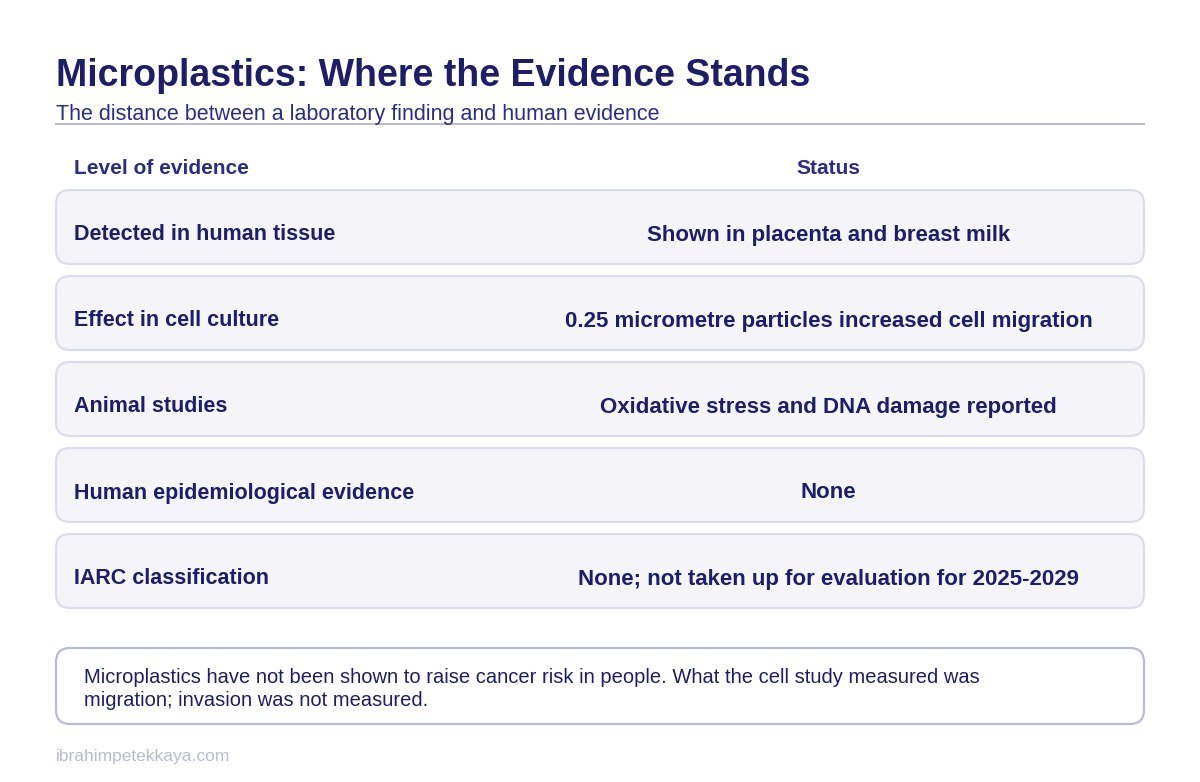
There Is No Human Data on Microplastics and Cancer
This is the decisive section of the article and it should not be blurred. There is no human epidemiological evidence showing that exposure to microplastics causes cancer. No cohort study and no case-control study establishing such a thing exists.
The International Agency for Research on Cancer has not classified microplastics. That is a stronger statement than merely not yet having reached the queue: microplastics were proposed as a candidate while the priorities for the 2025-2029 period were being set, but evaluating them was explicitly not recommended.
The reason reported was this: an absence of evidence relating to exposure, or the matter in question not constituting an external exposure. The agency, in other words, took a decision to defer evaluation for want of data; it did not take a decision about carcinogenicity.
Read together, those two statements make the present position on microplastics and cancer clear: the particles have been found in human tissue, their biological effects have been shown in the laboratory, and their effect on cancer risk in humans is unknown.
| Finding | Source of the evidence | Status |
|---|---|---|
| Detection in breast milk | Human samples | Demonstrated |
| Detection in the placenta | Series of 6 placentas | First detection; not a prevalence dataset |
| Oxidative stress and DNA damage | Cell and animal studies | Proposed mechanism |
| Increase in cell migration | Four colorectal cell lines | Migration alone measured; invasion not measured |
| Cancer risk in humans | Epidemiological study | No data |
| Carcinogenicity classification | IARC priority list | Not classified; evaluation not recommended |
Plastic Additives Are a Separate Subject
A careful distinction is needed here, because two subjects are frequently confused. Some of the individual building blocks and additives used in manufacturing plastics have been classified as carcinogenic: vinyl chloride sits in Group 1 and styrene in Group 2A.
These substances are chemically different from plastic particles. Vinyl chloride is a gas and exposure to it is a matter of manufacturing conditions; styrene is likewise a chemical compound. A particle, by contrast, is a polymerised solid structure.
Those classifications cannot therefore be used in a way that creates the impression that microplastics have been classified. The sentence plastic is carcinogenic puts the chemical substance and the particle in the same basket and implies more than the available evidence supports.
A similar distinction holds generally in the field of cancer risk factors: a classification applying to a substance cannot be transferred to every product form containing it. How risk factors are assessed is covered in early detection of cancer and on the hereditary cancer risk assessment page.
Does a High-Fibre Diet Reduce Colon Cancer Risk
The level of evidence at which the relationship between eating habits and colon cancer risk is discussed.
What Makes Sense to Do Today
The present state of the evidence can be summarised in three sentences. Microplastics have been detected in human tissues including the placenta and breast milk. Laboratory and animal studies show that micro and nanoplastic particles can lead to oxidative stress, DNA damage and inflammatory signalling, and can increase the migratory capacity of cancer cells in culture. Whether these exposures affect cancer risk in humans is unknown.
To that should be added that no human epidemiological study has shown such a link and that no health agency has classified microplastics as carcinogenic. This is the strongest statement the evidence supports; nothing beyond it is available.
Reducing avoidable exposure to plastic is a reasonable thing to do on general grounds: environmental burden, chemical additives and the size of what remains unknown make up those grounds. It cannot be said, however, that the behaviour will lower cancer risk, because no such measurement has been made.
- Glass or stainless steel containers can be chosen instead of plastic for hot food and drink.
- Plastic containers are not heated in a microwave; heat makes the release of additives easier.
- Plastic containers that are scratched, worn or discoloured are taken out of use.
- Reusable options can be preferred to single-use plastics.
- These measures are taken on general health grounds; they have not been shown to deliver a measured gain in cancer risk.
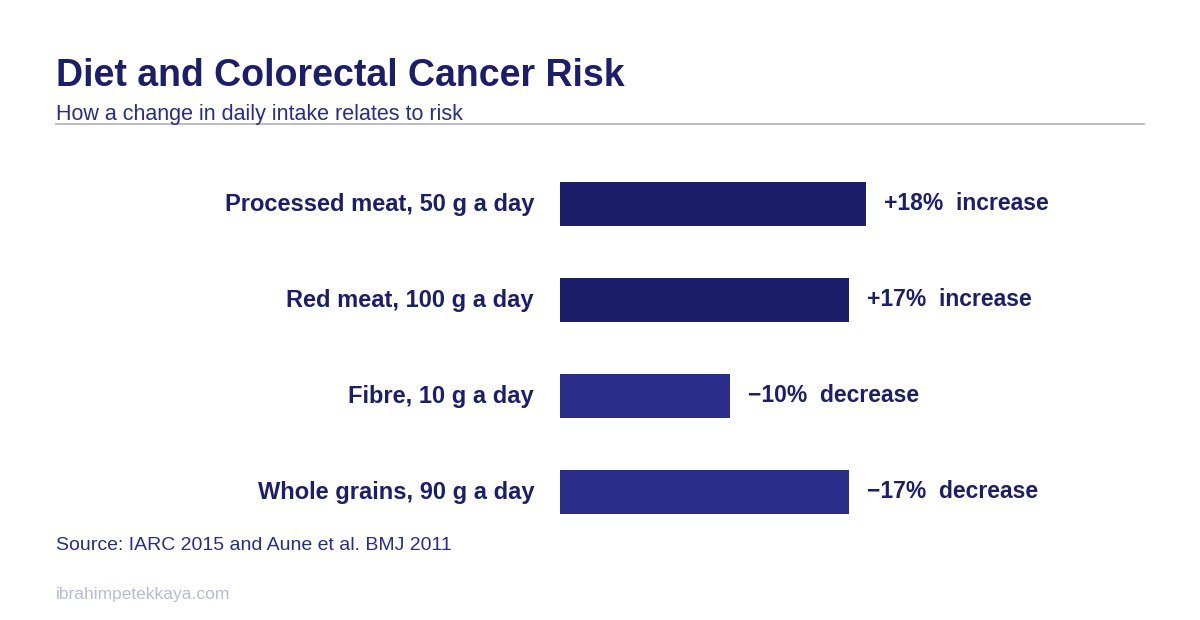
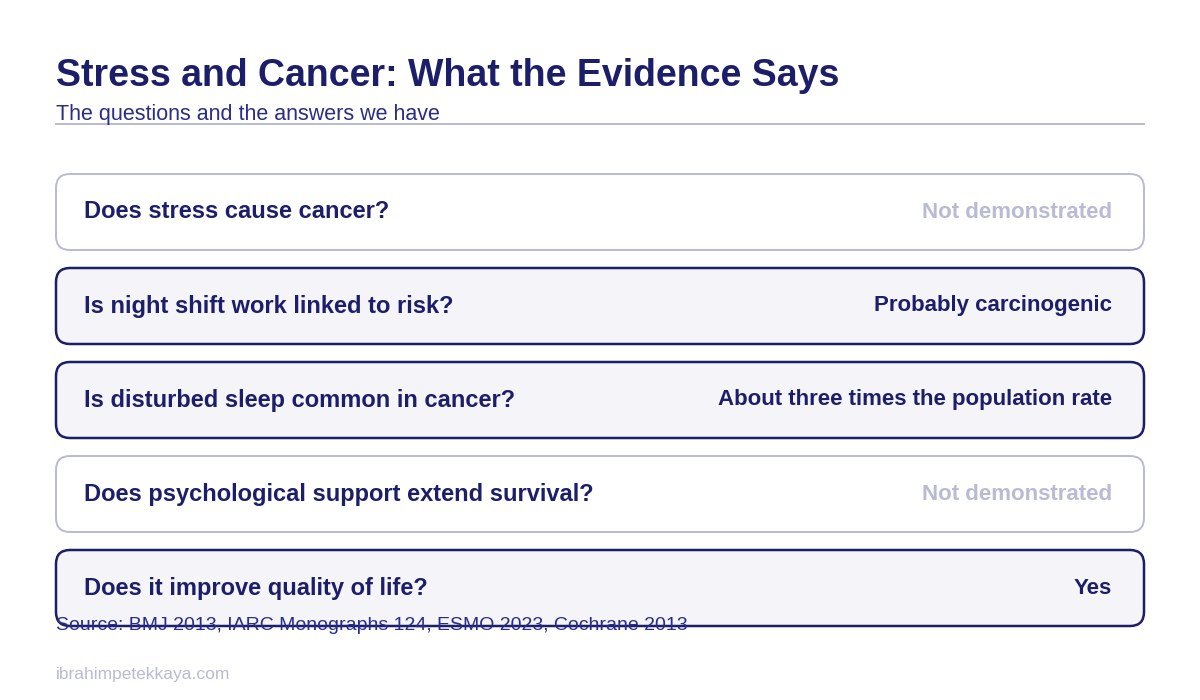
The behaviours shown to reduce cancer risk are well established and the list rests on far firmer ground than anything about microplastics and cancer: stopping smoking, weight control, regular physical activity, limiting alcohol and taking part in screening programmes. The lifestyle side is covered in diet and colorectal cancer and stress and cancer.
The question a patient should ask under this heading is whether there is anything they need to change in relation to their own diagnosis or risk status. The answer to that question today has nothing to do with microplastics. The framework of monitoring and assessment is set out on the treatment pathway and patient guide pages.
Send Your Reports for Assessment
Share your pathology, imaging and blood results on WhatsApp, or send them by email. Documents are reviewed before the consultation.
Frequently Asked Questions
Is there a proven link between microplastics and cancer?
No. There is no human epidemiological evidence showing that exposure to microplastics causes cancer, and no cohort study or case-control study establishing such a thing exists.
What is the difference between microplastics and nanoplastics?
According to the proposed classification framework, nanoplastics lie between 1 nanometre and below 1000 nanometres, and microplastics between 1 micrometre and below 1000 micrometres. The widely quoted 5 millimetre upper limit comes from a separate practical convention rather than from that framework.
Have microplastics been found in human tissue?
Yes, they have been detected in breast milk and in the placenta. The placenta study examined 6 placentas, found 12 particles in 4 of them and could identify only 3 of those as a polymer. That is a first detection, not a prevalence dataset.
How has the International Agency for Research on Cancer classified microplastics?
It has not classified them. Microplastics were proposed as a candidate while the 2025-2029 priorities were being set, but evaluating them was explicitly not recommended; the reason reported was an absence of evidence on exposure, or the matter not constituting an external exposure.
What do the laboratory studies show?
Cell and animal studies report that the particles can trigger oxidative stress, DNA strand breaks and inflammatory signalling. Most of those studies were carried out at concentrations far above documented human exposure.
Did migration or invasion increase in the cell study?
Only cell migration was measured, and it increased significantly in four colorectal cancer cell lines with polystyrene particles of 0.25 micrometres. Invasion was not an endpoint of that study, and particles of 1 and 10 micrometres did not show the same effect.
Does cutting plastic use lower cancer risk?
No such measurement has been made. Reducing avoidable exposure to plastic is reasonable on general health grounds, but it has not been shown to deliver any numerical gain in cancer risk.
Related Articles
Related Pages

Patient Guide
Open the Page
Treatment Pathway
Open the Page
Second Opinion
Open the Page
Precision Oncology
Open the PageSources
- Hartmann NB, Hüffer T, Thompson RC et al. Are We Speaking the Same Language? Recommendations for a Definition and Categorization Framework for Plastic Debris. Environ Sci Technol 2019;53(3):1039-1047. Link
- Ragusa A, Notarstefano V, Svelato A et al. Raman Microspectroscopy Detection and Characterisation of Microplastics in Human Breastmilk. Polymers (Basel) 2022;14(13):2700. Link
- Ragusa A, Svelato A, Santacroce C et al. Plasticenta: First evidence of microplastics in human placenta. Environ Int 2021;146:106274. Link
- Brynzak-Schreiber E, Schögl E, Bapp C et al. Microplastics role in cell migration and distribution during cancer cell division. Chemosphere 2024;353:141463. Link
- IARC Monographs Advisory Group. Advisory Group Recommendations on Priorities for the IARC Monographs during 2025-2029. Lyon: IARC; 2024. Link
- Mishra SK, Sanyal T, Kundu P et al. Microplastics as emerging carcinogens: from environmental pollutants to oncogenic drivers. Mol Cancer 2025;24(1):248. Link