
What Minimal Residual Disease Means
Minimal residual disease describes the cancer cells left behind after treatment in a patient who has reached remission. The quantity of those cells sits below the detection limit of standard tests: imaging shows no focus, and examination and routine blood tests are normal. The disease is nonetheless continuing biologically.
Detecting that remnant after surgery answers two questions. The first is prediction of the risk of recurrence: in patients in whom a remnant is detected, the probability of the disease returning is markedly higher. The second is the treatment decision: establishing who actually needs additional treatment.
Muscle-invasive bladder cancer is one of the diseases in which these questions are posed most sharply. After the bladder has been removed entirely, the disease returns in some patients and not in others. When immune treatment after surgery is given to every patient without separating those two groups, the number of patients treated unnecessarily is high.
Circulating tumour DNA, or ctDNA, is the measurement that is a candidate for making that separation in bladder cancer. What the test measures is set out in ctDNA testing after surgery, and the general framework of analyses performed on blood in liquid biopsy for cancer.

Follow-Up After Surgery in Bladder Cancer
How follow-up is arranged after removal of a bladder tumour and which investigations are requested.
The Limits of Tissue and the Advantage of Blood
A tissue biopsy is the foundation of a cancer diagnosis, but it has limits of its own. The first of them is heterogeneity: the genetic make-up differs between tumours and between different regions of the same tumour. A single needle sample may not represent the tumour as a whole.
The second limit is time. A tumour changes under treatment; some subclones are suppressed and others come to the fore. A tissue sample taken once shows the state of affairs at that moment and may lose its validity over the following months. The third limit is the procedure itself: every biopsy carries a risk of complication, which is why it cannot be repeated often.
ctDNA offers an alternative against all three of those limits. Taking blood is safe, can be repeated often and can track how the disease changes over time. Because DNA is shed into the circulation from different foci, the measurement is not confined to a single site. The situations in which a tissue sample falls short are covered in when the tissue biopsy is not enough.
That advantage does not mean ctDNA has taken the place of tissue. The diagnosis is made on tissue. The use of ctDNA discussed here is not to make a diagnosis but to monitor whether a disease that has been diagnosed and surgically removed has left anything behind.
How IMvigor011 Was Designed
IMvigor011 is a double-blind trial of phase 3 design. The patients had undergone surgical removal of muscle-invasive urothelial carcinoma of the bladder and had no radiological evidence of disease. They were entered into serial ctDNA monitoring lasting up to one year.
What is distinctive about the trial is that randomisation took place during that monitoring. Patients who turned ctDNA-positive during monitoring were randomised 2:1; one arm received atezolizumab every four weeks and the other placebo, and treatment continued for up to a year. Patients who remained continuously ctDNA-negative throughout monitoring were given no drug at all and were simply observed.
The numbers are as follows: 761 patients entered monitoring. Of those, 250 were randomised, with 167 allocated to atezolizumab and 83 to placebo. The number who remained continuously ctDNA-negative was 377, and 357 of those were found evaluable.
This is the first prospective phase 3 arrangement in which adjuvant immune treatment was given not to all patients but only to those who turned ctDNA-positive. The design of the trial therefore also determines how its result is to be read.
Send Your Reports for Assessment
Share your pathology, imaging and blood results on WhatsApp, or send them by email. Documents are reviewed before the consultation.
Results in the ctDNA-Positive Group in Bladder Cancer
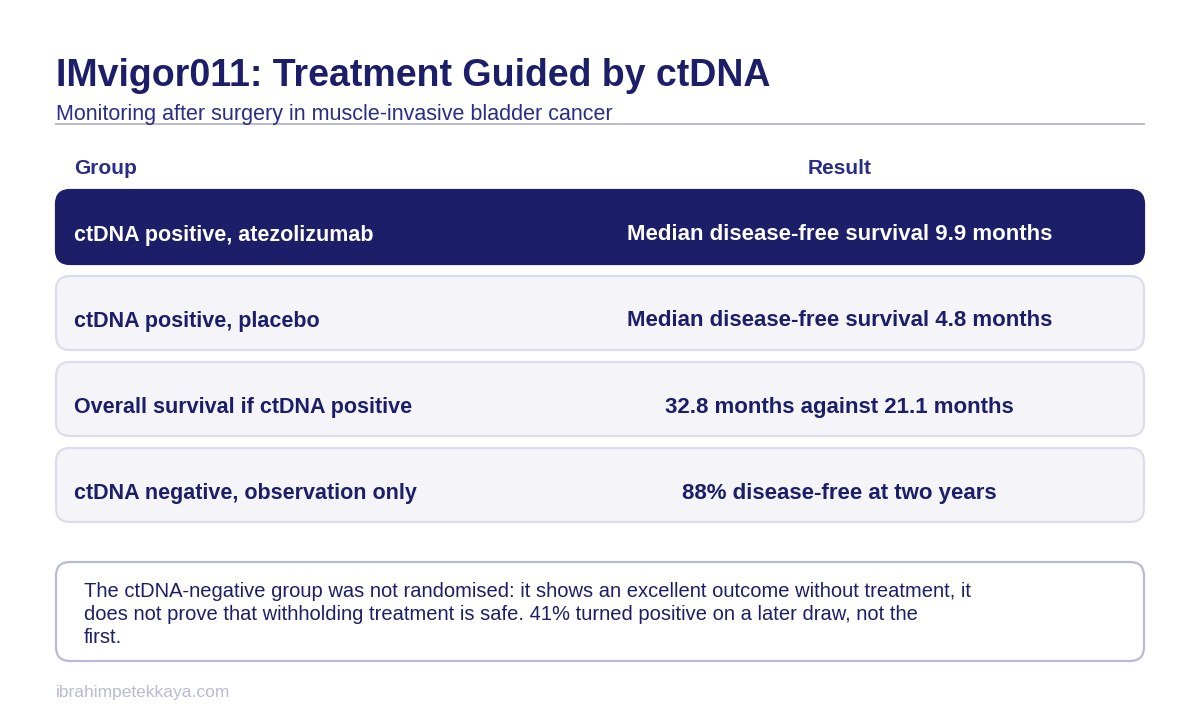
In the randomised ctDNA-positive group, median disease-free survival was 9.9 months in the atezolizumab arm and 4.8 months in the placebo arm. The hazard ratio was reported as 0.64 with a p value of 0.005. Median follow-up was 16.1 months.
Median overall survival was 32.8 months in the atezolizumab arm and 21.1 months in the placebo arm, with a hazard ratio of 0.59 and a p value of 0.01. One point needs stating here, and it strengthens the result: overall survival was tested in hierarchical order, so it is alpha-protected. This is not an exploratory secondary endpoint.
On the safety side, grade 3 and 4 adverse events occurred in 28 per cent of the atezolizumab arm and 22 per cent of the placebo arm. The difference is six percentage points and corresponds to the recognised price of immune treatment. How immune-related adverse events are managed is described on the immunotherapy page.
| Result | Atezolizumab | Placebo | Status |
|---|---|---|---|
| Median disease-free survival | 9.9 months | 4.8 months | Hazard ratio 0.64; p value 0.005 |
| Median overall survival | 32.8 months | 21.1 months | Hazard ratio 0.59; p value 0.01; alpha-protected |
| Grade 3 to 4 adverse events | 28 per cent | 22 per cent | Safety data |
| ctDNA-negative group, one year | 95 per cent | No treatment given | Not randomised; no comparison |
| ctDNA-negative group, two years | 88 per cent | No treatment given | Not randomised; no comparison |
What the ctDNA-Negative Group Tells Us
In patients who remained continuously ctDNA-negative, disease-free survival was 95 per cent at the end of the one-year monitoring period and 88 per cent at two years. None of these patients had received any adjuvant treatment. The figures are high and they show that this group genuinely does well.
The caveat in this section has to be stated plainly, because this is where the result is most often misread. The ctDNA-negative group was not randomised. There is no comparison arm within that group receiving atezolizumab, so withholding treatment has not been shown to be equivalent to giving it.
The accurate statement is this: in ctDNA-negative patients the outcome without treatment was excellent. A statement that this group does not benefit from adjuvant treatment is, by contrast, wrong and cannot be drawn from this trial, because no such comparison was made. The trial establishes an excellent prognosis for the group; it does not justify a treatment decision.
Important: The ctDNA-negative group was followed as an observation arm and was not randomised. It cannot therefore be concluded from that group that treatment may safely be withheld; what can be concluded is that the outcome without treatment was excellent.
Why a Single Measurement Is Not Enough
This is one of the most clinically useful details to come out of the trial: 41 per cent of the ctDNA-positive patients turned positive not on the first measurement after surgery but on a later blood draw.
The meaning of that figure is direct. Had a single-timepoint test been performed, those patients would have been missed and left under observation despite needing treatment. This use of ctDNA therefore rests not on one measurement but on serial monitoring.
In practice that means continuing to take blood at set intervals through the period after surgery. In the trial, monitoring continued for up to a year. A negative first measurement does not mean that the subsequent measurements are unnecessary.
Can a Liquid Biopsy Make a Diagnosis on Its Own
The place of a blood-based test in making a diagnosis and how it is used in follow-up.
Which Patients the Result Covers
The trial population is narrower than it appears, and that limit has to be stated. Patients either had to have received platinum-based chemotherapy before surgery, or, if they had not, to meet certain conditions.
- Not being suitable for cisplatin-based adjuvant chemotherapy,
- having declined that treatment themselves,
- or that treatment not being given by the decision of the treating doctor.
This population is therefore not a group of patients fit for cisplatin. The territory in which the result is valid is limited accordingly: no decision can be derived directly from these data for a patient able to receive cisplatin-based adjuvant chemotherapy. The general framework of chemotherapy regimens is set out on the chemotherapy page.
That limit is not a flaw in the trial; it reflects the real group of patients in whom adjuvant immune treatment comes up at all. Even so, when the question is which patient the result applies to, these conditions have to be listed.
How the Test Itself Works
Two different tumour-informed tests were used in the trial. Both are personalised multiplex PCR panels built by sequencing the patient’s own resected tumour. The test does not screen a ready-made gene list; it looks for the changes present in that particular tumour.
The criterion for positivity is also defined: detection of at least 2 of 16 patient-specific variants was counted as positive. That threshold was set to prevent technical noise in a single variant from being counted as a positive result.
The per-patient analytical sensitivity and specificity of the test were not reported in the main publication. No figure is therefore given here for either value. What the test measures is known, but the rate at which it returns a false negative or a false positive cannot be read from the main publication.
Building a tumour-informed test requires the surgical specimen to be sequenced. That means the approach cannot simply be started in every centre. The sequencing process is described on the comprehensive genomic profiling page.
How It Fits With the Earlier Trials
An older adjuvant trial of the same drug in an unselected bladder cancer population was negative. That trial enrolled 809 patients; median disease-free survival was 19.4 months against 16.6 months with a hazard ratio of 0.89, and the result was not statistically significant.
The retrospective ctDNA analysis of that same trial proved illuminating. At the start of treatment, 37 per cent of the patients were ctDNA-positive and that group did markedly worse. The benefit was seen to belong to that group alone, with no difference between the arms in ctDNA-negative patients.
IMvigor011 is the prospective confirmation of that retrospective finding. The overlap is striking: the overall survival hazard ratios came out almost identical in the two trials, reported as 0.59 in both.
A different adjuvant trial in an unselected population had, by contrast, given a positive result. In that trial, conducted with nivolumab, median disease-free survival was 20.8 months against 10.8 months with a hazard ratio of 0.70, and it is that trial on which the current adjuvant approval rests.
What the Result Claims and What It Does Not
The result needs positioning correctly, because the place of adjuvant immune treatment in bladder cancer is open to exaggeration in both directions. IMvigor011 does not displace the positive adjuvant trial conducted with nivolumab. The drug is different, the design is different, and the two trials have never been compared with one another.
What the trial actually is, is this: the first prospective phase 3 evidence that ctDNA status determines who benefits from adjuvant checkpoint blockade in this disease. That is a narrower claim than saying ctDNA should from now on decide who is offered adjuvant immune treatment.
The reason it is narrower is plain: no randomised trial has tested withholding treatment in ctDNA-negative patients. The good outcome of the negative group was shown by observation, not by comparison. Skipping treatment in a ctDNA-negative patient therefore rests on a good prognosis rather than on a demonstrated equivalence.
- The surgical specimen is sequenced and a patient-specific ctDNA test is built.
- Blood is taken at set intervals after surgery for serial monitoring; a single measurement is not treated as sufficient.
- If ctDNA turns positive, adjuvant immune treatment comes into consideration; benefit in this group has been shown prospectively.
- If ctDNA stays negative, monitoring continues; the outcome without treatment is excellent, but equivalence with treatment has not been shown.
- Fitness for cisplatin is assessed separately, because the trial population did not consist of patients fit for cisplatin.
- The decision is taken at a board on the whole body of findings rather than on a single test result.
Which board takes the decision is covered in molecular tumour board and how a tumour board works, and the order in which a patient is assessed on the treatment pathway page.
Send Your Reports for Assessment
Share your pathology, imaging and blood results on WhatsApp, or send them by email. Documents are reviewed before the consultation.
Frequently Asked Questions
What does minimal residual disease mean?
It describes the cancer cells left behind after treatment in a patient who has reached remission, at a quantity below the detection limit of standard tests. No focus is visible on imaging, yet the disease continues biologically. Detecting it after surgery for bladder cancer matters for predicting the risk of recurrence and for deciding on additional treatment.
How was the IMvigor011 trial designed?
Patients whose muscle-invasive urothelial carcinoma of the bladder had been surgically removed, with no radiological evidence of disease, were entered into serial ctDNA monitoring for up to a year. Those who turned ctDNA-positive during monitoring were randomised 2:1 to atezolizumab or placebo; those who stayed negative were given no drug.
What was the result in ctDNA-positive patients?
Median disease-free survival was 9.9 months against 4.8 months, with a hazard ratio of 0.64 and a p value of 0.005. Median overall survival was 32.8 months against 21.1 months, hazard ratio 0.59 and p value 0.01. Because overall survival was tested in hierarchical order it is alpha-protected.
Can treatment be skipped in ctDNA-negative patients?
This trial does not support that conclusion. The ctDNA-negative group was not randomised and contains no comparison arm receiving atezolizumab. What can be said is that without any adjuvant treatment, disease-free survival in these patients was 95 per cent at one year and 88 per cent at two years.
Is a single ctDNA measurement enough?
It is not. Of the ctDNA-positive patients, 41 per cent turned positive not on the first measurement after surgery but on a later blood draw. A single-timepoint test would have missed them, which is why serial monitoring is required.
Which patients does this result cover?
Patients either had to have had platinum-based chemotherapy before surgery or, failing that, to be unsuitable for cisplatin-based adjuvant chemotherapy, to have declined it, or not to be receiving it by the decision of their doctor. The population therefore did not consist of patients fit for cisplatin.
Does this trial invalidate the adjuvant nivolumab approval?
It does not. The drug and the design are different and the two trials have never been compared. In an unselected population, nivolumab gave disease-free survival of 20.8 months against 10.8 months with a hazard ratio of 0.70, and the current adjuvant approval rests on that trial.
Related Articles
Related Pages
Immunotherapy
Open the Page
Chemotherapy
Open the Page
Molecular Tumour Board
Open the Page
Treatment Pathway
Open the PageSources
- Powles T, Kann AG, Castellano D et al. ctDNA-Guided Adjuvant Atezolizumab in Muscle-Invasive Bladder Cancer (IMvigor011). N Engl J Med 2025;393(24):2395-2408. Link
- Bellmunt J, Hussain M, Gschwend JE et al. Adjuvant atezolizumab versus observation in muscle-invasive urothelial carcinoma (IMvigor010). Lancet Oncol 2021;22(4):525-537. Link
- Powles T, Assaf ZJ, Davarpanah N et al. ctDNA guiding adjuvant immunotherapy in urothelial carcinoma. Nature 2021;595(7867):432-437. Link
- Bajorin DF, Witjes JA, Gschwend JE et al. Adjuvant Nivolumab versus Placebo in Muscle-Invasive Urothelial Carcinoma (CheckMate 274). N Engl J Med 2021;384(22):2102-2114. Link
- Pascual J, Attard G, Bidard FC et al. ESMO recommendations on the use of circulating tumour DNA assays for patients with cancer. Ann Oncol 2022;33(8):750-768. Link