
Which Genes STK11 and KEAP1 Are
STK11, also known as LKB1, is a tumour suppressor gene with a central part in the energy balance and metabolism of the cell. The cell monitors its nutrient and energy status through this gene; when the gene loses its function, decisions about growth become independent of energy constraint. In lung adenocarcinoma that loss is one of the more frequent changes.
An STK11 mutation has been associated with low PD-L1 expression, low T-cell migration into the tumour and resistance to PD-1 and PD-L1 inhibitors. That association is a well-supported finding. In one series the response rate to PD-1 blockade was 7.4 per cent in tumours carrying an STK11 mutation together with KRAS, against 35.7 per cent where KRAS occurred with TP53 and 28.6 per cent in those carrying a KRAS mutation alone.
In the same study, among tumours with intermediate or high mutational burden, the only marker significantly associated with PD-L1 negativity was an STK11 change. Despite a high mutational burden, in other words, the visibility of the tumour to the immune system remained low.
KEAP1, for its part, is the negative regulator of NRF2 and controls the oxidative stress response of the cell. When KEAP1 loses its function NRF2 becomes overactive and the cell becomes dependent on glutamine. The source of that metabolic finding is a KRAS-driven mouse model; it cannot be presented as a demonstrated cause of immunotherapy resistance in patients. The mechanism looks plausible, but its clinical counterpart has not been proven.

One Patient’s Story: KEAP1 and STK11
How the treatment plan was built for a patient whose genetic report showed changes in these two genes.
How the Tumour Microenvironment Changes
The immune environment of these tumours is frequently described wrongly. The accurate description is a myeloid-suppressed environment: a structure in which suppressive myeloid cells gain weight while CD8 killer T cells decline. CD4 effector cells, by contrast, remain relatively preserved.
It is therefore wrong to describe the environment as immune-excluded in the classical sense, or as an immune desert. It is not that no immune cell gets inside the tumour; the composition of the cells that do get in has shifted in the tumour’s favour. That distinction is not merely a preference in naming.
The distinction has a mechanical consequence. The preservation of CD4 effector cells matters, because dual checkpoint blockade exerts its effect by bringing CD4 effector cells into play and by reprogramming suppressive myeloid cells. There is therefore a real lever available in these tumours, and which route the drug used opens is what decides the outcome.
That mechanism is a candidate framework for explaining why the subgroup data reported below look favourable only with a CTLA-4 containing regimen. It remains a candidate framework, however, and not a causal chain verified in patient data. The general way immune treatments work is set out on the immunotherapy page.
Which Gene Low PD-L1 Belongs To
A frequent error has to be corrected at this point. Low PD-L1 expression is an STK11 finding, not a KEAP1 finding. A KEAP1 mutation without a concurrent STK11 change has not been found to be associated with reduced PD-L1 expression.
Attributing low PD-L1 to KEAP1 is therefore not a defensible inference. Because the two genes are often seen together in the same picture of non-response, the findings become confused with one another; but the effect on PD-L1 belongs to STK11.
That distinction matters in practice, because the PD-L1 level is a marker used in choosing treatment. Seeing a KEAP1 mutation on a report is no reason to expect a low PD-L1 result. PD-L1 is read for what it measures. How biomarkers are assessed together is taken up in biomarker testing in lung cancer.
Why Co-Occurrence With KRAS Is Decisive
The strongest citation in this field comes from a pooled series of 1,261 lung adenocarcinomas. In that series STK11 and KEAP1 mutations were associated with significantly worse progression-free and overall survival on immunotherapy, but that association held only in tumours carrying a KRAS mutation.
The statement has to be constructed exactly: in KRAS wild-type tumours, an STK11 or KEAP1 mutation did not worsen immunotherapy outcomes. That does not mean KRAS wild-type tumours respond better in general; it means only that the adverse effect of these two genes was not seen in that group.
These are retrospective institutional data, not a randomised trial. Patient selection, testing methods and treatment sequencing can differ between centres. The direction of the finding is consistent, but for that reason the level of evidence is limited.
The practical consequence is this: when an STK11 or KEAP1 change is seen on a report, the first place to look is KRAS status. What co-occurrence with KRAS means clinically is covered through another tumour in KRAS in pancreatic cancer, and the order in which a report is read in how to read an NGS report.
Send Your Reports for Assessment
Share your pathology, imaging and blood results on WhatsApp, or send them by email. Documents are reviewed before the consultation.
What the POSEIDON Subgroup Data Showed
The POSEIDON trial compared a CTLA-4 containing triplet, in which durvalumab and tremelimumab were added to chemotherapy, against chemotherapy. The figures below belong to the mutation-evaluable non-squamous population of 612 patients.
The response rates were reported as follows: 45.2 per cent in the STK11 mutant subgroup, 45.5 per cent in the KEAP1 mutant subgroup and 55.0 per cent in the KRAS mutant subgroup. The response rates of the comparator arm are not reported in this article, because secondary sources contradict one another on those figures.
The overall survival hazard ratios are these: 0.56 with a confidence interval of 0.30 to 1.03 in the STK11 mutant subgroup; 0.43 with a confidence interval of 0.16 to 1.25 in the KEAP1 mutant subgroup; and 0.80 with a confidence interval of 0.62 to 1.04 in the KRAS mutant subgroup. Progression-free survival hazard ratios for the subgroups are not reported in accessible sources and are therefore not written here.
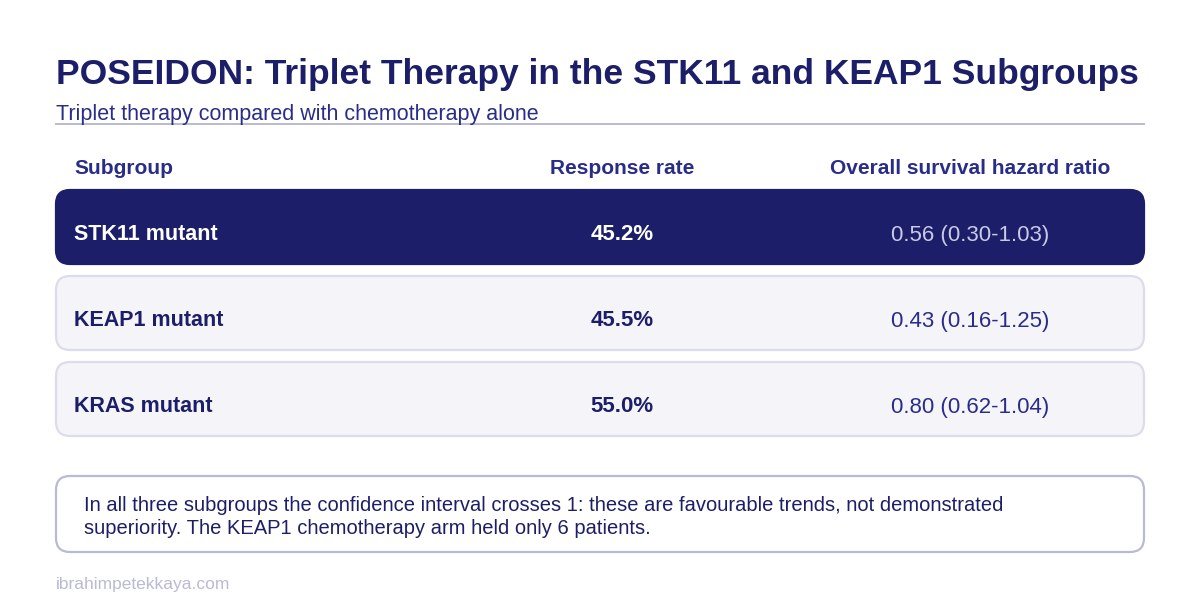
Important: In both mutant subgroups the confidence interval crosses 1. These figures are favourable numerical trends; they are not a demonstrated improvement. Because the chemotherapy comparator arm of the KEAP1 subgroup contained only 6 patients, no three-year rate can be reported as a percentage from that arm.
| Subgroup | Response rate | Overall survival hazard ratio | Status |
|---|---|---|---|
| STK11 mutant | 45.2 per cent | 0.56 (0.30-1.03) | Exploratory; confidence interval crosses 1 |
| KEAP1 mutant | 45.5 per cent | 0.43 (0.16-1.25) | Exploratory; 6 patients in the comparator arm |
| KRAS mutant | 55.0 per cent | 0.80 (0.62-1.04) | Exploratory; confidence interval crosses 1 |
It should not be forgotten that while the mutation-evaluable population of the trial was 612 patients, the individual subgroups were far smaller than that. Subgroup arms come down to as few as six patients, and reporting a percentage at that scale would be misleading.
Valid Only for the CTLA-4 Containing Triplet
There is a generalisation in this section that needs correcting. The claim that adding immune treatment to chemotherapy does better than chemotherapy holds, in this group of patients, only for the CTLA-4 containing triplet.
In STK11 mutant patients, with the PD-L1 doublet that does not contain tremelimumab, that is durvalumab with chemotherapy, the overall survival hazard ratio was 1.03. That means no benefit was found. There can therefore be no talk here of a general combination of chemotherapy and immune treatment; the regimen in question is the CTLA-4 containing triplet.
Measured language is needed on the chemotherapy side as well. The claim that these tumours do not respond to chemotherapy as expected goes too far. The accurate statement is this: with chemotherapy alone the course is poor. That is a poor course rather than a demonstrated resistance specific to chemotherapy. The general framework of chemotherapy is set out on the chemotherapy page.
Chemotherapy or Immunotherapy
The difference between chemotherapy and immune treatment, and which patient each is chosen for.
The Level of Evidence Is Exploratory
This has to be said openly: the finding built on CTLA-4 and low PD-L1 is exploratory and not alpha-protected. The prespecified statistical testing hierarchy of POSEIDON covered only the whole population of the trial.
- These are post hoc biomarker analyses performed in a subset.
- The p values reported are nominal; no correction for multiple comparisons was made.
- Subgroup arms shrink to as few as six patients.
- The confidence intervals cross 1.
- Adding a layer of low PD-L1 on top means dividing an already exploratory subgroup a second time.
The correct framing is hypothesis generation. That hypothesis is being tested prospectively in the TRITON trial: NCT06008093, a phase 2 study of approximately 103 patients, which is active but closed to recruitment and has not yet reported results. Until those results arrive, the words benefit, demonstrated and predictive biomarker cannot be used of this finding.
That caveat does not mean the finding is worthless. The mechanism and the clinical observation point in the same direction, and a trial to test it has been set up. All that is being said is this: the evidence is not yet at a level that can carry the claim.
The Presence of a Mutation Is Not Enough on Its Own
Seeing an STK11 or KEAP1 change on a report does not show that the picture above applies to that patient. Whether or not the change is present is not sufficient information on its own; what kind of change it is also has to be read.
- The type of mutation: whether it is truncating, missense, loss of function or a harmless change alters the outcome.
- Whether the change is clonal or subclonal shows whether it represents the whole of the tumour.
- Loss-of-heterozygosity status bears on whether the remaining intact copy is functioning.
- The PD-L1 level is a separate marker and is read on its own terms.
- Mutational burden gives additional information about the visibility of the tumour to the immune system.
- Co-occurrence with KRAS or TP53 is, as reported above, the factor that actually determines the outcome.
The assessment therefore rests on the report as a whole rather than on a single line. That not every change seen on a report carries the same clinical weight is covered in driver mutation or passenger, and what co-occurrence with TP53 means in TP53 mutation.
The board at which the decision is taken also matters. An assessment at this level is made in the setting of a molecular tumour board attended by pathology, molecular pathology and medical oncology together. The test itself is described on the comprehensive genomic profiling page.
Approaches Still in Development
Two corrections are needed about the drugs being developed in this area, because out-of-date lists remain in circulation.
TNG260 is a real drug candidate. It is a CoREST inhibitor and is being tested with pembrolizumab in an active phase 1/2 trial in tumours carrying an STK11 mutation. There is no published efficacy result, so it can be referred to only as an approach at the stage of mechanism.
MGY825, by contrast, has been discontinued. The decision to discontinue was a commercial one and did not rest on a safety signal. This drug is no longer in development and cannot be counted among the active candidates.
Bemcentinib is not being developed for this use. Its trials in lung cancer were not built on selection by STK11 or KEAP1 status, and those trials have either completed or been discontinued. The drug can be referred to only at the level of a mechanistic rationale.
In short, there is today no approved drug specific to this gene status for this group of patients. What exists is an exploratory subgroup signal belonging to a CTLA-4 containing triplet, and a phase 2 trial testing it. The general framework of targeted treatments is set out on the targeted therapy page, the field as a whole on the precision oncology page, and the treatment framework of the disease on the lung cancer page.
Send Your Reports for Assessment
Share your pathology, imaging and blood results on WhatsApp, or send them by email. Documents are reviewed before the consultation.
Frequently Asked Questions
What do STK11 and KEAP1 mutations do?
STK11, also known as LKB1, is a tumour suppressor gene controlling the energy balance and metabolism of the cell. KEAP1 is the negative regulator of NRF2 and governs the oxidative stress response. Loss of function in either has been associated with a poor response to immunotherapy in lung adenocarcinoma.
Do these mutations really lower the response to immunotherapy?
For STK11 the association is well supported: in one series the response rate to PD-1 blockade was 7.4 per cent where KRAS occurred with STK11, 35.7 per cent where KRAS occurred with TP53 and 28.6 per cent with a KRAS mutation alone. In a pooled series of 1,261 patients the poor outcome was seen only in KRAS mutant tumours.
Which gene is low PD-L1 associated with?
Low PD-L1 expression is an STK11 finding. A KEAP1 mutation without a concurrent STK11 change has not been found to be associated with reduced PD-L1 expression. Attributing low PD-L1 to KEAP1 is therefore not defensible.
What did the POSEIDON trial show in these patients?
In 612 mutation-evaluable non-squamous patients, the response rate with the CTLA-4 containing triplet was 45.2 per cent in the STK11 mutant group and 45.5 per cent in the KEAP1 mutant group. The overall survival hazard ratios were 0.56 and 0.43; because the confidence interval crosses 1 in both, these results sit at the level of a numerical trend.
Does every combination of chemotherapy and immunotherapy give the same result?
It does not. In STK11 mutant patients the overall survival hazard ratio with the PD-L1 doublet that does not contain tremelimumab was 1.03, so no benefit was seen. The favourable trend belongs only to the CTLA-4 containing triplet.
Can a treatment be chosen on the basis of these data?
This finding is exploratory and not alpha-protected. It is a post hoc subset analysis, the p values are nominal, no correction for multiple comparisons was made and subgroup arms shrink to as few as six patients. The hypothesis is being tested in the phase 2 TRITON trial, NCT06008093, which has not yet reported.
Is there an approved drug aimed at these genes?
There is not. TNG260 is a CoREST inhibitor being tested with pembrolizumab in an active phase 1/2 trial, but it has no published efficacy result. MGY825 was discontinued on a commercial decision. Bemcentinib is not being developed for this use.
Related Articles
Related Pages

Precision Oncology
Open the Page
Immunotherapy
Open the Page
Lung Cancer
Open the Page
Comprehensive Genomic Profiling
Open the PageSources
- Skoulidis F, Goldberg ME, Greenawalt DM et al. STK11/LKB1 Mutations and PD-1 Inhibitor Resistance in KRAS-Mutant Lung Adenocarcinoma. Cancer Discov 2018;8(7):822-835. Link
- Skoulidis F, Araujo HA, Do MT et al. CTLA4 blockade abrogates KEAP1/STK11-related resistance to PD-(L)1 inhibitors. Nature 2024;635(8038):462-471. Link
- Ricciuti B, Arbour KC, Lin JJ et al. Diminished Efficacy of PD-(L)1 Inhibition in STK11- and KEAP1-Mutant Lung Adenocarcinoma Is Affected by KRAS Mutation Status. J Thorac Oncol 2022;17(3):399-410. Link
- Romero R, Sayin VI, Davidson SM et al. Keap1 loss promotes Kras-driven lung cancer and results in dependence on glutaminolysis. Nat Med 2017;23(11):1362-1368. Link
- ClinicalTrials.gov. Durvalumab Plus Tremelimumab Versus Pembrolizumab With Chemotherapy in STK11, KEAP1 or KRAS Mutated Metastatic NSCLC (TRITON), NCT06008093. Link
- Hendriks LE, Kerr KM, Menis J et al. Oncogene-addicted metastatic non-small-cell lung cancer: ESMO Clinical Practice Guideline. Ann Oncol 2023;34(4):339-357. Link