
What a TP53 Mutation Is and How Often It Occurs
TP53 is a tumour suppressor gene that comes into play when DNA damage arises in a cell and directs that cell either to repair or to death. When the gene loses its function, a damaged cell can go on dividing. That is why TP53 is among the genes at the centre of cancer biology.
On frequency, the phrase used most often is that this gene is altered in more than 50 per cent of human cancers. That figure is correct, but it is approximate and it applies to cancers taken as a whole.
The difference between tumour types is very large indeed. In high-grade serous ovarian cancer the rate is above 90 per cent; in other tumour types it stays far below that level. The phrase half of all cancers therefore cannot be used as an estimate for any one disease. The wider framework of the disease is set out on the ovarian cancer page.
The changes discussed in this article are somatic changes arising in tumour tissue. Inherited predisposition is a separate subject assessed with a separate test, and it is covered on the hereditary cancer risk assessment page.

What Cancer Genetics Is
Which questions tumour genetics answers and how the report is put together.
Which Codons Are the Hot Spots
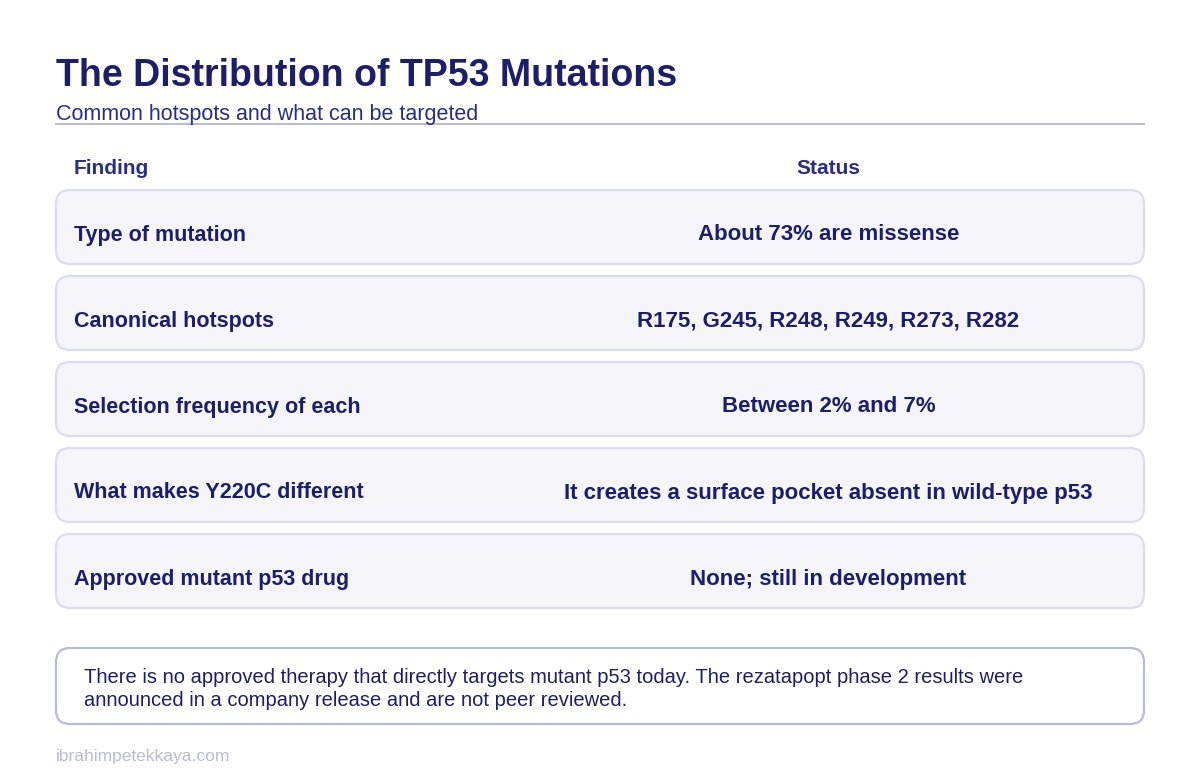
About 73 per cent of TP53 changes are missense. That is a different situation from deletion of the whole gene: the protein is produced, but because a single amino acid has changed its function is impaired or its structure becomes unstable.
These changes are not distributed evenly along the gene; they concentrate at particular codons, which are called hot spot codons. The canonical hot spot codons are R175, G245, R248, R249, R273 and R282.
Important: Codon R249 is frequently left out of lists of this kind. It is part of the canonical hot spot list and should not be dropped.
For each individual hot spot, a selection frequency of between 2 per cent and 7 per cent is reported. Taken together, eight hot spot codons account for roughly 28 per cent of all TP53 changes. More than a quarter of the changes are therefore gathered in that small group.
The concentration itself carries information. A change being selected again and again at one codon points to that change conferring an advantage on the tumour. The distinction between driver and passenger changes is set out in driver mutation or passenger.
| Measure | Value |
|---|---|
| TP53 change across all cancers | Approximately, above 50 per cent |
| High-grade serous ovarian cancer | Above 90 per cent |
| Proportion that are missense | Roughly 73 per cent |
| Selection frequency for a single hot spot | Between 2 and 7 per cent |
| Eight hot spot codons together | Roughly 28 per cent |
| Y220C | Roughly 1 per cent |
Why a Per-Codon Percentage Is Not Published
No separate percentage is given for each codon in this article, and the reason should be stated openly. Per-codon frequencies differ between databases.
A second problem arises from the unit of counting. The frequency changes again according to whether it is calculated per codon or per specific amino acid substitution. Because more than one substitution can occur at the same codon, the two methods give different answers.
The publishable form is therefore this: a selection frequency of between 2 per cent and 7 per cent for a single hot spot, and a rate of roughly 73 per cent for missense changes. A per-codon percentage beyond that is not a figure for which a source can be cited.
How uncertainties of this kind appear on a report is taken up in what does VUS mean on an NGS report, and the general reading of a report in how to read an NGS report.
Why Y220C Stands Apart
Y220C has a place of its own under the heading of the TP53 mutation, and the reason is structural. This amino acid substitution opens a surface cleft in the DNA-binding region of the protein. That cleft is not present in the wild-type p53 protein.
A molecule that binds where there is otherwise no cleft recognises only the protein carrying the change. The small molecules that bind into that cleft stabilise the correctly folded form of the protein. The work of the drug is therefore not to kill the protein but to correct the folding that has gone wrong.
This structural claim is among the best proven findings in the field; co-crystal structures exist. The presence of the cleft and the binding of molecules into it have been shown directly rather than put forward by inference.
On frequency, Y220C sits at roughly 1 per cent, and taken individually it is among the most common TP53 changes. No wider range is given here, because no readable source confirming such a range could be found.
Send Your Reports for Assessment
Share your pathology, imaging and blood results on WhatsApp, or send them by email. Documents are reviewed before the consultation.
What the Published Data on Rezatapopt Showed
Rezatapopt is the only agent developed against the Y220C change for which clinical data have been published. Seventy-seven heavily pretreated patients were enrolled in the phase 1 trial.
The overall response rate across all patients was 20 per cent. In the high-dose arm, among patients carrying no KRAS change, that rate rose to 30 per cent. The critical detail here is this: every patient who responded had a KRAS wild-type tumour.
The other side of that has to be said just as plainly. The drug was ineffective in tumours carrying a KRAS mutation. The presence of the Y220C change is therefore not sufficient on its own; KRAS status emerges as a condition that also determines the response.
The frequent adverse events were reported as nausea, vomiting, raised creatinine, fatigue and anaemia. That profile, in terms of how well the drug is tolerated, also shaped the design of the phase 2 trial.
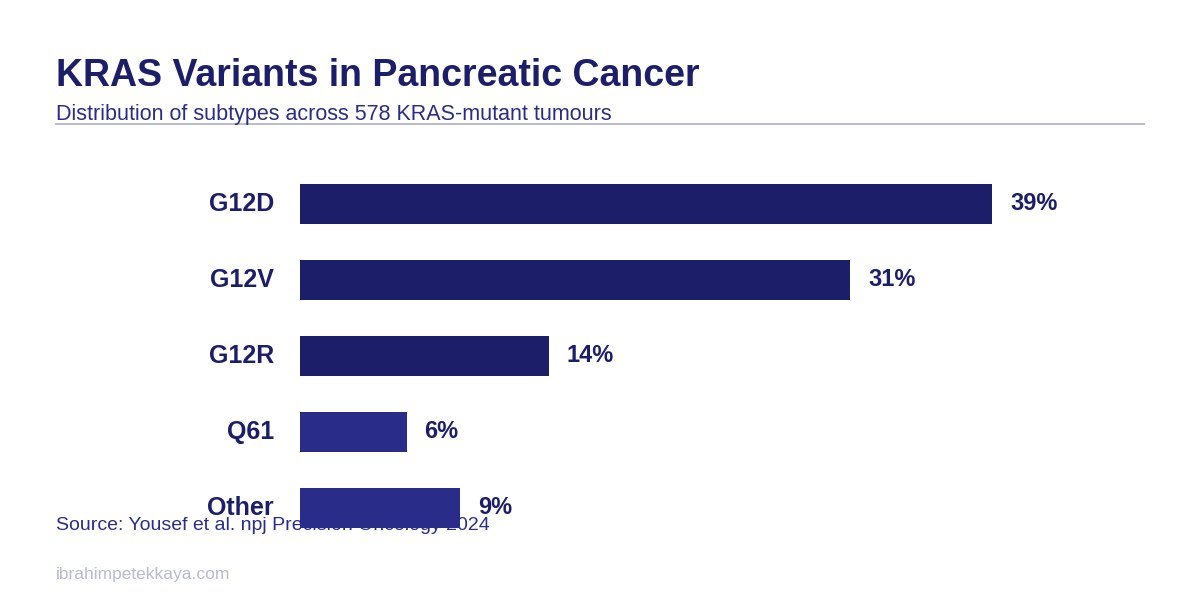
The part a KRAS change plays in treatment decisions is covered in KRAS in pancreatic cancer, and the general way targeted drugs work on the targeted therapy page.
Not Every Mutation Means a Targeted Drug
The conditions under which a change seen on a report turns into a treatment.
The PYNNACLE Trial and the Status of Its Interim Results
The registrational phase 2 trial is called PYNNACLE. It is a single-arm basket trial: patients from different tumour types are assessed together because they carry the same change. Being KRAS wild-type is a condition of entry.
What a single-arm design means is that there is no comparator arm. A trial of that kind can measure a response rate, but it cannot show superiority in survival. That limit has to be kept in mind when the results are read.
Two figures are in circulation as interim results of the phase 2 trial: a response rate of 34 per cent overall and 46 per cent in ovarian cancer. These figures come from a company press release and have not been through peer review. That label has to stay attached in every text that reports them.
Important: The phase 2 interim results rest on a company press release rather than on a peer-reviewed publication. The subgroup rates in that same release, which come from very small numbers of patients, are not reported here.
Why high response rates from small subgroups are not reported needs explaining. A response in three patients out of five can be written as 60 per cent, but that figure shifts enormously if one patient is added or removed. A rate of that kind cannot be used for a clinical decision.
The institutional side of the decision is set out on the molecular tumour board page, and the routes of access to trials in early access programme and clinical trials.
Can a TP53 Mutation Be Targeted Today
The plain answer to the question is this: no approved treatment that directly targets the mutant p53 protein exists anywhere in the world, in any indication. That is today’s position reported exactly as it stands.
Against that, the undruggable framing has begun to loosen. The Y220C example showed that a mutant protein can carry a structural feature absent from the wild type, and that this feature can serve as a binding point for a drug. The published phase 1 data also showed that the approach can produce a response in humans.
Loosening, however, is not ending. What exists is a single-arm registrational trial and a small phase 1 series, for one single change. For most of the hot spot codons no comparable structural opening has been described, and no clinical data on them exist.
- Seeing a TP53 change on a report does not mean there is an approved treatment today.
- If a Y220C change is found, KRAS status has to be assessed alongside it.
- Because every patient who responded was KRAS wild-type, that information is looked for in the file.
- Whether a suitable clinical trial exists is assessed at the tumour board.
- Rates coming from a press release are not given the same weight as published data.
In the file of a patient found to have a TP53 mutation, the real use of this gene today lies elsewhere: it helps in understanding the biology of the tumour and in reading that biology together with the other findings. As a single line it does not generate a treatment decision.
The complementary reading on the RNA side is covered in RNA analysis of tumours, the testing process itself on the comprehensive genomic profiling page, and the general framework of the field on the precision oncology page.
Send Your Reports for Assessment
Share your pathology, imaging and blood results on WhatsApp, or send them by email. Documents are reviewed before the consultation.
Frequently Asked Questions
How often does a TP53 mutation occur?
Approximately, in more than 50 per cent of cancers taken as a whole. But the rate varies greatly by tumour type: it is above 90 per cent in high-grade serous ovarian cancer and far below that in other tumours.
What type are most TP53 changes?
Roughly 73 per cent are missense. The protein is produced, but because a single amino acid has changed its function is impaired or its structure becomes unstable.
Which codons are the hot spots?
The canonical hot spot codons are R175, G245, R248, R249, R273 and R282. The selection frequency for each individual hot spot lies between 2 per cent and 7 per cent; eight hot spot codons together account for roughly 28 per cent of all TP53 changes.
Why is Y220C a special target?
This change opens a surface cleft in the DNA-binding region of the protein that is absent in the wild type. Small molecules binding into that cleft stabilise the correctly folded form of the protein. The structural claim has been shown by co-crystal structures. Its frequency is roughly 1 per cent.
What did the rezatapopt phase 1 trial find?
In 77 heavily pretreated patients the overall response rate was 20 per cent, rising to 30 per cent at the high dose in KRAS wild-type patients. Every patient who responded had a KRAS wild-type tumour; the drug was ineffective in tumours carrying a KRAS mutation.
Are the PYNNACLE interim results reliable?
The rates reported as 34 per cent overall and 46 per cent in ovarian cancer come from a company press release and have not been through peer review. The trial is also single-arm: it measures a response rate and cannot show superiority in survival.
Is there an approved drug targeting mutant p53?
No. No approved treatment directly targeting the mutant p53 protein exists anywhere in the world, in any indication. The Y220C example has loosened the undruggable framing, but it has not ended it.
Related Articles
Related Pages
Comprehensive Genomic Profiling
Open the Page
Precision Oncology
Open the Page
Molecular Tumour Board
Open the Page
Hereditary Cancer Risk Assessment
Open the PageSources
- Hernández Borrero LJ, El-Deiry WS. Tumor suppressor p53: Biology, signaling pathways, and therapeutic targeting. Biochim Biophys Acta Rev Cancer 2021;1876(1):188556. Link
- Baugh EH, Ke H, Levine AJ et al. Why are there hotspot mutations in the TP53 gene in human cancers? Cell Death Differ 2018;25(1):154-160. Link
- Boeckler FM, Joerger AC, Jaggi G et al. Targeted rescue of a destabilized mutant of p53 by an in silico screened drug. Proc Natl Acad Sci U S A 2008;105(30):10360-10365. Link
- Dumbrava EI, Shapiro GI, Parikh A et al. Phase 1 Study of Rezatapopt, a p53 Reactivator, in TP53 Y220C-Mutated Tumors. N Engl J Med 2026;394(9):872-883. Link
- Schram AM, Fellous M, LeDuke R et al. PYNNACLE phase II clinical trial protocol: rezatapopt monotherapy in advanced solid tumors with a TP53 Y220C mutation. Future Oncol 2025;21(24):3159-3166. Link