
When a Second Opinion Is Worth Seeking
A second opinion does not add the same value at every stage. It contributes most where the decision is hard to reverse or more than one option exists.
- When the diagnosis is new and treatment has not started.
- Before a decision about surgery.
- Where more than one treatment option has been offered.
- Where the tumour type is rare.
- When the response to treatment is not what was expected.
- When a genetic or molecular result could change the plan.
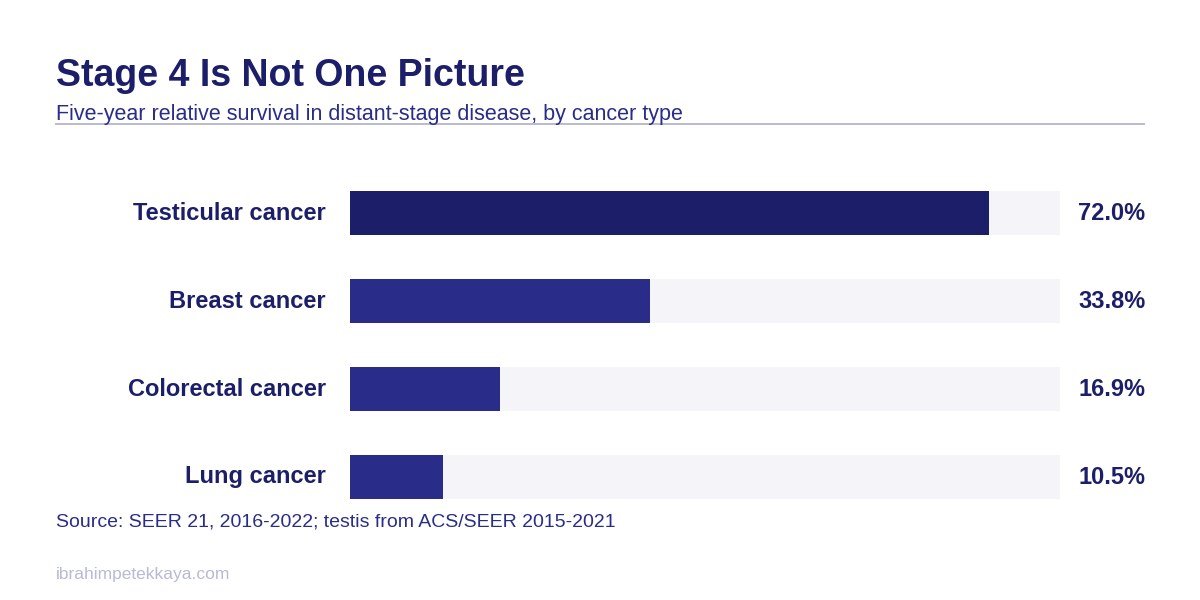
- When you are told there are no options left.
The last item deserves attention. The phrase "there is nothing more to do" usually means nothing more can be done at that centre. If molecular testing has not been done, a trial not considered, or supportive care not discussed, the picture is not complete.
Timing has a practical side. Taken before the first treatment starts, the information gathered serves the whole plan; taken afterwards, the assessment must account for the side effects of previous treatment and the response obtained. That does not lower the value of a second opinion, but it narrows the decision.
Important: The most important timing is before the first treatment starts. A treatment already begun can still be changed, but choice is widest at the beginning.
Which Documents Are Needed
What determines the value of a second opinion is not only the physician but the documents brought to it. A consultation held with incomplete records usually ends with a request to come back.
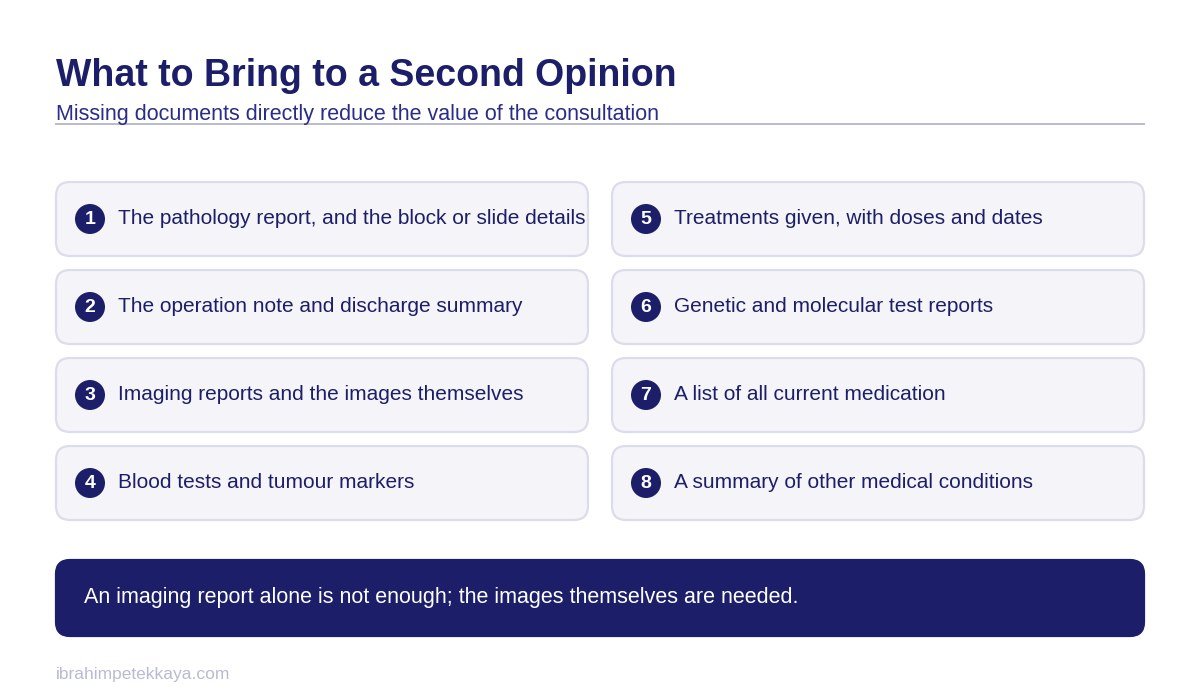
The two most often omitted are the pathology material and the images themselves. A pathology report is an interpretation, and a second pathologist examining the same slide can reach a different conclusion. A scan report is likewise an interpretation, and re-reading the images can reveal a finding it did not mention.
How the documents are organised matters too. A single-page summary ordered by date, showing when each treatment started and finished, is read faster than a thick file, and a patient or relative can prepare it: date of diagnosis, treatments given, imaging dates and the names of any genetic test reports.
In the Newman breast cancer tumour board review, re-reading the images changed the radiological interpretation in 67 of 149 patients, and re-examining the pathology changed it in 43. That shows why the material itself has to travel with the patient. The vaccination schedule during treatment is set out in a separate article.
Send Your Reports for Assessment
Share your pathology, imaging and blood results on WhatsApp, or send them by email. Documents are reviewed before the consultation.
Why Two Readings Can Differ
Pathology and radiology reports are interpretations rather than measurements. A pathologist classifies what is seen in sections from the block against defined criteria, and where a case sits near the edge of those criteria two specialists can decide differently. Tumour grade, subtype and some staining thresholds lie in that border zone.
The second source is sampling. Sections taken from a block are limited and not every part of a tumour looks the same, so extra sections or an added stain can reveal a finding absent from the first report. Imaging is similar: a report answers the question asked at the time, and the same images read differently against a new one.
The third source is experience. In rare tumours the diagnosis shifts with how many similar cases a centre sees in a year, which is why they are the group a second opinion helps most. The same holds for molecular reports, where the panel used and its interpretation need their own reading.
How to Get a Second Opinion: Step by Step
- Tell your physician you want a second opinion; it is an ordinary request.
- Ask for a full copy of your file: summaries, reports and test results.
- Apply to borrow the pathology block and slides.
- Obtain the images on a disc or as a digital link.
- Confirm when booking which documents to bring.
- Write down your questions in advance.
- Take someone with you and make notes.
Writing the questions down beforehand is the simplest and most useful step. Three will do: is the diagnosis certain and what rests on it, what benefit is expected from the proposed treatment and how will it be measured, and what other options exist. A written list keeps the consultation on the subject.
Borrowing pathology material is a patient right and an ordinary procedure. If it is skipped, the second opinion amounts to a re-reading of the first report.

The Process Through a Relative’s Eyes
A patient’s relative describes how the uncertainty of the early days gradually gave way to confidence.
What to Expect From a Second Opinion
A second opinion does not have to produce a different plan. Most often it confirms the first plan, and that is valuable in itself: it lets the patient continue with confidence.
The Basta systematic review in gastrointestinal cancers reported that multidisciplinary review changed the diagnosis in about 18 to 27 per cent of cases and the treatment plan in 23 to 42 per cent. Across the wider literature, covering different cancer types, that proportion ranges from 2 to 52 per cent.
To set expectations properly, a second opinion is not an arbitration. Two physicians weighting the same data differently follows from medicine being a field that contains uncertainty. The decision remains the patient’s, taken with a team that knows their priorities.
Where a different recommendation emerges, the reason should be asked for. A good second opinion does not say "this is what I would do"; it explains which data led to a different conclusion.
- The plan is confirmed: the decision is strengthened.
- The sequence changes: which treatment comes first may differ.
- Further testing is suggested: genetic or molecular analysis.
- The diagnosis is reassessed: the pathological interpretation may change.
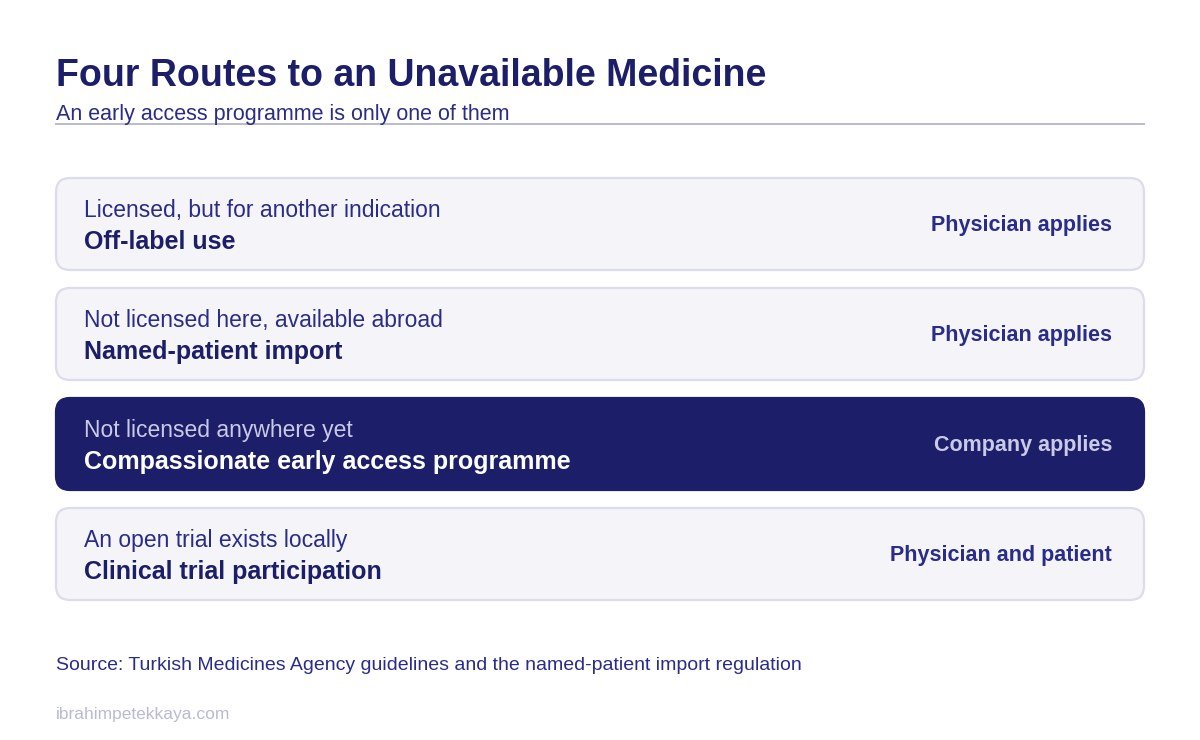
- A new option is added: a clinical trial or early access route.
The last matters most. How those routes work is described in the early access programme article.
One Physician or a Board?
A second opinion can come from a single physician, but most decisions in cancer care are not made alone. European policy documents expect every new and recurrent case to be discussed at a tumour board, or the plan verified as consistent with the evidence.
That contribution has been measured. In the Kesson study of 13,722 women in the west of Scotland, breast cancer mortality in the area where multidisciplinary working was introduced had been 11 per cent higher than elsewhere beforehand and was 18 per cent lower afterwards. The study was not randomised, but the reversal in direction is striking.
Whether decisions can be carried out matters too. Some board decisions cannot be implemented; the reasons are set out in how a tumour board works.
One further question is worth asking at a second opinion: has this plan been discussed at a board? How that works is described on the molecular tumour board page.
Making the Decision Together
How a treatment plan is built not by one physician alone but through the joint assessment of several specialties.
What These Proportions Do and Do Not Say
The proportion of diagnoses or plans that change does not show the change was in the right direction. A plan differing at a second assessment is not evidence that the new plan is better; showing that would need a trial comparing the two. The published proportions measure how often a decision is reopened.
The width of the range also needs weighing. A range that broad across different cancer types shows how far centres differ in case mix and referral patterns, and in patients referred to a tertiary centre the proportion that changes is naturally higher.
The regional comparison behind the board figure was not randomised, and that caveat is kept. Since treatment options were also changing over the same period, attributing the whole reversal to one practice would be wrong. The value of the finding lies in the consistency of its direction.
Common Mistakes
- Arriving with incomplete documents and splitting the consultation in two.
- Bringing only the reports, leaving the images and pathology material behind.
- Concealing it from the first physician, which breaks the flow of information.
- Applying to many centres at once and delaying the decision.
- Seeking it months after treatment has started.
- Judging opinions by which is more optimistic rather than comparing them.
- Taking no notes and later being unable to recall what was said.
What these have in common is treating the second opinion as a contest. The aim is not choosing between physicians but having the data looked at twice.
Three things are worth writing down afterwards: the plan proposed, the reasoning behind it, and where it departs from the first. With those lines the two opinions become comparable; without them the patient is left with two impressions.
The last point is the most damaging. The difference between two plans is not optimism but the evidence they rest on. The right question is what finding the recommendation is based on, and why it differs.
Remote Second Opinions
Where documents can be shared digitally, the consultation can be held remotely, which saves time for patients living in another city or country.
Documents have to be shared in a readable form. Photographs of reports taken with a phone are often insufficient; scanned documents and digital copies of the images are preferred. Hospital links to imaging may expire, so they are best downloaded and kept.
The order of sending documents matters. Sending the pathology report and operation note first lets the assessment begin, and that preliminary reading saves time while the images upload.
The limitation of a remote consultation is that no physical examination is possible, so it is usually a preliminary assessment and an in-person examination may be needed before the plan is settled. How the process runs is described on the second opinion page.
Frequently Asked Questions
How do I get a second opinion?
Start by asking your physician for a full copy of your file, the pathology material and the images. Confirming which documents are needed before the appointment is what makes the consultation productive.
Which documents are needed for a second opinion?
The pathology report and material, the operation note and discharge summary, imaging reports and the images themselves, blood tests, a record of treatments given, genetic test reports and current medication.
Can I seek a second opinion without telling my physician?
You can, but it is not advisable. Breaking the flow of information means two plans proceed unaware of each other and tests are repeated.
Is it difficult to obtain the pathology material?
No. Borrowing blocks and slides is an ordinary procedure and a patient right. Without it, a second opinion is only a re-reading of the first report.
Will a second opinion delay treatment?
A second opinion usually takes a few days to a week, an acceptable delay ahead of a decision that is hard to reverse. Emergencies are a separate matter.
What if the second plan is different?
Ask both physicians what data they rely on. The difference usually comes from a new finding or a different interpretation; if needed, ask for the case to go to a tumour board.
Is a remote second opinion possible?
Yes, where documents can be shared digitally. Because no physical examination is possible, it is usually a preliminary assessment.
Related Articles
Related Pages
Second Opinion
Open the Page
Molecular Tumour Board
Open the Page
Treatment Pathway
Open the Page
Preparing for Your Appointment
Open the PageSources
- Borras JM, Albreht T, Audisio R et al. Policy statement on multidisciplinary cancer care. Eur J Cancer 2014;50(3):475-480. Link
- Newman EA, Guest AB, Helvie MA et al. Changes in surgical management resulting from case review at a breast cancer multidisciplinary tumor board. Cancer 2006;107(10):2346-2351. Link
- Basta YL, Bolle S, Fockens P, Tytgat KMAJ. The Value of Multidisciplinary Team Meetings for Patients with Gastrointestinal Malignancies: A Systematic Review. Ann Surg Oncol 2017;24(9):2669-2678. Link
- Lamb BW, Brown KF, Nagpal K et al. Quality of Care Management Decisions by Multidisciplinary Cancer Teams: A Systematic Review. Ann Surg Oncol 2011;18(8):2116-2125. Link
- Blazeby JM, Wilson L, Metcalfe C et al. Analysis of clinical decision-making in multi-disciplinary cancer teams. Ann Oncol 2006;17(3):457-460. Link
- Rajan S, Foreman J, Wallis MG, Caldas C, Britton P. Multidisciplinary decisions in breast cancer: does the patient receive what the team has recommended? Br J Cancer 2013;108(12):2442-2447. Link
- Kesson EM, Allardice GM, George WD, Burns HJG, Morrison DS. Effects of multidisciplinary team working on breast cancer survival: retrospective, comparative, interventional cohort study of 13 722 women. BMJ 2012;344:e2718. Link
- Prades J, Remue E, van Hoof E, Borras JM. Is it worth reorganising cancer services on the basis of multidisciplinary teams? A systematic review. Health Policy 2015;119(4):464-474. Link
- Pillay B, Wootten AC, Crowe H et al. The impact of multidisciplinary team meetings on patient assessment, management and outcomes in oncology settings: a systematic review. Cancer Treat Rev 2016;42:56-72. Link
- ESMO Clinical Practice Guidelines, guidelines by cancer type. Link
- NCCN Clinical Practice Guidelines in Oncology, guidelines by cancer type. Link