
Are Vaccines During Chemotherapy Safe?
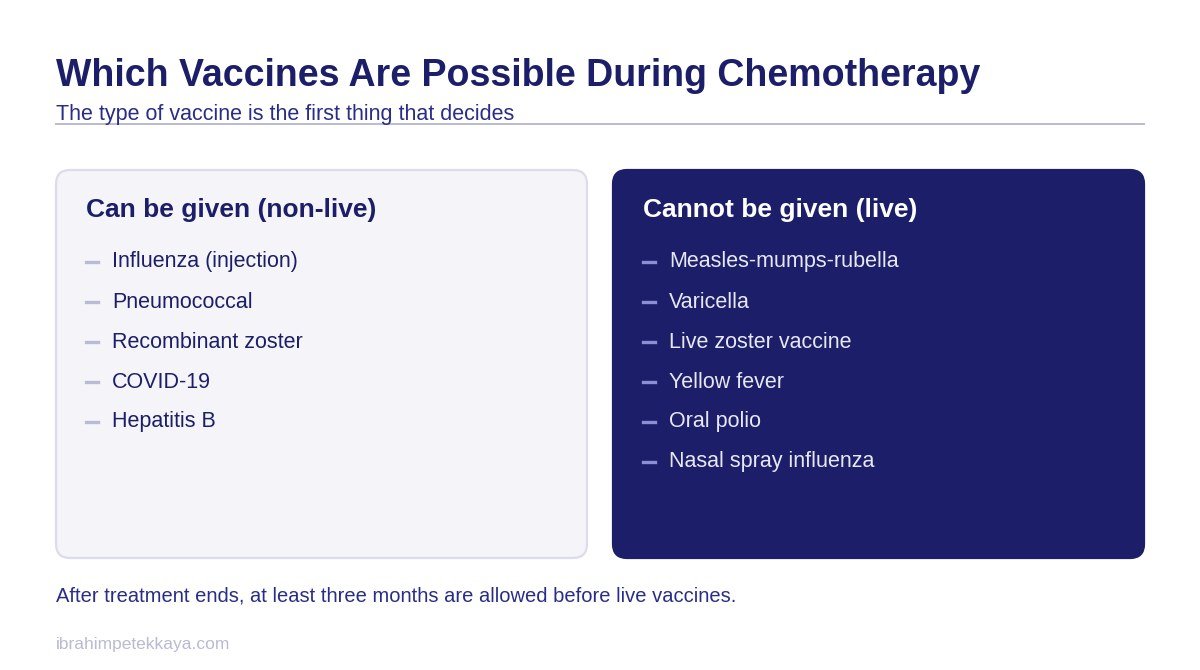
The answer depends on the type of vaccine. Killed or subunit vaccines can be given safely during chemotherapy; vaccines containing live replicating organisms cannot. Every international guideline agrees on that distinction.
There are two limits to vaccinating during chemotherapy. First, the immune response can be weaker than in a healthy person. Second, some vaccines given in this period are not counted as valid doses and have to be repeated once treatment ends. Delaying treatment for the sake of a vaccine, however, is not recommended.
| Vaccine | Type | During chemotherapy |
|---|---|---|
| Influenza (injection, inactivated) | Killed | Can be given, recommended yearly |
| Influenza (nasal spray) | Live | Cannot be given |
| Pneumococcal (conjugate/polysaccharide) | Killed | Can be given, preferably before |
| Zoster (recombinant) | Killed | Can be given |
| Zoster (live) | Live | Cannot be given |
| Measles-mumps-rubella | Live | Cannot be given |
| Varicella | Live | Cannot be given |
| Yellow fever, BCG, oral polio | Live | Cannot be given |
Live vaccines are given at least three months after chemotherapy ends, and only once immunosuppression has resolved. That interval lengthens with the class of drug: after B-cell-depleting treatment such as rituximab, guidelines advise waiting at least six months, and after a stem cell transplant two years. The timing is always set together with the treating team.
Why the Vaccine Response Is Weaker on Treatment
A vaccine makes a harmless introduction to the immune system, which then builds its own defence. Two groups of cells are needed: B cells that produce antibody and the helper T cells that direct them. Chemotherapy acts on rapidly dividing cells, so it also lowers both numbers for a time, and what the vaccine delivers is then recorded more weakly.
The live and inactivated distinction follows from the same picture. The material in an inactivated vaccine cannot multiply, so it cannot start an infection even when immunity is suppressed. A live vaccine delivers an organism that is weakened but still able to multiply; a healthy immune system restricts it at once, a suppressed one may not. The prohibition rests on that risk, not on the vaccine failing to work.
The same frame explains why intervals after treatment differ by drug class. After treatments that suppress B cells directly, the cells able to produce antibody take longer to recover; after a stem-cell transplant the wait is longest, because immune memory is rebuilt from scratch.
The Best Timing
The best result comes from vaccinating before chemotherapy starts. Guidelines recommend at least two weeks ahead of treatment; ASCO frames the window as two to four weeks.
If a vaccine has to be given after treatment has started, which day of the cycle to choose was debated for years. In a randomised study by Keam and colleagues in patients on three-weekly chemotherapy, giving the influenza vaccine on day 1 or day 11 of the cycle made no significant difference to protective antibody levels. In other words, there is no need to wait for the "right day": that the vaccine is given matters more than when in the cycle it is given.

Timing of the Flu Vaccine During Chemotherapy
This post explains which point after a cycle the vaccine is recommended and how that relates to the recovery of immune cells.
- Where possible, vaccines are completed 2-4 weeks before chemotherapy.
- If treatment has started, the inactivated influenza vaccine is given without delay.
- Vaccination and chemotherapy are kept off the same day where practical.
- Some vaccines given during treatment are repeated at least three months after it ends.
- Live vaccines wait at least three months; at least six months after B-cell-depleting treatment, and two years after a stem cell transplant.
Important: Chemotherapy is not delayed for a vaccine. The consistent position of the guidelines is to fit the vaccine around the treatment plan, not the other way round.
Send Your Reports for Assessment
Share your pathology, imaging and blood results on WhatsApp, or send them by email. Documents are reviewed before the consultation.
The Influenza Vaccine
An inactivated influenza vaccine is recommended every year for adults receiving cancer treatment. The response can be weaker in patients on intensive regimens, but the vaccine still reduces the risk of hospital admission and severe illness. The live nasal spray vaccine is not used in this group.
How well the influenza vaccine protects varies from year to year with how closely its content matches the circulating virus. That variability is not a reason to skip it: in a patient on cancer treatment the expected benefit is not that influenza will never be caught, but that severe illness and admission are avoided if it is. For patients whose treatment schedule cannot absorb even a week of delay, that protection means treatment can continue uninterrupted.
In immunocompromised patients, high-dose or adjuvanted influenza vaccines may produce a stronger response. Giving the influenza, COVID-19 and RSV vaccines in the same session is considered appropriate.
The Flu Vaccine During Chemotherapy
A short video on which period after a chemotherapy cycle the influenza vaccine is recommended for patients on treatment.
The Pneumococcal Vaccine
Pneumococcus, the organism behind most bacterial pneumonia, is among the leading causes of severe infection in patients receiving chemotherapy. Guidelines recommend pneumococcal vaccination in newly diagnosed cancer patients, preferably before treatment.
The IDSA guideline describes a sequential schedule in which a conjugate vaccine is followed by a polysaccharide vaccine at least eight weeks later. This area has moved on: single-dose higher-valency conjugate vaccines now lead adult schedules. Which product is used is therefore set by the current national immunisation schedule; the sequence given here is the historical guideline position.
Mild swelling and soreness in the arm after a vaccine show the immune system responding, and are seen in patients on chemotherapy in the same way. Choosing an arm other than the one used for chemotherapy infusions is preferred, particularly in patients who have had axillary lymph nodes removed for breast cancer.
The Shingles Vaccine
Shingles becomes more common during cancer treatment and can be painful and prolonged. The recombinant zoster vaccine contains no live virus and can therefore be used in immunosuppressed patients.
In a randomised study of patients with solid tumours, the vaccine produced substantial antibody and cellular immune responses whether it was given before or during chemotherapy, and those responses persisted for a year. The response was stronger when the vaccine was given before chemotherapy, which confirms the general rule once more: vaccinate beforehand where you can.
The older live zoster vaccine is not used in these patients. Which product is available varies by country, so whether it is live is confirmed before administration.
What the Evidence Measured
In the comparison of which day within a cycle to choose, the outcome measured was the antibody level regarded as protective. Influenza episodes, hospital admissions and deaths were not measured. An antibody level is an established surrogate but not the clinical outcome itself, so the finding cannot be presented as proof that the choice of day leaves clinical outcomes unaffected.
That study was run on three-weekly cycles; schedules at other intervals are outside its scope. In the shingles vaccine study the outcome measured was also the immune response. That response was reported to persist for a year; a reduction in the frequency of shingles was not shown. The response being stronger when the vaccine was given before chemotherapy is the basis for the timing advice.
The third limit is the patient groups: most studies run in patients with solid tumours and good general condition. Very advanced disease, severe neutropenia and the combined use of more than one immunosuppressive treatment are not well represented. Guideline advice still applies, but a weaker response is allowed for.
Household Members and Carers
One of the most effective ways of protecting a patient is vaccinating the people around them. This is known as cocooning, and guidelines recommend it explicitly.
- Household members can receive all inactivated vaccines on the standard schedule.
- Annual influenza vaccination is recommended for every household member aged over six months.
- Measles-mumps-rubella and varicella vaccines are safe for household contacts.
- Oral polio vaccine is not given to household contacts.
- Close contacts of stem-cell transplant recipients should have the injected rather than the nasal influenza vaccine.
The logic is simple: when the patient’s own immune response is weak, the most reliable protection is that the organism never enters the house. Household vaccinations are therefore a separate item from the patient’s schedule and, where possible, completed before treatment starts.
In practice this is often missed simply because it is never raised. Reviewing the household vaccination status on the day of diagnosis is the simplest protection available for the whole treatment period. Other practical aspects of treatment are set out on the chemotherapy page.
Fever and Side Effects After Vaccination
Arm soreness, mild fever and tiredness can follow a vaccine and usually settle within a day or two. In a patient receiving chemotherapy, however, fever cannot simply be attributed to the vaccine.
Telling vaccine fever from infection fever is not always possible. Fever after a vaccine usually begins within the first day and is short-lived, whereas fever from infection tends to come with shivering, pain or signs pointing to a source. Where the distinction cannot be made, the assumption is infection.
Important: During chemotherapy, a temperature of 38°C or above is treated as infection until proven otherwise and must be assessed without delay. Having had a vaccine does not change that rule.
Vaccination records save time at the consultation: which vaccine on which date, how far the pneumococcal course has progressed, and any previous reaction. The name of the current treatment and the date of the last dose are needed too, since a drug that suppresses B cells changes how the interval is calculated.
For that reason, vaccination is kept away from the days when the white cell count is expected to be lowest. The aim is not a stronger immune response but avoiding confusion about the cause if fever appears. The route to follow in case of fever is described on the treatment pathway page.
Frequently Asked Questions
Can I have a flu vaccine during chemotherapy?
Yes. The inactivated influenza vaccine can be given safely during chemotherapy and is recommended every year. The live nasal spray vaccine is not used in this period.
Which day of the cycle should I be vaccinated on?
In the Keam randomised study of three-weekly cycles, giving the vaccine on day 1 or day 11 made no significant difference to protective antibody levels. That the vaccine is given matters more than which day is chosen.
Which vaccines are definitely ruled out?
Vaccines containing live organisms: measles-mumps-rubella, varicella, the live zoster vaccine, yellow fever, BCG, oral polio and the nasal spray influenza vaccine are the main ones.
Do vaccines need repeating after treatment?
Some vaccines given during chemotherapy, or within two weeks of starting it, are not counted as valid doses. They are repeated at least three months after treatment ends, once immunity has recovered.
When should the pneumonia vaccine be given?
Preferably before chemotherapy starts. Which product and how many doses are set by the current national immunisation schedule.
Should my household be vaccinated?
Yes. Vaccinating the household protects the patient indirectly. All inactivated vaccines and most live vaccines such as measles and varicella are safe for household members; oral polio vaccine is not given.
Will a vaccine delay my chemotherapy?
No. Guidelines do not recommend postponing treatment for a vaccine. Vaccination is timed to fit the treatment plan.
Related Articles
Why Fatigue After Chemotherapy Does Not Go Away
Open the Page
ctDNA Testing After Surgery: What Minimal Residual Disease Means
Open the PageRelated Pages
Chemotherapy
Open the Page
Treatment Pathway
Open the Page
Patient Guide
Open the Page
Immunotherapy
Open the PageSources
- Rubin LG, Levin MJ, Ljungman P et al. 2013 IDSA Clinical Practice Guideline for Vaccination of the Immunocompromised Host. Clin Infect Dis 2014;58(3):e44-e100. Link
- Kamboj M, Bohlke K, Baptiste DM et al. Vaccination of Adults With Cancer: ASCO Guideline. J Clin Oncol 2024;42(14):1699-1721. Link
- Nellore A, Goepfert P, Tan CS et al. IDSA 2025 Guidelines on the Use of Vaccines for the Prevention of Seasonal COVID-19, Influenza, and RSV Infections in Immunocompromised Patients. Clin Infect Dis 2026;ciag114. Link
- Baden LR, Swaminathan S, Almyroudis NG et al. Prevention and Treatment of Cancer-Related Infections, Version 3.2024, NCCN Clinical Practice Guidelines in Oncology. J Natl Compr Canc Netw 2024;22(9):617-644. Link
- Pedrazzoli P, Lasagna A, Cassaniti I et al. Vaccination for seasonal influenza, pneumococcal infection and SARS-CoV-2 in patients with solid tumors: recommendations of the Associazione Italiana di Oncologia Medica (AIOM). ESMO Open 2023;8(3):101215. Link
- Keam B, Kim MK, Choi Y et al. Optimal timing of influenza vaccination during 3-week cytotoxic chemotherapy cycles. Cancer 2017;123(5):841-848. Link
- Vink P, Delgado Mingorance I, Maximiano Alonso C et al. Immunogenicity and safety of the adjuvanted recombinant zoster vaccine in patients with solid tumors, vaccinated before or during chemotherapy: a randomized trial. Cancer 2019;125(8):1301-1312. Link
- Centers for Disease Control and Prevention. Altered Immunocompetence — General Best Practice Guidelines for Immunization (ACIP). Link
- Pedrazzoli P, Lasagna A, Cassaniti I et al. Vaccination for herpes zoster in patients with solid tumors: a position paper on behalf of the Associazione Italiana di Oncologia Medica (AIOM). ESMO Open 2022;7(4):100548. Link
- Rubin LG, Levin MJ, Ljungman P et al. 2013 IDSA Clinical Practice Guideline for Vaccination of the Immunocompromised Host, recommendation 73 and Table 3. Clin Infect Dis 2014;58(3):e44-e100. Link