
Why KRAS in Pancreatic Cancer Matters So Much
KRAS is a switch that carries growth signals to the cell. Normally it turns on and off; when mutated it sticks in the on position, and the cell keeps dividing with no signal from outside.
In pancreatic cancer this alteration is the rule rather than the exception. In the Singhi study profiling more than 3,500 pancreatic adenocarcinomas with a broad panel, KRAS mutations were found in 88 per cent, most often alongside TP53, CDKN2A and SMAD4.
One consequence of that prevalence is that a KRAS mutation is not a distinguishing finding in pancreatic cancer. Present in almost everyone, it does not separate one patient from another. What does distinguish patients is which variant is present and what else sits alongside it.
The remaining ten to twelve per cent are tumours without a KRAS alteration, a small group that matters disproportionately for treatment, because targetable alterations are found most often within it.
KRAS Variants in Pancreatic Cancer
A KRAS mutation is not a single thing. It divides into variants according to which position in the gene is altered, and those variants behave differently, biologically and clinically.
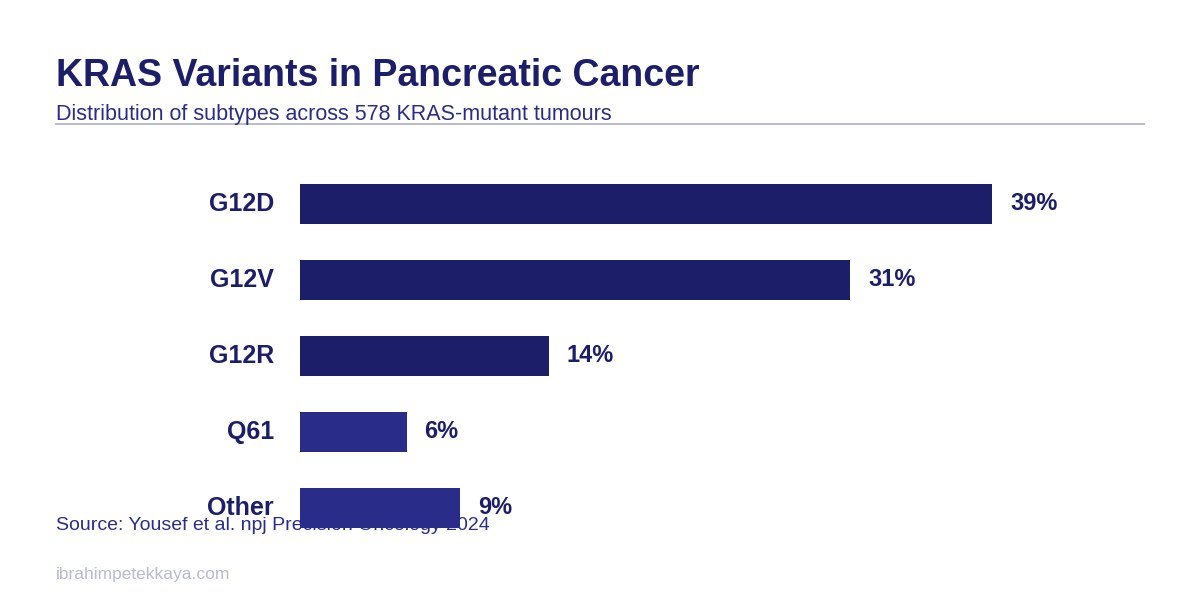
In the Yousef study of 578 KRAS-mutant tumours the distribution was G12D 39 per cent, G12V 31 per cent, G12R 14 per cent, Q61 6 per cent and other rare alterations 9 per cent. The variant tracked with outcome: median overall survival was 38 months without a KRAS alteration, 34 months with G12R, 22 months with G12D and 20 months with Q61.
Important: These figures are averages across groups of patients and do not predict an individual course. Even so, a report saying only that a KRAS mutation is present is not enough: the variant should be stated.

Genomic Analysis in Pancreatic Cancer
Examining the genetic make-up of the tumour is becoming increasingly decisive in identifying treatment options in pancreatic cancer.
Why It Resisted Targeting for So Long
The surface of the KRAS protein had no deep pocket for a drug molecule to grip, so for decades it was regarded as undruggable. The breakthrough came from noticing a small structural gap that appears in one particular variant.
A second difficulty is where KRAS sits inside the cell. The protein works by anchoring to the inner face of the cell membrane and passing the signal down. Targeting the steps below it was tried instead, but that failed on both the burden of side effects and the speed with which tumours switch to alternative routes.
The first drugs targeted the G12C variant, which is relatively common in lung cancer and rare in pancreatic cancer. Even so, they proved KRAS could be bound by a drug at all, and opened the field.
Send Your Reports for Assessment
Share your pathology, imaging and blood results on WhatsApp, or send them by email. Documents are reviewed before the consultation.
Variant-Specific and Broad Targeting
A variant-specific drug binds only the shape the protein takes when it carries that one alteration. This largely leaves normal cells alone, and in return its use is confined to patients carrying that variant. Because G12C is rare in pancreatic cancer, the approach covers only a small group here.
Broader targeting covers several members of the family and several variants at once. The gain is obvious, in that far more patients fall within its scope, and so is the theoretical cost, since wider coverage raises the chance of affecting normal cells. Side-effect profiles and discontinuation rates are therefore measured separately in this class and read alongside the comparator arm.
For reading a report the distinction means the codon and the amino-acid change should be written out, not just the presence of a KRAS mutation. The equivalent reasoning in lung cancer is covered in KRAS G12C inhibitors.
Where the New Drugs Stand
Sotorasib was tested in 38 previously treated patients with metastatic KRAS G12C pancreatic cancer. The objective response rate was 21 per cent, median progression-free survival 4.0 months and median overall survival 6.9 months. In a trial of adagrasib across tumour types, 7 of 21 patients with pancreatic cancer responded.
A drug that covers variants such as G12D, which are far more common in pancreatic cancer, is no longer in development. Daraxonrasib, which targets the RAS family broadly, was compared with chemotherapy in a randomised phase 3 trial of 500 patients with previously treated metastatic pancreatic cancer. In the overall population median overall survival was 13.2 months against 6.7 months, hazard ratio 0.40, and median progression-free survival was 7.2 months against 3.6 months, hazard ratio 0.49. Treatment was stopped because of side effects in 1.2 per cent of the daraxonrasib arm and 11.2 per cent of the chemotherapy arm.
On 26 August 2026, on the strength of those results, daraxonrasib was approved for adult patients with metastatic pancreatic adenocarcinoma who have received at least one prior systemic therapy or who are not candidates for multiagent systemic therapy. The approved indication carries no mutation requirement, although 91.8 per cent of the trial population had a RAS G12 mutation. Drugs directed specifically at G12D remain unapproved, with phase 3 trials still running.
Important: Being approved is not the same as being available everywhere; reimbursement and supply differ from country to country. Eligibility is judged together with the patient’s treatment history and the variant involved.
Where the Evidence Stops
The phase 3 results quoted belong to previously treated patients with metastatic disease and to a comparison against chemotherapy. That is not a demonstration of superiority to chemotherapy in the first line, and no such superiority can be read from the trial. Its place in the sequence is limited to the group the approved indication defines.
The second limit concerns the mutation. The approved indication carries no mutation requirement, yet most of the trial population had a RAS G12 mutation, so the same result has not been demonstrated in patients without a RAS alteration. The data for that group are limited today, and the decision is taken at board level.
The third limit is the status of drugs aimed specifically at variants such as G12D, which are far more common in pancreatic cancer. Phase 3 trials of those drugs are still running and the drugs are not approved. A variant being common does not mean a drug specific to it is available.
BRCA and Other Targets
The main target beyond KRAS is BRCA. In patients with metastatic pancreatic cancer carrying an inherited BRCA alteration, maintenance olaparib after platinum-based chemotherapy gave a median progression-free survival of 7.4 months against 3.8 months. The overall survival analysis of the same trial showed no difference: 19.0 months against 19.2 months. The drug therefore delays progression and extends time spent off chemotherapy; it has not been shown to extend life. Both findings are discussed together.
- Inherited BRCA1 and BRCA2 alterations: a PARP inhibitor becomes an option.
- Tumours with high microsatellite instability: immunotherapy becomes an option.
- NRG1 fusions: seen almost exclusively in tumours without a KRAS alteration.
- NTRK and ALK fusions: rare, but with drugs approved irrespective of tumour type.
- BRAF and other MAPK-pathway alterations: an option in selected patients.
Genomic testing in pancreatic cancer should not stop at KRAS. The scope of that testing is described on the comprehensive genomic profiling page.
Does Genomic Profiling Change the Outcome?
The clearest answer comes from the Know Your Tumor registry, to which 1,856 patients were referred. Among the 1,082 who received a molecular report, 26 per cent had a targetable alteration.
Among those with outcome data, median overall survival was 2.58 years in patients given treatment matched to the alteration found, against 1.51 years in those who were not, and 1.32 years in patients with no targetable alteration. There was no difference between the unmatched group and the group with no target.
What makes the difference is not that the test was done but that the result was acted on. Where the result is not used, the gain disappears.
In practice this is a question of timing. If the result arrives after the treatment options are exhausted, the patient may no longer be well enough to benefit. Testing is therefore planned at diagnosis or while first-line treatment is running, not saved for the last step.
Timing matters for KRAS testing in pancreatic cancer for the same reason. Tissue taken at diagnosis can serve both for the variant and for coexisting alterations, with no further procedure once the disease has progressed, and the block is kept so the same specimen can be tested again when a new question arises.
Who Should Be Tested
NCCN recommends germline testing for every patient diagnosed with pancreatic cancer, whatever the stage; ESMO ties BRCA testing to treatment selection in metastatic disease. Broad panel testing on tumour tissue comes into play mainly in advanced disease, and germline testing concerns the patient’s first-degree relatives as well.
- Broad panel testing of tumour tissue is planned at diagnosis.
- Blood is taken for germline BRCA and related genes.
- Where tissue is insufficient, tumour DNA in blood is an alternative.
- The result is weighed when the treatment plan is made.
- If an inherited alteration is found, counselling is arranged for family members.
- If the result opens no new option, the patient is told that plainly.
It matters to say at the outset that testing does not open a new option in every patient. Finding no targetable alteration is not a bad result; it means the plan continues with standard treatment.
The whole process from diagnosis to treatment is set out on the pancreatic cancer page.
Frequently Asked Questions
How common is a KRAS mutation in pancreatic cancer?
Very common. In the Singhi study of more than 3,500 tumours it was found in 88 per cent. The remaining ten to twelve per cent carry no KRAS alteration.
Why does the KRAS variant matter?
Variants differ biologically and in outcome, and they determine which drugs can be tried. The variant should therefore appear in the report.
Is there a drug for KRAS?
Yes. There are approved drugs for the G12C variant, but that variant is rare in pancreatic cancer. In August 2026 daraxonrasib, which targets the RAS family broadly, was approved for adult patients with metastatic pancreatic adenocarcinoma who have had at least one prior systemic therapy or who are not candidates for multiagent therapy. Drugs aimed specifically at G12D are still in phase 3 trials.
Is a KRAS mutation inherited?
No. The KRAS alterations seen in pancreatic cancer arise in the tumour cell and are not passed to children. Inherited alterations sit in different genes, such as BRCA.
Is BRCA testing needed in pancreatic cancer?
Yes. An inherited BRCA alteration opens the option of a PARP inhibitor, and the result also bears on risk assessment for family members.
Does the test result really change treatment?
In the Know Your Tumor registry study, median overall survival was 2.58 years in patients who received matched treatment against 1.51 years in those who did not. The difference comes from acting on the result, not from ordering the test.
What if there is no KRAS alteration?
Targetable findings such as NRG1, NTRK and ALK fusions and MAPK-pathway alterations are more common in this group, which makes broad panel testing particularly valuable there.
Related Articles


Related Pages
Pancreatic Cancer
Open the Page
Gastrointestinal Cancers
Open the Page
Comprehensive Genomic Profiling
Open the Page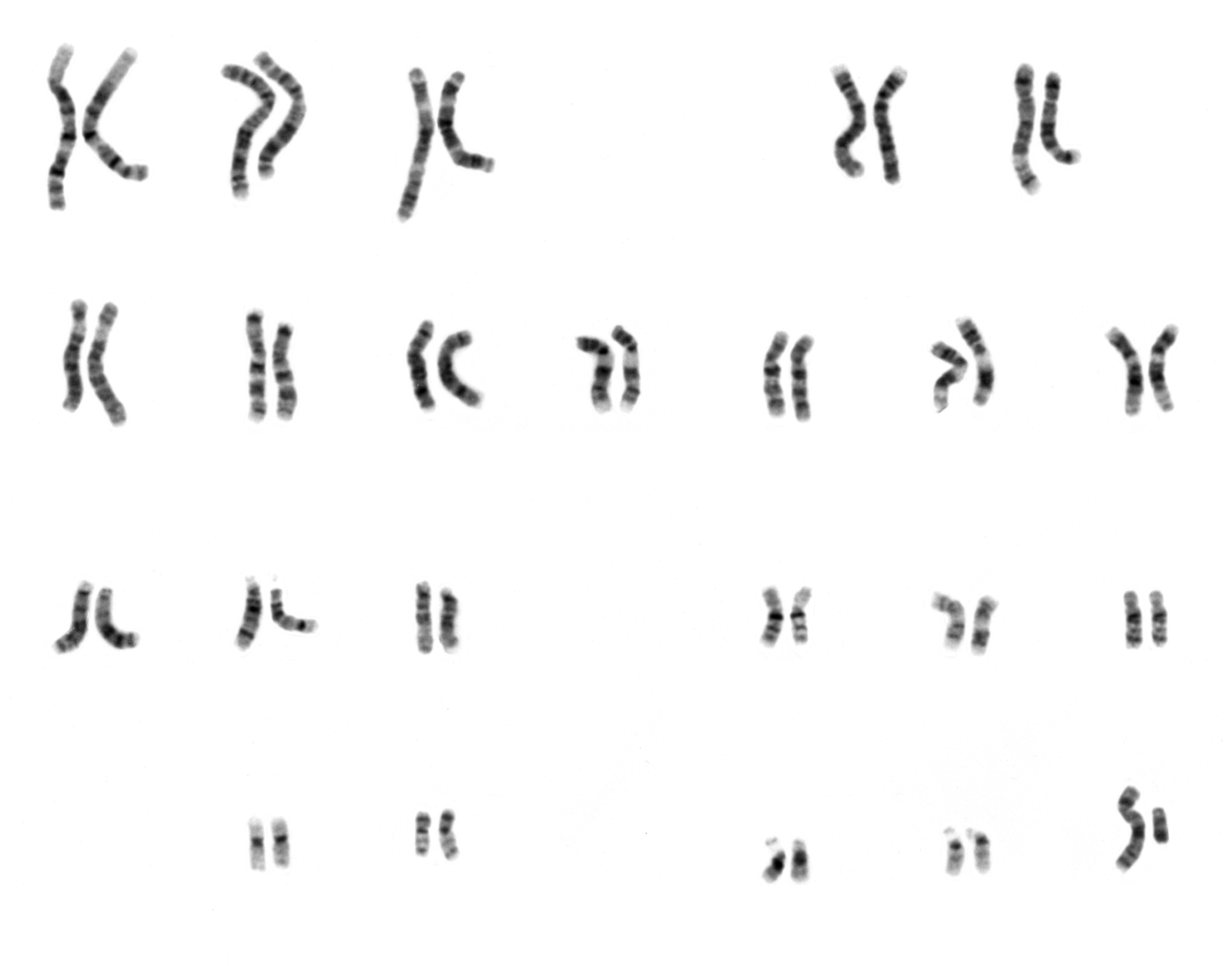
Hereditary Cancer Risk Assessment
Open the PageSources
- Singhi AD, George B, Greenbowe JR et al. Real-Time Targeted Genome Profile Analysis of Pancreatic Ductal Adenocarcinomas. Gastroenterology 2019;156(8):2242-2253. Link
- Yousef A, Yousef M, Chowdhury S et al. Impact of KRAS mutations and co-mutations on clinical outcomes in pancreatic ductal adenocarcinoma. npj Precis Oncol 2024;8:27. Link
- Raphael BJ, Hruban RH, Aguirre AJ et al. Integrated Genomic Characterization of Pancreatic Ductal Adenocarcinoma. Cancer Cell 2017;32(2):185-203. Link
- Waddell N, Pajic M, Patch AM et al. Whole genomes redefine the mutational landscape of pancreatic cancer. Nature 2015;518(7540):495-501. Link
- Conroy T, Pfeiffer P, Vilgrain V et al. Pancreatic cancer: ESMO Clinical Practice Guideline for diagnosis, treatment and follow-up. Ann Oncol 2023;34(11):987-1002. Link
- Strickler JH, Satake H, George TJ et al. Sotorasib in KRAS p.G12C-Mutated Advanced Pancreatic Cancer. N Engl J Med 2023;388(1):33-43. Link
- Bekaii-Saab TS, Yaeger R, Spira AI et al. Adagrasib in Advanced Solid Tumors Harboring a KRAS G12C Mutation. J Clin Oncol 2023;41(25):4097-4106. Link
- Wolpin BM et al. Daraxonrasib in Previously Treated Advanced RAS-Mutated Pancreatic Cancer. N Engl J Med 2026;394(18):1790-1802. Link
- Golan T, Hammel P, Reni M et al. Maintenance Olaparib for Germline BRCA-Mutated Metastatic Pancreatic Cancer (POLO). N Engl J Med 2019;381(4):317-327. Link
- Pishvaian MJ, Blais EM, Brody JR et al. Overall survival in patients with pancreatic cancer receiving matched therapies following molecular profiling (Know Your Tumor). Lancet Oncol 2020;21(4):508-518. Link
- Jones MR, Williamson LM, Topham JT et al. NRG1 Gene Fusions Are Recurrent, Clinically Actionable Gene Rearrangements in KRAS Wild-Type Pancreatic Ductal Adenocarcinoma. Clin Cancer Res 2019;25(15):4674-4681. Link
- Marabelle A, Le DT, Ascierto PA et al. Efficacy of Pembrolizumab in Patients With Noncolorectal High Microsatellite Instability Cancer (KEYNOTE-158). J Clin Oncol 2020;38(1):1-10. Link
- Kindler HL, Hammel P, Reni M et al. Overall Survival Results From the POLO Trial: A Phase III Study of Active Maintenance Olaparib Versus Placebo for Germline BRCA-Mutated Metastatic Pancreatic Cancer. J Clin Oncol 2022;40(34):3929-3939. Link