
The RAS Family and the Real Frequencies
RAS genes encode the switch proteins that carry growth signals from the cell surface into the cell. The family has three members: KRAS, NRAS and HRAS. According to the standard reference on the question, roughly 19 per cent of cancer patients carry a RAS mutation, and 75 per cent of RAS-mutant cancers are driven by KRAS. The remainder divides into 17 per cent for NRAS and 7 per cent for HRAS.
Frequencies by tumour type are often passed on in inflated form, so the correct bands are given here. The claim that one in every three lung cancer patients carries a KRAS mutation is too high for the disease taken as a whole.
- Lung: a KRAS mutation is found in roughly a quarter of non-small-cell lung cancers, and the proportion rises to about a third in lung adenocarcinoma. KRAS is uncommon in squamous and small-cell disease.
- Colorectal: the figure is roughly 35 to 45 per cent, approaching 50 per cent in advanced metastatic series. The one-in-two claim comes from the figure of around 50 per cent for RAS as a whole, that is KRAS and NRAS taken together.
- Pancreas: publications report between 90 and 98 per cent. Some datasets give lower values of 70 to 75 per cent, because stromal fibroblasts carrying no mutation dilute the sample. Nine in ten is a defensible way to put it.
The place of this mutation in pancreatic disease is covered in detail in KRAS in pancreatic cancer, and the general treatment framework for the disease is set out on the pancreatic cancer page.

KRAS and Tablet Treatment in Pancreatic Cancer
What a KRAS mutation means in pancreatic cancer and where treatments taken by mouth currently stand.
Why KRAS Stays Switched On
The KRAS protein moves between two states. Bound to GTP it is active and passes the signal on; once it has broken the GTP down and moved to the GDP-bound state, its activity goes out. In a normal cell that transition is fast and orderly. Mutations damage the switching-off step and lock the protein in its active state.
The form the damage takes depends on where the mutation sits, and merging the two mechanisms into a single sentence would be wrong. Mutations at codons 12 and 13 block the hydrolysis that the GAP protein carries out: they physically obstruct the seating of the structure known as the arginine finger of GAP.
Mutations at codon 61 damage something different, the intrinsic machinery of hydrolysis itself. The amino acid at this position carries the job of placing the attacking water molecule in the correct position; once that job is gone, the protein becomes defective independently of GAP. Codon 12 and 13 mutations therefore disable the external regulator, while codon 61 mutations damage the internal reaction.
Both routes arrive at the same outcome: KRAS stays in its active state and the pathways beneath it are stimulated without pause. Chief among these are the MAPK pathway and the pathway running through PI3K, AKT and mTOR. The instruction to the cell to keep dividing is delivered along them.
KRAS was regarded for years as an undruggable target because the surface of the protein offered no suitable pocket for a drug to bind. That framing no longer holds; approved drugs exist. The general logic of driver changes is set out in driver mutation versus passenger.
Which Tumours KRAS G12C Inhibitors Are Approved In
Two allele-specific drugs have been developed: sotorasib and adagrasib. Both bind the G12C change alone and have no activity against the other KRAS variants.
Both are approved in advanced non-small-cell lung cancer carrying a KRAS G12C mutation, for use after at least one line of systemic treatment. One caveat has to be stated here: the lung indications remain under accelerated approval.
In colorectal cancer both drugs were approved in combination with an EGFR antibody. Sotorasib was approved with panitumumab in January 2025 and adagrasib with cetuximab in June 2024. Single-agent use is known to be insufficient in this tumour, which is why the approvals are for the combinations.
In pancreatic cancer neither sotorasib nor adagrasib is approved. That does not mean they were never tried; as set out below they were, but no result emerged that converted into an approval. The general logic by which these drugs are used is covered on the targeted therapy page.
| Drug | Tumour | Status |
|---|---|---|
| Sotorasib | Non-small-cell lung cancer | Approved after at least one line of systemic treatment; accelerated approval |
| Sotorasib | Colorectal cancer | Approved with panitumumab, January 2025 |
| Sotorasib | Pancreatic cancer | Not approved |
| Adagrasib | Non-small-cell lung cancer | Approved after at least one line of systemic treatment; accelerated approval |
| Adagrasib | Colorectal cancer | Approved with cetuximab, June 2024 |
| Adagrasib | Pancreatic cancer | Not approved |
Send Your Reports for Assessment
Share your pathology, imaging and blood results on WhatsApp, or send them by email. Documents are reviewed before the consultation.
How Common Is G12C in Pancreatic Cancer
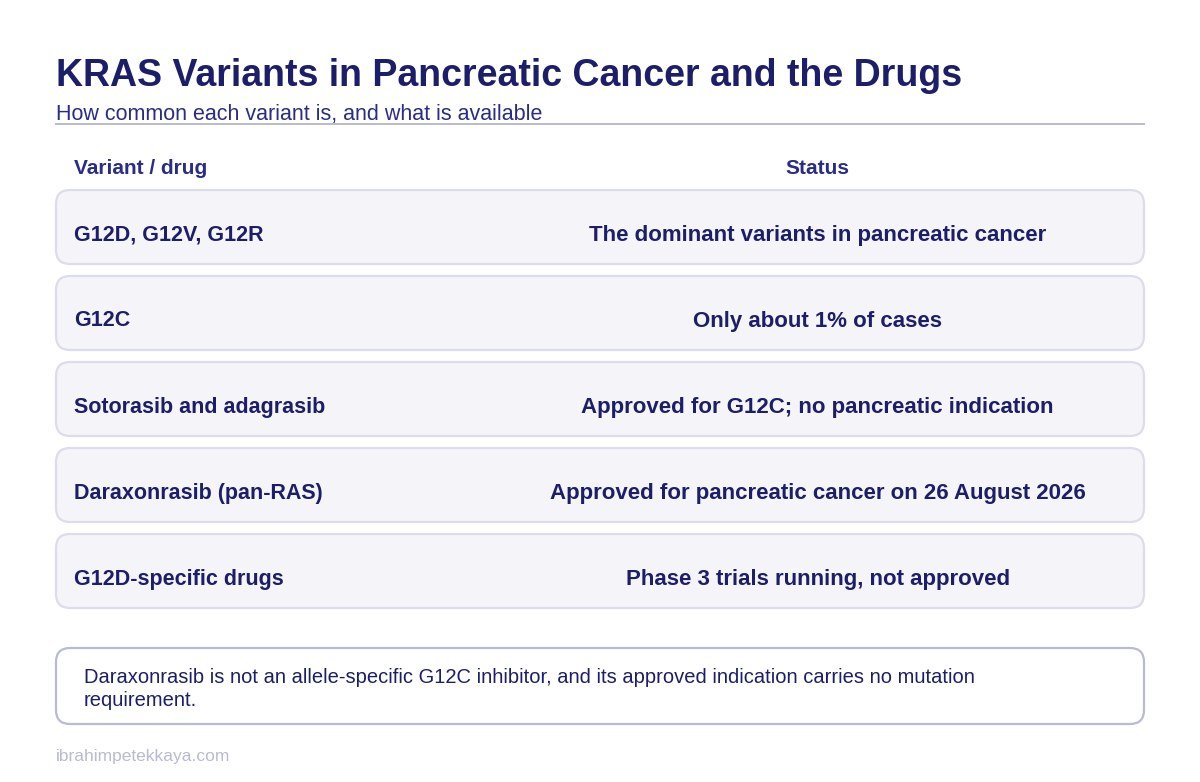
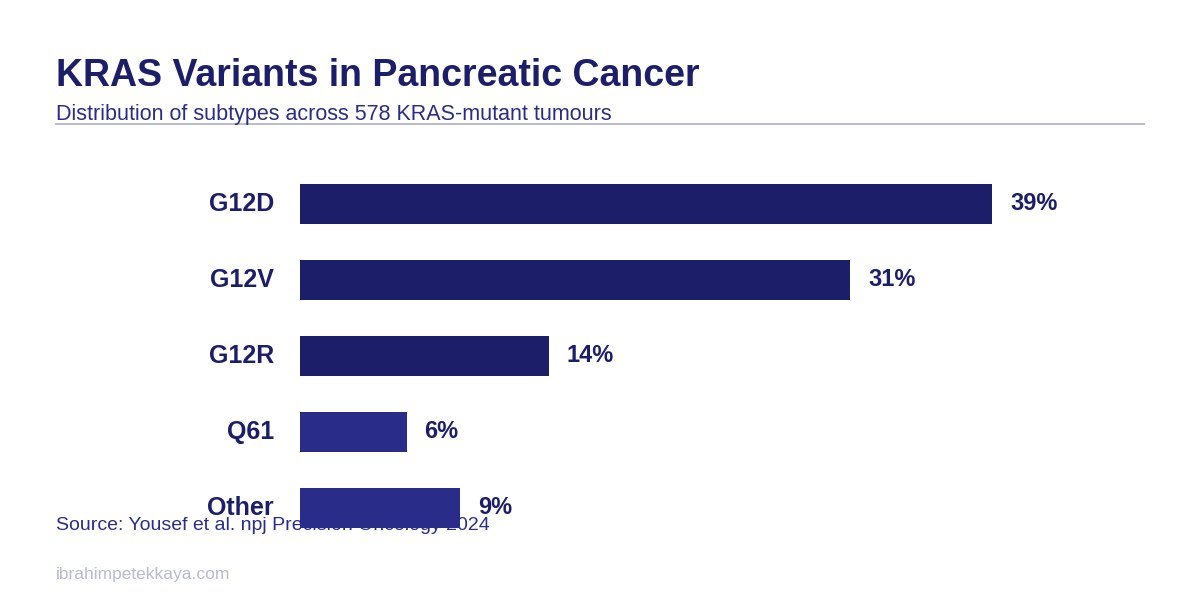
A KRAS mutation is close to a rule in pancreatic cancer, but G12C is an uncommon variant in this tumour: it is found in only about 1 per cent of cases. The dominant variants are G12D, G12V and G12R. The change encountered most often in this disease is therefore not the change the allele-specific drug binds to.
Data have nonetheless been generated in the patients who do carry G12C. Sotorasib was tried in 38 previously treated patients: the response rate was 21 per cent, median progression-free survival 4.0 months and median overall survival 6.9 months. This is the most solid dataset in the field that does not come from a single centre.
Adagrasib was tried in the pancreatic arm of a basket trial, where 7 of 21 patients responded, which comes to 33.3 per cent. That figure should not be read as carrying the same weight as the dedicated 38-patient study: it is a subgroup of a basket trial and the number of patients is small.
Some pancreatic figures attributed to this drug class circulate in secondary sources. Because they could not be traced back to a primary source, no pancreatic figure from the CodeBreaK 101 trial is reported in this article at all. That finding a mutation does not always mean a usable drug exists is also discussed in how to read an NGS report.
Finding a Mutation Does Not Mean a Treatment Exists
Why a change detected on a genetic report does not always correspond to a drug that can be used.
The Drug That Gained Approval in Pancreatic Cancer
The real development in this field came not from the allele-specific drugs but from a different approach. Daraxonrasib, marketed as RASONQUE, was approved on 26 August 2026 in metastatic pancreatic adenocarcinoma. The approval covers adults who have had at least one line of systemic treatment or who are not suitable for multi-agent systemic treatment.
Two points have to be kept strictly apart. First, daraxonrasib is not an allele-specific G12C inhibitor; it is a pan-RAS(ON) multi-selective inhibitor. Second, the approved indication carries no mutation requirement whatsoever; the drug is not approved for RAS-mutant pancreatic cancer.
The registration trial is of phase 3 design and enrolled 500 patients, with arms of 248 and 252. Median overall survival was 13.2 months against 6.7 months, with a reported hazard ratio of 0.40. Median progression-free survival was 7.2 months against 3.6 months, hazard ratio 0.49. The p value was below 0.001 for both results.
The side-effect picture points the same way. Treatment was stopped because of an adverse event in 1.2 per cent against 11.2 per cent, so discontinuation was markedly less frequent than in the chemotherapy arm. Grade 3 and higher adverse events were 61.8 per cent against 69.6 per cent. A RAS G12 mutation was present in 91.8 per cent of the trial population.
An earlier phase 1/2 report of the same drug also exists: in 26 patients carrying a RAS G12 mutation, treated in the second line, the response rate was 35 per cent, median progression-free survival 8.5 months and median overall survival 13.1 months. The primary endpoint of that study was safety, and because the patient numbers are small its confidence intervals are wide. The result to put forward is therefore the phase 3 trial.
Important: The approved indication is not conditional on a mutation. That 91.8 per cent of the trial population carried a RAS G12 mutation does not mean the approval is restricted to patients who have one. Daraxonrasib is also not a G12C inhibitor but a pan-RAS(ON) multi-selective inhibitor.
Why G12D Is the Harder Target
Because G12D is the variant seen most often in pancreatic cancer, drug development specific to that position continues. Those drugs are at phase 3 and none of them is approved.
Nor has the route been free of trouble. Development of an earlier G12D candidate was terminated because of problems with the formulation of the drug. Developing allele-specific G12D drugs has, in other words, not been straightforward. That does not mean the target is out of reach; it means that today there is no approved G12D drug.
This picture also explains why the pan-RAS approach produced a result first. Rather than aiming at a single allele, a drug that targets the active form of the RAS proteins collectively reaches more patients in a tumour whose variant distribution is broad. Routes of access to trials are described in the early access programme and clinical trials.
What Has Changed in First-Line Treatment
First-line treatment in metastatic pancreatic cancer has not been affected by any of this. The standard regimens remain FOLFIRINOX and the combination of gemcitabine with nab-paclitaxel.
The NALIRIFOX regimen was found superior to gemcitabine with nab-paclitaxel and is an accepted third option. That regimen has never been compared with FOLFIRINOX, however, and it has not displaced it. Superiority holds only against the regimen it was actually compared with.
The approval of daraxonrasib does not change the first line either; it covers patients who have had at least one line of systemic treatment or who are unsuitable for multi-agent treatment. The general framework of chemotherapy regimens is set out on the chemotherapy page.
Which Sequence Is Followed in Practice
When a KRAS change appears on a report, the sequence that follows is built around the type of the tumour and around the variant itself. The steps below rest on the approval status set out above rather than on any general principle.
- The type of the tumour is established: approval status differs between lung, colorectal and pancreatic disease.
- The KRAS variant is read exactly; the difference between G12C and G12D or G12V changes the treatment option directly.
- In lung cancer, if G12C is present and at least one line of systemic treatment has been given, sotorasib or adagrasib comes into consideration.
- In colorectal cancer, if G12C is present, these drugs are assessed in combination with an EGFR antibody.
- In pancreatic cancer the allele-specific G12C drugs are not approved; after at least one line of systemic treatment, daraxonrasib is assessed.
- Where no suitable approved option exists, trial opportunities are investigated and the decision is taken at a board.
Which board takes the decision and on what data is covered on the molecular tumour board page, and the test itself on the comprehensive genomic profiling page. The field as a whole is set out on the precision oncology page.
In summary, KRAS is no longer an undruggable target. The allele-specific KRAS G12C inhibitors have established themselves in lung and colorectal cancer; in pancreatic cancer, where that variant is uncommon, the real gain has come from the pan-RAS approach. Each route has limits of its own, and reading the variant is where the decision starts.
Send Your Reports for Assessment
Share your pathology, imaging and blood results on WhatsApp, or send them by email. Documents are reviewed before the consultation.
Frequently Asked Questions
Which cancers are KRAS G12C inhibitors approved in?
Sotorasib and adagrasib are approved in advanced non-small-cell lung cancer carrying a KRAS G12C mutation, after at least one line of systemic treatment; those lung indications remain accelerated approvals. In colorectal cancer they were approved in combination with an EGFR antibody: sotorasib with panitumumab and adagrasib with cetuximab.
Are KRAS G12C inhibitors used in pancreatic cancer?
There is no approved use. G12C is found in only about 1 per cent of cases of this tumour. Sotorasib gave a response rate of 21 per cent, progression-free survival of 4.0 months and overall survival of 6.9 months in 38 previously treated patients; adagrasib produced a response in 7 of 21 patients in the pancreatic arm of a basket trial.
What is the newly approved drug in pancreatic cancer?
Daraxonrasib, marketed as RASONQUE, was approved on 26 August 2026 in metastatic pancreatic adenocarcinoma. It is not an allele-specific G12C inhibitor but a pan-RAS(ON) multi-selective inhibitor, and the approved indication carries no mutation requirement.
What are the phase 3 results of that drug?
Five hundred patients were enrolled, in arms of 248 and 252. Median overall survival was 13.2 months against 6.7 months with a hazard ratio of 0.40, and median progression-free survival 7.2 months against 3.6 months with a hazard ratio of 0.49. The p value was below 0.001 for both.
Which KRAS variant is most common in pancreatic cancer?
The dominant variants are G12D, G12V and G12R. G12C is uncommon and is seen in roughly 1 per cent of cases, which is why the allele-specific G12C drugs concern only a very small group of patients in this tumour.
Is there an approved drug for G12D?
No. Drugs specific to G12D remain in phase 3 trials. Development of an earlier candidate was terminated because of formulation problems, so targeting this allele has not been straightforward.
Has first-line treatment changed?
It has not. FOLFIRINOX and the combination of gemcitabine with nab-paclitaxel remain standard in metastatic pancreatic cancer. NALIRIFOX is an accepted option found superior to gemcitabine with nab-paclitaxel, but it has never been compared with FOLFIRINOX.
Related Articles
Related Pages
Pancreatic Cancer
Open the Page
Targeted Therapy
Open the Page
Precision Oncology
Open the Page
Molecular Tumour Board
Open the PageSources
- Prior IA, Hood FE, Hartley JL. The Frequency of Ras Mutations in Cancer. Cancer Res 2020;80(14):2969-2974. Link
- Strickler JH, Satake H, George TJ et al. Sotorasib in KRAS p.G12C-Mutated Advanced Pancreatic Cancer. N Engl J Med 2023;388(1):33-43. Link
- Bekaii-Saab TS, Yaeger R, Spira AI et al. Adagrasib in Advanced Solid Tumors Harboring a KRAS G12C Mutation. J Clin Oncol 2023;41(25):4097-4106. Link
- de Langen AJ, Johnson ML, Mazières J et al. Sotorasib versus docetaxel for previously treated non-small-cell lung cancer with KRAS G12C mutation (CodeBreaK 200). Lancet 2023;401(10378):733-746. Link
- O’Reilly EM, Wainberg ZA, Hendifar AE et al. Daraxonrasib or Chemotherapy in Previously Treated Metastatic Pancreatic Cancer. N Engl J Med 2026;395(4):325-337. Link
- U.S. Food and Drug Administration. FDA approves daraxonrasib for metastatic pancreatic adenocarcinoma, 26 Ağustos 2026. Link
- Wolpin BM et al. Daraxonrasib in Previously Treated Advanced RAS-Mutated Pancreatic Cancer. N Engl J Med 2026;394(18):1790-1802. Link
- Wainberg ZA, Melisi D, Macarulla T et al. NALIRIFOX versus nab-paclitaxel and gemcitabine in treatment-naive metastatic pancreatic ductal adenocarcinoma (NAPOLI 3). Lancet 2023;402(10409):1272-1281. Link
- Simanshu DK, Nissley DV, McCormick F. RAS Proteins and Their Regulators in Human Disease. Cell 2017;170(1):17-33. Link