
Who the Prize Went To and On What Citation
The 2025 Nobel Prize in Physiology or Medicine was shared equally between Mary E. Brunkow, Frederick J. Ramsdell and Shimon Sakaguchi, one third each. The official citation consists of a single phrase: for their discoveries concerning peripheral immune tolerance.
There is a detail in the spelling of the names: the official announcement gives the second laureate as Frederick J. Ramsdell, not in an abbreviated form. Details of this kind are often garbled when the wording of a prize is passed on.
The key word in the citation is peripheral. The prize was awarded for showing that the control preventing the immune system from attacking its own tissue is established not only centrally but within the tissues themselves. That amounts to a change in a picture immunology accepted for a long time.
Why this concerns oncology is simple: this control mechanism is among the principal routes tumours use to escape the immune system. The general framework of immune treatments is set out on the immunotherapy page.

Chemotherapy or Immunotherapy
The difference between chemotherapy and immunotherapy, and which patient each is chosen for.
Why the Immune System Does Not Attack Itself
The immune system has to do two things at the same time: attack what is foreign and leave its own tissue alone. Those are opposing requirements, because some of the molecular patterns immune cells recognise occur both in microbes and in human tissue.
For a long time this control was thought to be established centrally alone, in the thymus. T cells maturing in the thymus pass through a selection, and cells that bind their own tissue strongly are removed at that stage. This mechanism is called central tolerance.
Central tolerance is not sufficient by itself. Cells that escape the selection enter the circulation; more than that, the thymus shrinks in adult life and largely ceases to function. Yet most adults do not develop autoimmune disease. There must therefore be a second safety mechanism operating within the tissues.
That is exactly what the discovery behind the prize concerns: the existence of this second mechanism working in the peripheral tissues, outside the thymus, and the cells that correspond to it. When the mechanism is absent, the resulting picture is not mild; it ends in severe autoimmune disease involving many organs.
What Sakaguchi Showed in 1995
The work Shimon Sakaguchi published in 1995 defined a subset of T cells carrying suppressor function. Those cells carried CD4 and CD25 on their surface, which is to say they were CD4-positive cells expressing the alpha chain of the interleukin-2 receptor.
The study identified CD4-positive, CD25-positive suppressor T cells; these are the cells known today as regulatory T cells. Sakaguchi framed them directly as a mechanism of peripheral tolerance, and that framing matches the wording of the prize citation exactly.
A correction of terminology is needed here. The name regulatory T cell, and the understanding that FOXP3 is the marker defining this cell lineage, came after the 1995 paper. An account in which that work identified FOXP3-positive regulatory T cells therefore goes further than the publication itself.
The suppressor function of these cells was measured by the restriction they place on the responses of other cells: when the subset was removed in the experimental system, the animals developed autoimmune disease involving many organs, and when it was given back the picture was prevented. For a cell subset both to cause disease by its absence and to prevent it by its presence is a direct demonstration of function rather than an indirect one.
Acceptance of the discovery at the time was not easy. The idea of a suppressor cell had been tried in the 1970s and had fallen out of favour because no reliable markers could be found. Using CD25 as a distinguishing marker made the idea measurable again.
Send Your Reports for Assessment
Share your pathology, imaging and blood results on WhatsApp, or send them by email. Documents are reviewed before the consultation.
The Foxp3 Gene and IPEX Syndrome
In 2001, Mary E. Brunkow and Frederick J. Ramsdell identified the Foxp3 gene in the mouse. This was the gene disrupted in the mouse mutant called scurfy; the scurfy mouse develops a fatal lymphoproliferative disorder, meaning that immune cells proliferate without control.
There is a common overstatement at this point which needs correcting. Brunkow and Ramsdell did not link this gene to the regulatory T cell. The connection between the gene and that cell lineage was established in 2003 by other research groups. An account in which these two researchers showed FOXP3 to be the master gene of the regulatory T cell goes beyond the content of the 2001 paper.
A decisive finding in humans was published the same year: mutations in the FOXP3 gene were shown to cause IPEX syndrome. IPEX is a severe autoimmune disease of early onset involving many organs, running with immune dysregulation, multiple endocrine disorders and bowel involvement.
The importance of that finding is this: it showed the mechanism was not merely a curiosity confined to the mouse. When the same gene was disrupted in humans, severe disease followed. The three steps were thereby complete: the cell was defined, the gene was found, and its counterpart in humans was demonstrated.
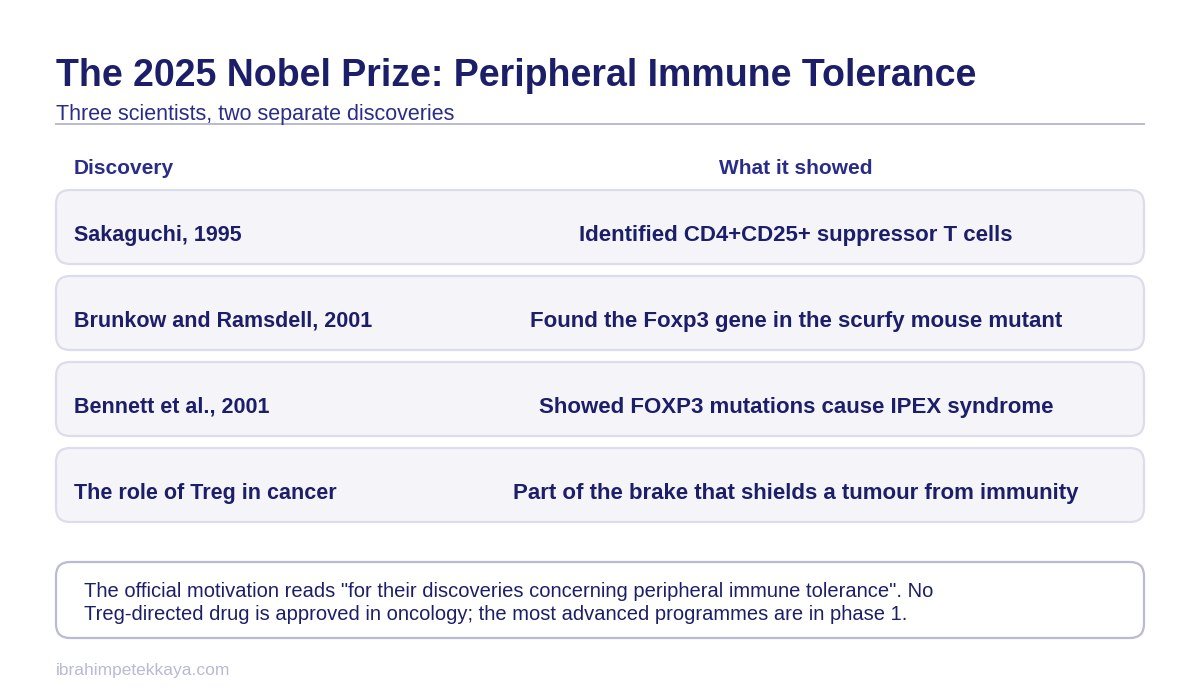
- Sakaguchi 1995: CD4-positive, CD25-positive suppressor T cells were defined as a mechanism of peripheral tolerance.
- Brunkow and Ramsdell 2001: Foxp3 was identified as the gene disrupted in the scurfy mouse; no link was made to the suppressor cell lineage.
- Bennett and colleagues 2001: mutations in FOXP3 were shown to cause IPEX syndrome in humans.
- 2003: the connection between FOXP3 and this cell lineage was established by other research groups.
- 2025: the Nobel Prize in Physiology or Medicine was awarded for discoveries concerning peripheral immune tolerance.
Why Regulatory T Cells Count as a Brake in Cancer
The function of these cells is to suppress. In healthy tissue that is a protective function: it limits inflammation and prevents autoimmune damage. In autoimmune disease the aim would be to strengthen this brake.
In cancer the picture reverses. Tumours draw these cells into their surroundings and increase their numbers, so that a zone of suppressed immune response forms around the tumour. What is wanted in cancer is therefore to weaken this brake inside the tumour.
Their accumulation within a tumour happens by more than one route. The tumour and the cells around it secrete signalling molecules that attract suppressor cells, and the surface receptors those molecules bind to are now being tried as drug targets. The balance inside the tumour ends up set against the attacking cells.
The difficulty here is the selectivity of the target. The same cells serve a protective function in the rest of the body. When they are depleted outside the tumour as well, the result is a worsening of immune-related adverse events. The field is therefore looking for depletion confined to the tumour rather than general depletion.
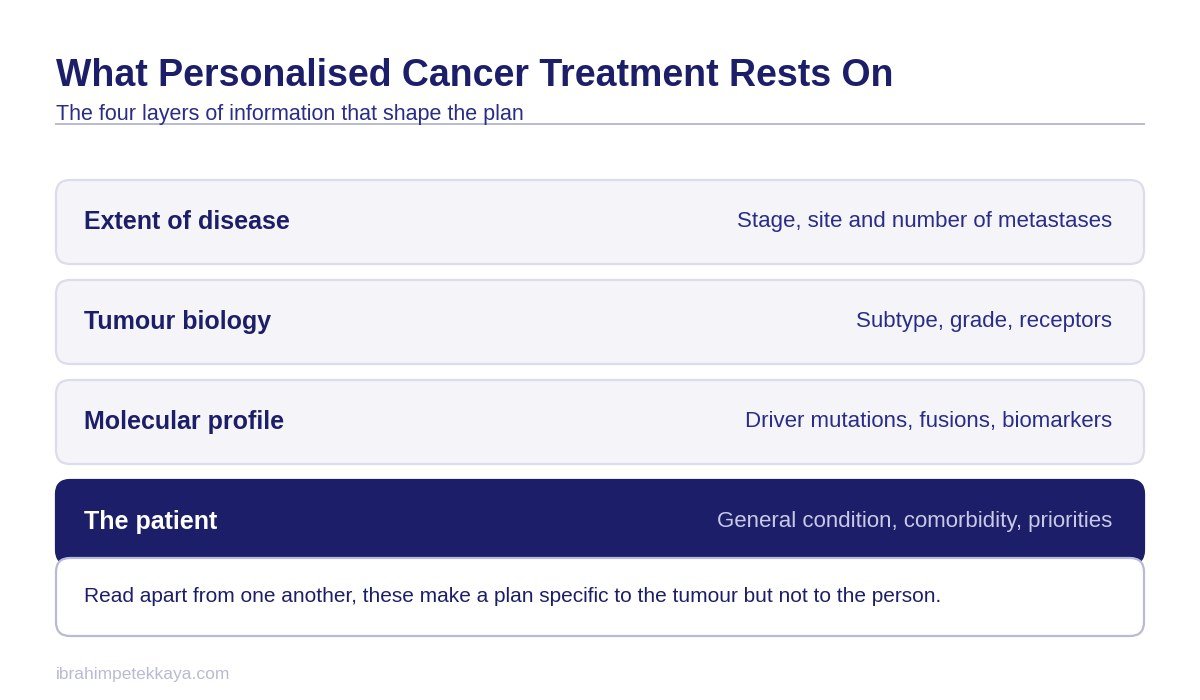
This framework should be read as a conceptual opening rather than as a gain. Understanding a mechanism describes the road towards a treatment; it does not show that the road has been walked. The general logic of choosing treatment for the individual patient is covered in what personalised cancer treatment means.
The Relationship With Checkpoint Inhibitors
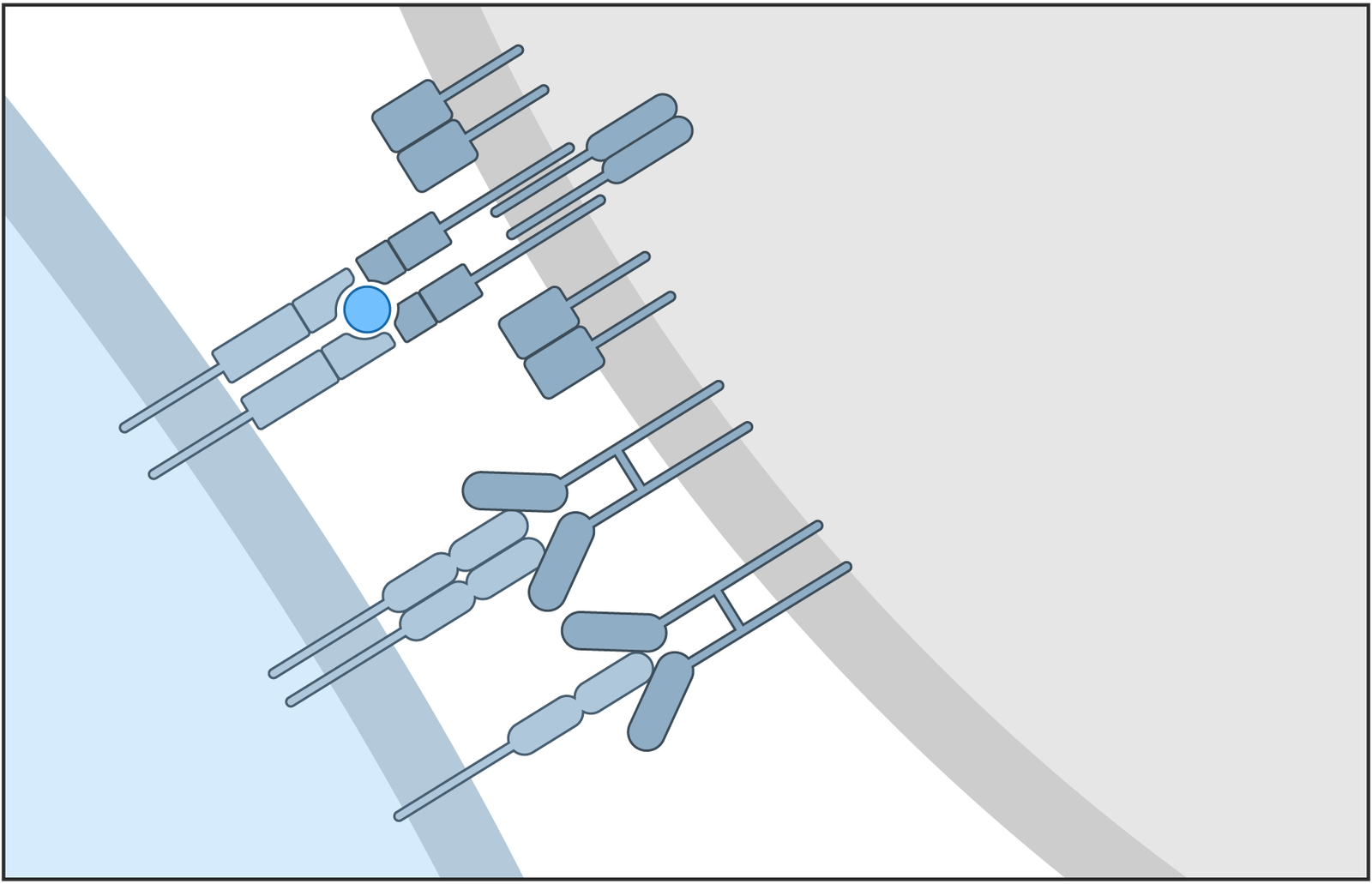
Both mechanisms rest on releasing brakes within the immune system, but the brakes are not the same. Checkpoint inhibitors act on the molecular brakes carried by the T cell itself: PD-1, PD-L1 and CTLA-4 are the recognised targets of that group.
A suppressor T cell is a separate brake and works at the level of the cell. What presses the brake here is not a molecule but another cell. The two approaches therefore do not substitute for one another; they intervene at different steps.
There are differences between the checkpoints as well. Studies exist showing that CTLA-4 blockade can be effective in disease that does not respond to PD-1 or PD-L1 inhibitors, which supports the view that different brakes are not equivalents of one another.
The practical counterpart of that distinction is what side effects to expect. Releasing a brake strengthens the response around the tumour but can also free the same response in healthy tissue; thyroid dysfunction, skin rash, colitis and inflammation of the liver or the lung occur for that reason. Recognised early, most of these pictures are reversible.
For a patient, this is the most intelligible consequence of the prize: the discovery explains why immunotherapy works, and it also explains why it sometimes causes autoimmune side effects. The brake that protects healthy tissue and the brake that protects the tumour are the same brake; loosen one and the other loosens with it.
Can a Limited Response to Chemotherapy Be Improved
How the treatment plan is rebuilt when the response obtained remains limited.
Where We Stand in the Clinic Today
Plain speaking is needed here: no drug developed to deplete regulatory T cells in cancer is approved anywhere in the world. The field is at phase 1 and early phase 2.
The most advanced target is CCR8. This surface molecule is found at higher density on the suppressor cells inside a tumour than on their counterparts in normal tissues. Afucosylated antibodies aim to exploit that property to deplete the cells within the tumour while sparing those in the tissues; one of these programmes is running at phase 1, both alone and in combination with an anti-PD-1 antibody.
A clarification is needed about ipilimumab. The drug has a partial suppressor-cell-depleting mechanism and it is approved; it was not, however, developed as a drug against regulatory T cells and it is not described that way in its licence. Citing an approved drug as an example of this class makes the field look further advanced than it is.
| Approach | Status |
|---|---|
| CCR8-targeted afucosylated antibodies | Phase 1; alone and with anti-PD-1 |
| Strategies for depletion confined to the tumour | Early phase; no approval |
| Ipilimumab | Approved; but not developed or labelled for this class |
| Strengthening the brake in autoimmune disease | Conceptual; outside oncology |
The second question a patient should ask in this field is how selective the depletion strategy is: whether the drug also depletes suppressor cells in tissues outside the tumour, which side effects are expected and which monitoring investigations are planned. In early-phase trials these questions do not yet have numerical answers; the expected side-effect profile can be discussed, its frequency cannot be stated.
The question a patient can usefully ask under this heading is this: is the treatment being offered to me an approved treatment or a clinical trial? How access to treatments within a trial is arranged is described in the early access programme and clinical trials, and which board takes the decision on the molecular tumour board page.
This prize is not an announcement of a treatment; it is the recognition of a mechanism. The randomised evidence needed to turn that mechanism into a drug has not yet been produced. How the process works in general is covered on the treatment pathway and patient guide pages.
Send Your Reports for Assessment
Share your pathology, imaging and blood results on WhatsApp, or send them by email. Documents are reviewed before the consultation.
Frequently Asked Questions
Who won the 2025 Nobel Prize in Medicine?
It went to Mary E. Brunkow, Frederick J. Ramsdell and Shimon Sakaguchi, one third each. The official citation reads: for their discoveries concerning peripheral immune tolerance.
What are regulatory T cells?
They are a subset of T cells that suppress, or brake, the immune response. In healthy tissue they prevent autoimmune damage; around a tumour they contribute to suppression of the immune response.
What exactly did Sakaguchi define?
In the 1995 paper he defined CD4-positive, CD25-positive suppressor T cells and framed them as a mechanism of peripheral tolerance. The name regulatory T cell, and the understanding that FOXP3 is the lineage-defining marker, came later.
What did Brunkow and Ramsdell find?
In 2001 they identified the Foxp3 gene in the mouse as the gene disrupted in the scurfy mutant. They did not link that gene to the suppressor cell lineage; that connection was established in 2003 by other groups.
What is IPEX syndrome?
A severe autoimmune disease of early onset involving many organs, caused by mutations in the FOXP3 gene. It is the finding that showed the mechanism holds in humans as well as in the mouse.
Is there an approved cancer drug based on this discovery?
No. No drug developed to deplete suppressor T cells in cancer has been approved. The field is at phase 1 and early phase 2, and the most advanced target is CCR8.
Is ipilimumab a drug of this class?
It is not. Ipilimumab is an approved drug and carries a partial suppressor-cell-depleting mechanism, but it was not developed for that purpose and is not described that way in its licence.
Related Articles
What Personalised Cancer Treatment Means
Open the Page
Targeted Therapy Resistance: Why It Happens
Open the PageRelated Pages
Immunotherapy
Open the Page
Targeted Therapy
Open the Page
Precision Oncology
Open the Page
Patient Guide
Open the PageSources
- The Nobel Assembly at Karolinska Institutet. The Nobel Prize in Physiology or Medicine 2025: Mary E. Brunkow, Frederick J. Ramsdell, Shimon Sakaguchi. Link
- Sakaguchi S, Sakaguchi N, Asano M et al. Immunologic self-tolerance maintained by activated T cells expressing IL-2 receptor alpha-chains (CD25). J Immunol 1995;155(3):1151-1164. Link
- Brunkow ME, Jeffery EW, Hjerrild KA et al. Disruption of a new forkhead/winged-helix protein, scurfin, results in the fatal lymphoproliferative disorder of the scurfy mouse. Nat Genet 2001;27(1):68-73. Link
- Bennett CL, Christie J, Ramsdell F et al. The immune dysregulation, polyendocrinopathy, enteropathy, X-linked syndrome (IPEX) is caused by mutations of FOXP3. Nat Genet 2001;27(1):20-21. Link
- Skoulidis F, Araujo HA, Do MT et al. CTLA4 blockade abrogates KEAP1/STK11-related resistance to PD-(L)1 inhibitors. Nature 2024;635(8038):462-471. Link