
Why Treatment Is Given Around Surgery
In operable cancer of the stomach and the gastro-oesophageal junction, treatment is not surgery alone. Chemotherapy given before and after the operation shrinks the tumour and makes the surgery more straightforward, and it also targets spread that imaging cannot detect. This arrangement is called perioperative treatment.
The standard regimen here is FLOT: 5-fluorouracil, leucovorin, oxaliplatin and docetaxel. The FLOT4 trial set that standard by showing the regimen to be superior to the older epirubicin-based combinations. European guidelines likewise recommend perioperative chemotherapy in operable disease rather than surgery followed by observation.
Immunotherapy has been used in metastatic stomach cancer for years. The open question was a different one: does the same approach help while the disease can still be removed surgically? MATTERHORN was built to answer it. The general treatment framework for the disease is set out on the stomach cancer page.
How MATTERHORN Was Designed
MATTERHORN is a multinational, randomised, double-blind phase 3 trial. Nine hundred and forty-eight previously untreated patients with operable stage II to IVA adenocarcinoma of the stomach or the gastro-oesophageal junction were divided between two arms.
- 474 patients received durvalumab with FLOT and 474 received placebo with FLOT.
- Durvalumab is an anti-PD-L1 drug; it was given intravenously at 1500 mg every four weeks.
- Four cycles of FLOT were given: two before surgery and two after it.
- A further 10 cycles of durvalumab or placebo followed surgery, making one year of immunotherapy in all.
- Patients had to be in ECOG performance status 0 or 1.
One detail needs stating accurately. FLOT is administered fortnightly, on days 1 and 15 of each four-week cycle. Four cycles therefore mean eight FLOT administrations, not four.
Send Your Reports for Assessment
Share your pathology, imaging and blood results on WhatsApp, or send them by email. Documents are reviewed before the consultation.
What Was Found
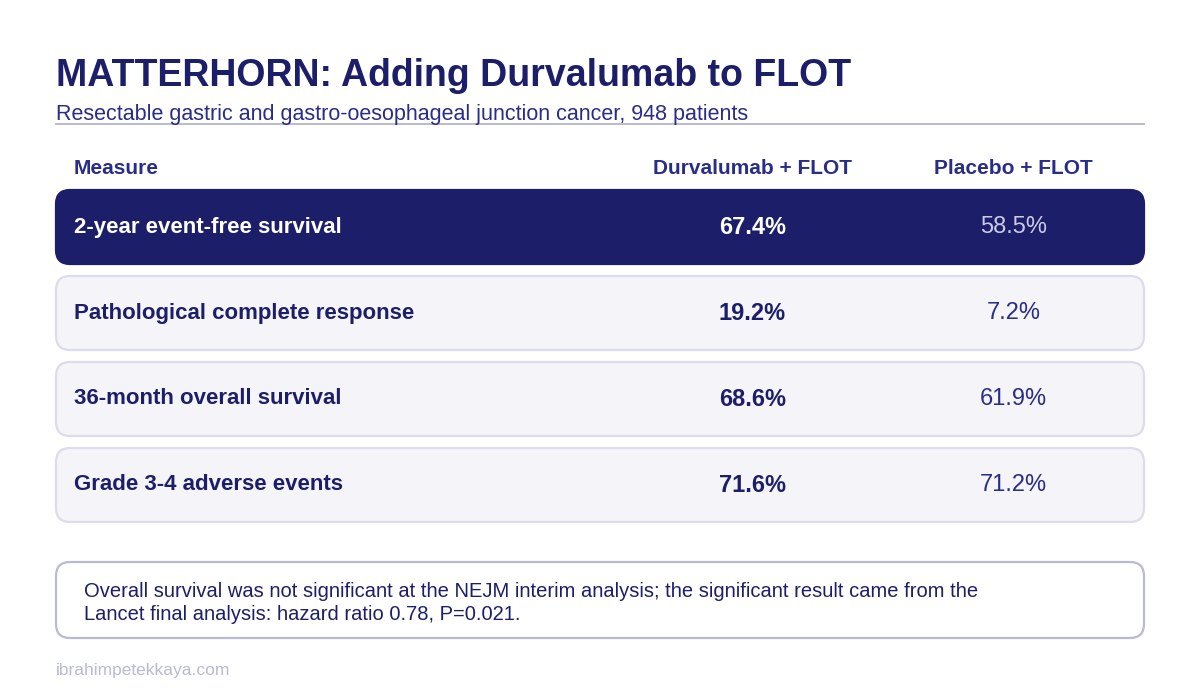
At a median follow-up of 31.5 months, two-year event-free survival was 67.4 per cent in the durvalumab arm and 58.5 per cent in the placebo arm. The hazard ratio was 0.71 and the difference was statistically significant. In absolute terms the gap is about nine percentage points.
Pathological complete response, meaning that no live tumour cells remain in the surgical specimen, was seen in 19.2 per cent of the durvalumab arm and 7.2 per cent of the placebo arm. That is a 2.7-fold increase, and it is the most direct available measure of what adding immunotherapy to chemotherapy does to the tumour itself.
The success of the surgery, by contrast, was the same in both arms. The R0 resection rate, meaning complete removal of the tumour, was 91.5 per cent in the durvalumab arm and 92.3 per cent in the placebo arm. These rates were calculated over the patients whose surgery could be completed, not over all randomised patients.

Can a Limited Response to Chemotherapy Be Improved
How the treatment plan is rebuilt when the response to chemotherapy remains limited.
Overall Survival Is Read in Two Analyses
This is the most frequently misreported part of the trial, and it needs setting out in order.
In the first published analysis, at a median follow-up of 31.5 months, overall survival was not statistically significant. The p value obtained was 0.03, while the prespecified significance threshold was below 0.0001. The conclusion of that publication rests on event-free survival alone and claims no overall survival superiority.
The frequently quoted hazard ratio of 0.67 is not the whole picture either: that figure is a piecewise estimate covering only the period after month 12. The matching estimate for the first 12 months is 0.99. In other words, the arms did not begin to separate during the first year but afterwards.
The significant overall survival result came later, from the final analysis carried out at around 43 months of follow-up. There the hazard ratio was 0.78 with a p value of 0.021, and 36-month overall survival was 68.6 per cent against 61.9 per cent. The regimen therefore now has a positive overall survival result, but that result comes from the final analysis and not from the first publication.
Important: The sentence “it extended overall survival” is correct, but its basis is the final analysis rather than the first publication. Conflating the two makes the level of evidence look stronger than it is.
Does PD-L1 Status Make a Difference
The choice of word matters here. The benefit appeared consistent across the PD-L1 subgroups; that is not the same as having shown the benefit to be independent of PD-L1.
In patients whose PD-L1 expression was 1 per cent or above, the hazard ratio for event-free survival was 0.70; in those below 1 per cent it was 0.77. The second group, however, contained only 95 patients and its confidence interval crossed 1. A subgroup of that size cannot carry a claim of independence whichever direction the point estimate happens to fall in.
These subgroup analyses were prespecified but exploratory, and no formal test of interaction was performed. This is the first question that gets asked about a result of this kind, which is precisely why the accurate word is consistent rather than independent.
| Result | Status |
|---|---|
| Event-free survival | Primary endpoint; hazard ratio 0.71, significant |
| Pathological complete response | 2.7-fold increase; supportive |
| Overall survival | Not significant in the first analysis; significant in the final analysis |
| PD-L1 subgroups | Exploratory; benefit consistent, independence not shown |
How Much Did Side Effects Increase
Adding durvalumab did not meaningfully worsen tolerability. Grade 3 and 4 adverse events occurred in 71.6 per cent of the durvalumab arm and 71.2 per cent of the placebo arm, so the burden of severe toxicity was almost identical. The reason is that most of that burden comes from the FLOT regimen itself.
- The most frequent adverse events were diarrhoea, nausea, neutropenia and loss of appetite.
- Immune-related adverse events occurred in 23.2 per cent of the durvalumab arm against 7.2 per cent of the placebo arm.
- Grade 3 to 4 immune-related events were 7.2 per cent against 3.6 per cent.
- Deaths considered possibly treatment-related were 0.6 per cent against 0.2 per cent.
Immune-related adverse events are the particular price of immunotherapy: they present as thyroid dysfunction, skin rash, colitis and, less often, inflammation of the lung or the liver. Most are reversible when recognised early. How these events are managed is described on the immunotherapy page.
How the Decision on Immunotherapy in Stomach Cancer Is Made
MATTERHORN showed that PD-L1 inhibitors can produce clinical benefit not only in metastatic disease but in locally advanced stomach cancer as well. With this trial the place of immunotherapy in stomach cancer moved from the metastatic setting to the period around surgery.
- Staging confirms that the disease really is operable.
- General condition, renal function and liver function are assessed for fitness for the FLOT regimen.
- A history of autoimmune disease and any immunosuppressive drugs in use are asked about.
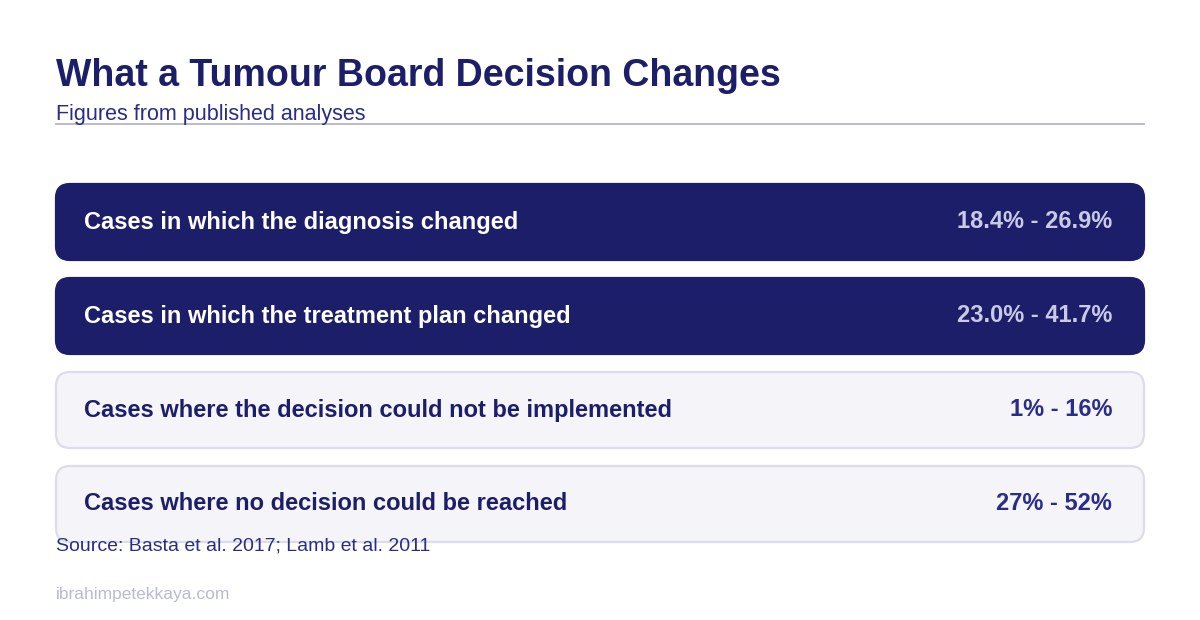
- The treatment plan is agreed at a board attended by surgery, pathology and medical oncology together.
- Regular monitoring for immune-related adverse events is planned for the whole treatment period.
As the molecular tumour board and treatment pathway pages describe, the decision rests not on one result but on reading the findings together. The other tumours in this group are covered on the gastrointestinal cancers page.
Chemotherapy or Immunotherapy
The difference between chemotherapy and immunotherapy, and which patient each is chosen for.
Send Your Reports for Assessment
Share your pathology, imaging and blood results on WhatsApp, or send them by email. Documents are reviewed before the consultation.
Frequently Asked Questions
At what stage is immunotherapy in stomach cancer used?
It has been used in metastatic disease for years. With the MATTERHORN trial it was also shown that it can be added to standard FLOT chemotherapy before and after surgery in operable stage II to IVA disease.
What was given in the MATTERHORN trial?
Durvalumab 1500 mg every four weeks was added to the standard FLOT regimen. Four cycles of FLOT were given, two before surgery and two after; a further 10 cycles of durvalumab followed surgery, completing one year of immunotherapy.
How large was the difference in event-free survival?
Two-year event-free survival was 67.4 per cent in the durvalumab arm and 58.5 per cent in the placebo arm, with a reported hazard ratio of 0.71.
Why does pathological complete response matter?
It means no live tumour cells remain in the surgical specimen, so it shows directly what the treatment did to the tumour. In MATTERHORN the rate rose from 7.2 per cent to 19.2 per cent.
Was overall survival really extended?
In the first published analysis it was not significant: the p value was 0.03 while the prespecified threshold was below 0.0001. The significant result came from the later final analysis, with a hazard ratio of 0.78 and a p value of 0.021.
Is the benefit independent of PD-L1?
The benefit appeared consistent across the PD-L1 subgroups, but independence was not shown. The group with PD-L1 expression below 1 per cent contained only 95 patients and its confidence interval crossed 1.
How much did side effects increase?
Grade 3 to 4 adverse events were almost identical in the two arms, at 71.6 per cent against 71.2 per cent. The real difference was in immune-related adverse events: 23.2 per cent against 7.2 per cent.
Related Articles
Related Pages
Gastrointestinal Cancers
Open the Page
Immunotherapy
Open the Page
Chemotherapy
Open the Page
Molecular Tumour Board
Open the PageSources
- Janjigian YY, Al-Batran SE, Wainberg ZA et al. Perioperative Durvalumab in Gastric and Gastroesophageal Junction Cancer (MATTERHORN). N Engl J Med 2025;393(3):217-230. Link
- Janjigian YY, Al-Batran SE, Wainberg ZA et al. Perioperative durvalumab plus FLOT for resectable gastric and gastro-oesophageal junction adenocarcinoma (MATTERHORN): final overall survival results. Lancet 2026;408(10560):1114-1128. Link
- Al-Batran SE, Homann N, Pauligk C et al. Perioperative chemotherapy with FLOT versus ECF/ECX for resectable gastric or gastro-oesophageal junction adenocarcinoma (FLOT4). Lancet 2019;393(10184):1948-1957. Link
- Lordick F, Carneiro F, Cascinu S et al. Gastric cancer: ESMO Clinical Practice Guideline for diagnosis, treatment and follow-up. Ann Oncol 2022;33(10):1005-1020. Link
- Marabelle A, Le DT, Ascierto PA et al. Efficacy of Pembrolizumab in Patients With Noncolorectal High Microsatellite Instability Cancer (KEYNOTE-158). J Clin Oncol 2020;38(1):1-10. Link
- NCCN Clinical Practice Guidelines in Oncology, guidelines by cancer type. Link