
Why the Position Has Changed
That physical activity helps in cancer has been said for a long time. The advice rested on observational work, and observational work leaves one question open: patients who moved more were seen to do better, but whether the benefit came from the activity itself or from the fact that patients already in better condition are the ones able to move could not be separated. Without randomisation the two explanations fit the same data equally well.
CHALLENGE settled the question by randomising. Eight hundred and eighty-nine patients with resected stage III or high-risk stage II colon cancer, all of whom had finished their adjuvant chemotherapy, were assigned either to a structured exercise programme or to a health education arm. The median follow-up was 7.9 years.
The result changed the standing of exercise in colon cancer. The hazard ratio for disease-free survival was 0.72 and the difference was statistically significant. Five-year disease-free survival reached 80.3 per cent in the exercise arm against 73.9 per cent in the health education arm, a gap of 6.4 percentage points.
Important: The comparator was not a group left to its own devices. The health education arm also received an active intervention, and the difference was added on top of that.
What the Prescription Actually Was
This is the part most often reported wrongly. The prescription in the trial was not “150 to 300 minutes of exercise a week”. One hundred and fifty minutes a week was an eligibility threshold set for entry into the trial: patients whose activity fell below that level were the ones enrolled.
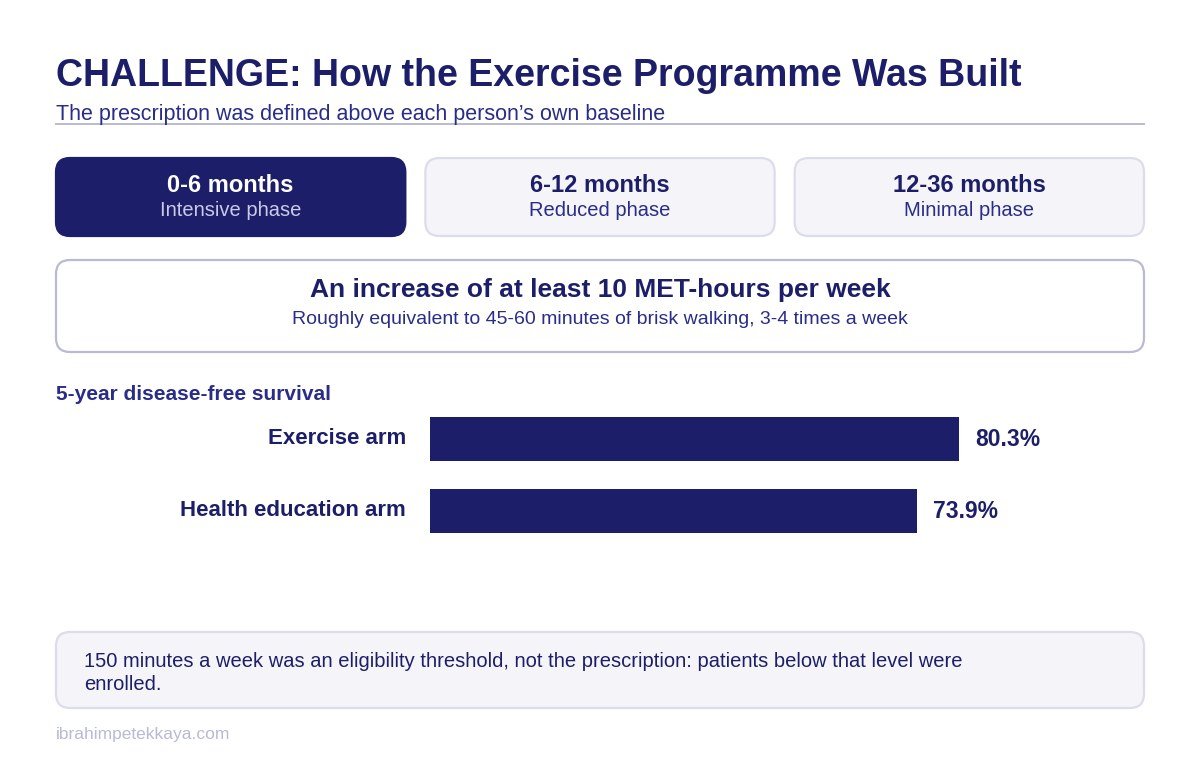
The real target was an increase of at least 10 MET-hours a week in recreational physical activity, measured against the person’s own baseline. A MET-hour is a unit that captures intensity and duration together, so a short hard session and a longer easy one can be compared. The trial described this target as roughly equivalent to 45 to 60 minutes of brisk walking three or four times a week.
The programme ran for 36 months and was delivered alongside a physical activity consultant. The prescription was written for the individual: baseline fitness, activity history, performance status and the patient’s own preference all fed into it. Most patients chose walking. Any activity was accepted provided it reached at least moderate intensity.
- Months 0 to 6, the intensive phase: supervised sessions together with frequent consultation visits.
- Months 6 to 12, the tapered phase: visits become less frequent and home-based activity takes over.
- Months 12 to 36, the minimal phase: the aim is to make the habit that has been built permanent.
- The target stays the same in every phase: at least 10 MET-hours a week above the starting level.

Is Chemotherapy Necessary After Colon Cancer Surgery
The criteria on which the decision to give chemotherapy after colon cancer surgery actually rests.
Send Your Reports for Assessment
Share your pathology, imaging and blood results on WhatsApp, or send them by email. Documents are reviewed before the consultation.
What Can Be Said About Length of Life
Care is needed at this point. Overall survival was not the primary endpoint of the trial. It was a secondary endpoint, and it was not assessed within a statistically protected testing scheme, which changes how much weight the figures can carry.
The numbers themselves are favourable: the hazard ratio for death was 0.63 and eight-year overall survival was 90.3 per cent against 83.2 per cent. The published report, however, deliberately describes this as consistent with longer overall survival and reports no p value for it. Saying that exercise extended life therefore claims more than the trial itself claims, and the distinction is not a pedantic one.
| Result | Status |
|---|---|
| Disease-free survival | Primary endpoint; hazard ratio 0.72, significant |
| Overall survival | Secondary endpoint; figures favourable, no p value reported |
| Musculoskeletal adverse events | 18.5 per cent in the exercise arm, 11.5 per cent in the comparator |
Exercise is not a cost-free intervention. Adverse events involving the muscles and the skeleton were more frequent in the exercise arm. Writing the programme individually and running it alongside a consultant therefore matters as much as the headline result.
Who This Result Applies To
The patient definition used in the trial is a narrow one, and that definition draws the boundary of what the result can be used for.
- The colon cancer had to have been removed surgically.
- The disease had to be stage III or high-risk stage II.
- Adjuvant chemotherapy had to be complete; the programme began 60 to 180 days after it ended.
- At baseline the patient had to be active at less than 150 minutes a week of moderate to vigorous intensity.
Nothing in this trial supports the same conclusion in metastatic disease, in rectal cancer, or while chemotherapy is still running. Nor is there another phase 3 trial in which exercise in colon cancer has been measured this cleanly, so there is no second dataset to fall back on when a patient sits outside the definition.
How the effect arises is not fully known. The explanations put forward include reduced insulin resistance, lower levels of circulating growth factors, regression of chronic inflammation and stronger immune surveillance. None of these was measured separately in this trial, so the mechanism remains at the level of hypothesis rather than finding.
A further limit is the length of the recruitment window. Patients were enrolled between 2009 and 2024, and across those fifteen years adjuvant regimens, their durations and surveillance practice all changed. That does not invalidate the result, but whether the difference would be the same size in a patient treated to today’s standards is not known.
Important: Surgical recovery, stoma status, and cardiac and joint problems must be assessed before exercise begins. A programme written without that assessment is not a safe programme.
What the General Recommendations Say
The nutrition and physical activity guidelines published for the period after cancer recommend at least 150 to 300 minutes of moderate or 75 to 150 minutes of vigorous aerobic activity a week, together with resistance work on two days a week. That recommendation is written for general health and should not be confused with the CHALLENGE prescription.
The two are not in conflict; they answer different questions. The guideline sets a floor for anyone with a history of cancer. CHALLENGE shows something narrower and stronger: that in a defined group of patients, at a defined point in their treatment, a programme delivered in a defined way changed the oncological outcome.
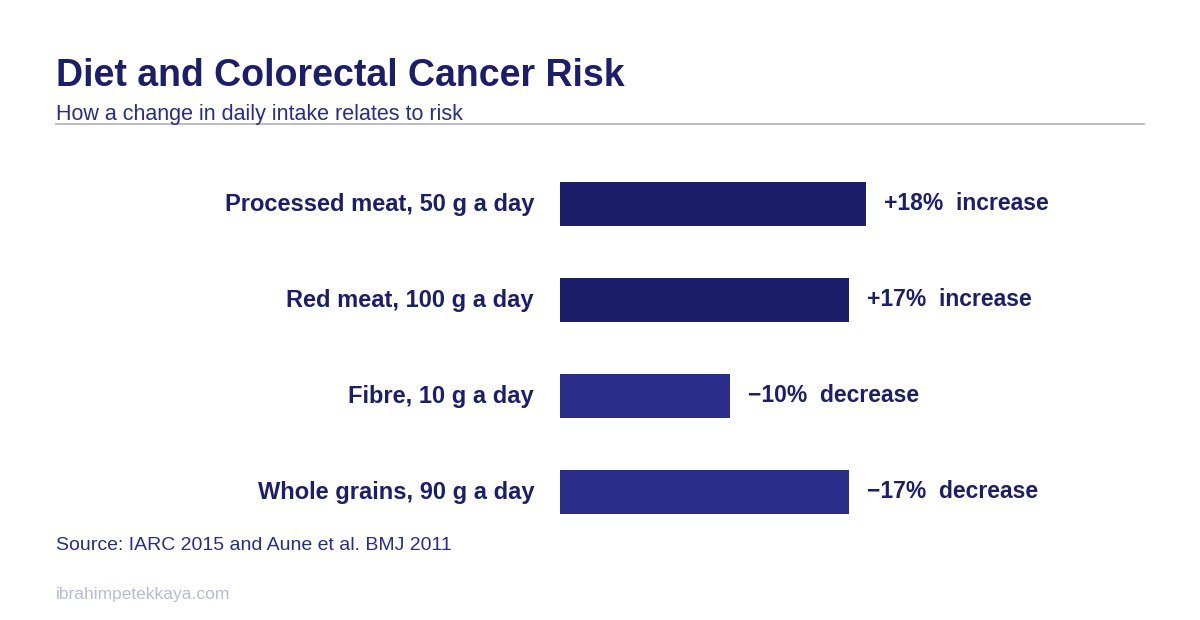
Excess weight belongs in the same picture. The International Agency for Research on Cancer working group assessed the association between body fatness and a long list of cancers, colorectal cancer among them. The dietary side of this question is taken up separately in diet and colorectal cancer.
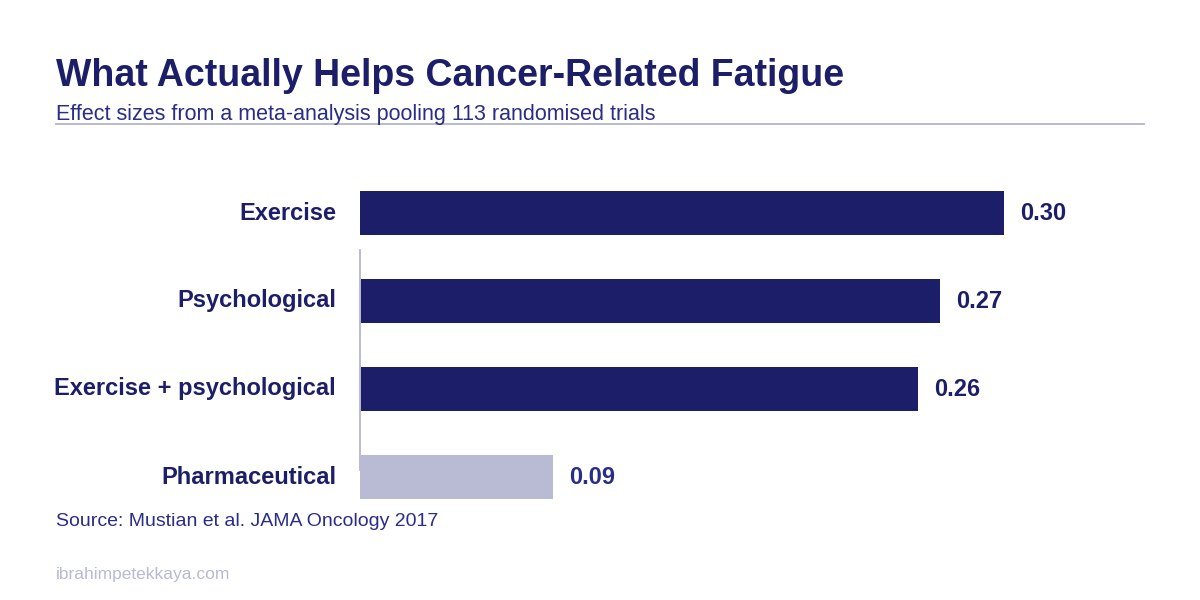
What exercise does for fatigue is a heading of its own. In a meta-analysis comparing pharmaceutical, psychological and exercise treatments for cancer-related fatigue, exercise stood out among the most effective approaches. The subject is set out in detail in why fatigue after chemotherapy does not go away.
Does a High-Fibre Diet Lower the Risk of Colon Cancer
The evidence behind the relationship between fibre intake and the risk of colon cancer.
How to Start Exercise in Colon Cancer
An exercise in colon cancer programme is built on a baseline measurement rather than on a target. What the person already does in a normal week is established first, and the increase is then added on top of that. A number handed over without that first step is an instruction nobody can follow.
- Current weekly activity is recorded: what it is, how long it lasts, how many times a week it happens.
- The target is written so that at least 10 MET-hours a week are added on top of that figure.
- Brisk walking is the most workable option for most patients and needs no equipment.
- Regular review is planned for the first months; one-off advice does not change behaviour.
- If joint or muscle pain appears, the programme is rewritten rather than abandoned.
- The aim is a habit that holds for three years, not a short burst of intensity.
The whole follow-up plan is set out on the patient guide page, and how patients are reassessed after treatment is described on the treatment pathway page. The general treatment framework for the disease itself is on the colorectal cancer page.
Frequently Asked Questions
Does exercise in colon cancer really count as treatment?
The CHALLENGE trial showed that a structured programme delivered after adjuvant chemotherapy improved disease-free survival. On that basis exercise is no longer only a supportive recommendation; it is an intervention that changes an oncological outcome in the group studied.
How many minutes a week are needed?
The trial did not set an absolute number of minutes. The target was an increase of at least 10 MET-hours a week above the person’s own baseline, which it described as roughly 45 to 60 minutes of brisk walking three or four times a week.
What does MET-hour mean?
It is a unit that measures the intensity of an activity together with its duration. An hour of moderate activity corresponds to roughly 3 to 6 MET-hours, which is why 10 MET-hours a week can be reached with a few walks.
How long did the programme last?
Thirty-six months. The first six months were intensive, months six to twelve were tapered, and from twelve months onwards the programme ran at minimal intensity. The aim was to leave a habit behind rather than a finished course.
Does exercise extend life?
Overall survival was a secondary endpoint. The figures were favourable, with a hazard ratio for death of 0.63 and eight-year overall survival of 90.3 per cent against 83.2 per cent, but the trial described this as consistent with longer survival and reported no p value.
Can exercise do harm?
Adverse events involving the muscles and the skeleton occurred in 18.5 per cent of the exercise arm and 11.5 per cent of the comparator. The programme should therefore be written individually, after surgical recovery, joint status and cardiac status have been assessed.
Does the same result apply in metastatic disease?
The trial covered only surgically resected stage III or high-risk stage II colon cancer. Nothing in it supports the same conclusion for metastatic disease or for rectal cancer.
Related Articles
Related Pages
Colorectal Cancer
Open the Page
Chemotherapy
Open the Page
Patient Guide
Open the Page
Treatment Pathway
Open the PageSources
- Courneya KS, Vardy JL, O’Callaghan CJ et al. Structured Exercise after Adjuvant Chemotherapy for Colon Cancer (CHALLENGE). N Engl J Med 2025;393(1):13-25. Link
- The Lancet Gastroenterology & Hepatology. Exercise for colon cancer: from supportive care to therapy (başyazı). Lancet Gastroenterol Hepatol 2025;10(8):701. Link
- Rock CL, Thomson CA, Sullivan KR et al. American Cancer Society nutrition and physical activity guideline for cancer survivors. CA Cancer J Clin 2022;72(3):230-262. Link
- Mustian KM, Alfano CM, Heckler C et al. Comparison of Pharmaceutical, Psychological, and Exercise Treatments for Cancer-Related Fatigue: A Meta-analysis. JAMA Oncol 2017;3(7):961-968. Link
- World Cancer Research Fund / American Institute for Cancer Research. Diet, Nutrition, Physical Activity and Colorectal Cancer. Continuous Update Project Expert Report, 2018. Link
- Lauby-Secretan B, Scoccianti C, Loomis D et al. Body Fatness and Cancer — Viewpoint of the IARC Working Group. N Engl J Med 2016;375(8):794-798. Link