
There Are Four Separate Routes
Patients usually ask one question: can I get this drug? The answer depends on the drug’s regulatory status, and in Türkiye there are four distinct legal routes.
| Situation | Route | Who applies |
|---|---|---|
| Licensed locally, but for another indication | Off-label use | The physician |
| Not licensed locally, available abroad | Named-patient import | The physician |
| Not licensed anywhere, still in development | Compassionate early access programme | The company |
| An open trial exists locally | Clinical trial participation | Physician and patient together |
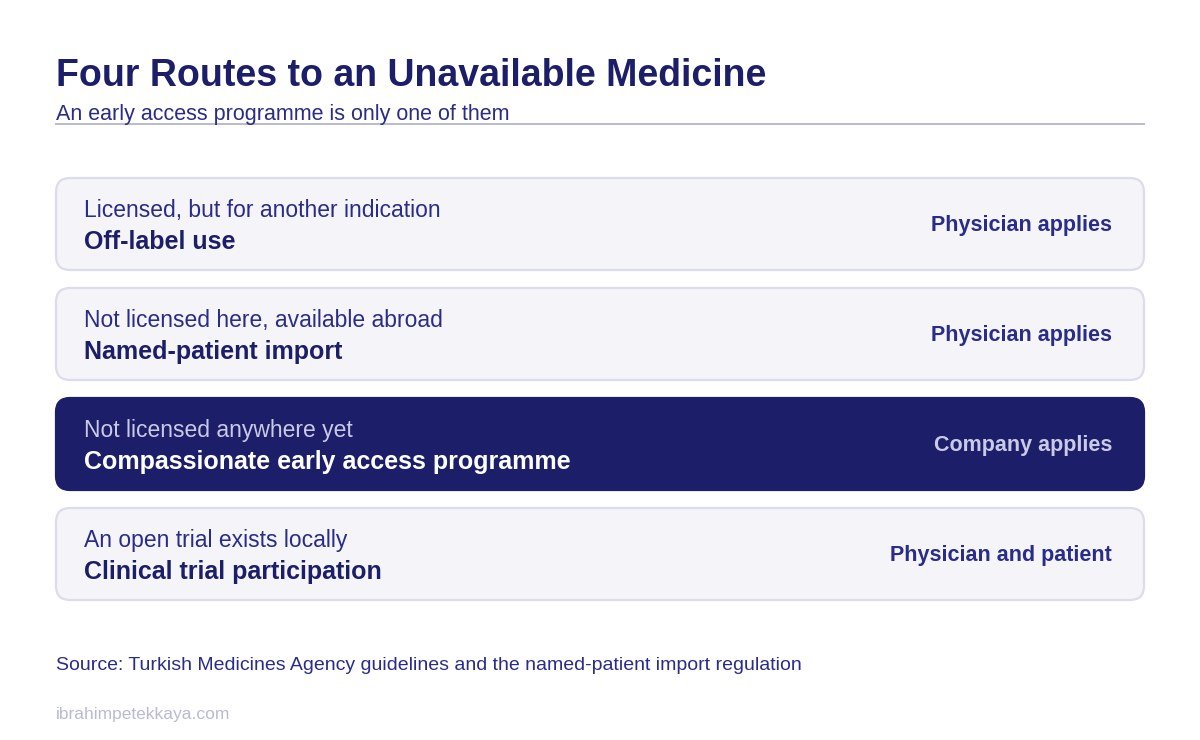
Important: The two most often confused are the second and third. Named-patient import proceeds on an application by the physician; a compassionate access programme can only be opened by the company that makes the drug, never by a physician alone.
Why the Four Routes Are Legally Separate
Underlying the distinction is where responsibility sits. For a licensed drug, responsibility for safety rests with the licence holder and the drug is used in a defined indication. Off-label use steps outside that definition, so the physician sets out the reasoning in writing and the agency assesses it.
For an imported drug, responsibility is shared between the prescribing physician and the party running the supply chain, and the drug being licensed abroad is what the assessment rests on. A drug still in development has no such basis, and because only the sponsor can be responsible for manufacture, distribution and monitoring, only the sponsor can apply.
A clinical trial stands apart because its purpose differs. In the other routes the purpose is treating one patient; in a trial, knowledge is produced, and ethics committee approval, insurance and protocol-defined follow-up follow from that. The same drug given to the same patient by two routes is governed by different rules.
What an Early Access Programme Is
In Türkiye the official name of this route translates as the humanitarian-purpose early access programme; internationally the equivalent terms are compassionate use and expanded access. The framework is set by a guideline published by the Turkish Medicines and Medical Devices Agency.
The conditions in that guideline are explicit. The disease must be life-threatening or seriously impair quality of life, standard treatments must have failed or be unavailable, and the drug must have completed at least global phase 2. Within the programme it is supplied to the patient free of charge.
- The application is made by the sponsor or its locally resident representative.
- The programme is not a clinical trial; ethics committee approval is not required.
- The disease must be life-threatening or seriously impair quality of life.
- Standard treatments must have been exhausted.
- The medicine is provided without charge.
In practice the question becomes whether a programme has been opened locally for that drug. The agency publishes a list of active programmes, and the physician checks it.
Send Your Reports for Assessment
Share your pathology, imaging and blood results on WhatsApp, or send them by email. Documents are reviewed before the consultation.
Named-Patient Import
This is the route for a drug that is not licensed locally but is in use in another country, and its framework was set by a 2023 regulation. That regulation explicitly excludes products used in clinical trials: a trial drug and an imported drug are two different things.
- The physician starts the application through the electronic prescription system.
- A medical board report or a drug-use report is prepared.
- An informed consent form is signed.
- Scientific publications supporting use in that situation are attached.
- The agency assesses the application and authorises it.
- Only then does the licensed supplier import the drug.
How complete the dossier is determines how long the process takes. Most delays come not from medical assessment but from missing paperwork: a current medical board report, signed consent, publications supporting the use and a dated summary of previous treatments all have to be in the file.
Reimbursement runs separately. The social security institution defines three routes for drugs obtained from abroad: supply through the pharmacists association, direct application to the relevant social security centre, and, exceptionally, the patient obtaining the drug and claiming reimbursement afterwards. All three require a prescription, a medical board report and the agency authorisation.
Off-Label Use
Where the drug is licensed locally but the patient falls outside the licensed indication, an off-label application is made. This route is used often in oncology, because a drug’s effect on a particular mutation can be independent of the tumour type on its licence.
The physician applies, supports the case with scientific publications, and the agency assesses it; approval opens the way both to use and to reimbursement.

Routes to New Treatments
This post explains the ways in which medicines that are unlicensed or unavailable locally can still be reached.
Taking Part in a Clinical Trial
The fourth route is joining the study in which the drug is being investigated. Legally this is separate from the other three, and it carries ethics committee approval, a defined follow-up programme and mandatory insurance.
Participation rates are lower than assumed. In an analysis of accreditation data from 1,200 United States centres, 7.1 per cent of patients with cancer joined a treatment trial, while participation in any form of research study was at least 21.9 per cent.
The reason is not patient reluctance. In the Unger meta-analysis of barriers to trial participation, 55.6 per cent of patients had no suitable trial open at their own institution, and 21.5 per cent of those with a trial available did not meet its criteria. A further 14.8 per cent had an available trial and met its criteria but were not enrolled; the authors state plainly that this group covers both those never offered a trial and those who declined one.
In the end only 8.1 per cent of patients were able to join a trial. Where an offer is made, acceptance is high: in a separate Unger meta-analysis, 55 per cent of patients offered a trial agreed to take part.
Important: The problem is not that patients do not want to join research. It is that no suitable research is open to them.
What Phase 1 Trials Offer
The idea that phase 1 trials measure nothing but safety is out of date. In an analysis of 465 National Cancer Institute-sponsored phase 1 trials and 13,847 patients, the overall response rate was 12.2 per cent, rising from 9.6 per cent in 2000-2005 to 18.0 per cent in 2013-2019.
The rate of treatment-related death did not change over the same period, remaining at 0.7 per cent. The two figures are read together: a phase 1 trial is neither a promise of treatment nor merely a toxicity exercise.
How Clinical Trials Work
The phases of a clinical trial, the rules that protect patient safety, and what taking part actually involves.
What to Expect, Honestly
It is often said that patients who join trials live longer, but that claim has not been demonstrated. In a structured review of 24 published studies, only three of the eight comparisons with a properly constructed control group showed a difference favouring the trial. The conclusion of the review is unambiguous: there are insufficient data to say that taking part in a trial improves outcomes in itself.
The apparent survival advantage is largely explained by selection: trials take patients in better general condition who meet the criteria. It is not correct to tell a patient that joining a trial will make them live longer.
- The real reasons to take part: access to a drug otherwise unavailable.
- More frequent and detailed monitoring required by the protocol.
- A contribution to knowledge that will help future patients.
- An extra option where standard treatment has been exhausted.
There is also a known problem with consent. In the Joffe survey of consent quality, most patients reported being satisfied with the process, yet fewer than 40 per cent understood that the treatment being tested had not been shown to be better than the available options. Consent is therefore a continuing conversation rather than a signed document.
Where These Figures Come From
The figures on participation and barriers come from United States data. Centre structures, insurance arrangements and the spread of open trials differ between countries, so these proportions are not a measure for Türkiye. What they carry is where the obstacle sits: the largest obstacle is not patient reluctance but the absence of a suitable trial.
The phase 1 response data also belong to a particular pool of trials, those sponsored by the National Cancer Institute, not to the whole of industry-sponsored research. A response rate also says nothing about how long a response lasts or whether it translates into length of life.
The finding on consent quality comes from a survey and measures what patients report understanding. Its direction is nonetheless clear: high satisfaction is no guarantee that the information was conveyed accurately. The consent conversation therefore states explicitly that the treatment being tested has not been shown to be better than the available options.
How Open Trials Are Found
The registries are public and free. ClinicalTrials.gov, run by the United States National Library of Medicine, and the World Health Organization registry platform can both be searched by diagnosis and country. What the stage 4 label means is covered in a separate article.
- The search is made by diagnosis and, where there is one, the mutation.
- Türkiye is selected first; if nothing appears, neighbouring countries are searched.
- Whether a trial is still recruiting is shown on the registry page.
- Inclusion and exclusion criteria are the section to read before making contact.
- Sharing what is found with a physician makes eligibility quicker to assess.
- Which documents are needed is asked first; the list differs between centres.
The search is far more productive done together with a physician, because judging eligibility is a medical decision. How that assessment is made is described on the molecular tumour board page.
How Eligibility for a Trial Is Assessed
This post explains the criteria by which a patient is judged eligible for an open clinical trial.
Frequently Asked Questions
What is an early access programme?
An early access programme is the route by which an unlicensed drug still in development is supplied free of charge to patients whose standard treatments have been exhausted. In Türkiye it is formally the humanitarian-purpose early access programme.
Who applies for an early access programme?
The sponsor of the drug or its locally resident representative. A physician cannot open a programme alone, although they can refer a patient to one already open.
Is named-patient import the same as early access?
No. Named-patient import brings in a drug licensed in another country on a physician’s application. An early access programme is for drugs not licensed anywhere and still in development.
Who pays for a drug imported from abroad?
The social security institution covers it under defined conditions. Supply usually runs through the pharmacists association, and a prescription, medical board report and agency authorisation are required.
Does taking part in a trial extend life?
Taking part in a trial has not been shown to extend life. A structured review concluded that with a properly constructed comparison group there are insufficient data to show that participation improves outcomes in itself.
Should a response be expected in a phase 1 trial?
Overall response rates in National Cancer Institute-sponsored phase 1 trials have been reported at 12.2 per cent, rising to 18 per cent recently. Treatment-related death is about 0.7 per cent.
How can I find a suitable trial?
Search ClinicalTrials.gov and the World Health Organization registry platform by diagnosis and country. Eligibility should be assessed together with your physician.
Related Articles
Related Pages

Molecular Tumour Board
Open the Page
Comprehensive Genomic Profiling
Open the Page
Treatment Pathway
Open the Page
Second Opinion
Open the PageSources
- Turkish Medicines and Medical Devices Agency (TİTCK). Guideline on the compassionate-use early access programme, 19.01.2023. Link
- T.C. Resmî Gazete [Official Gazette of Türkiye]. Regulation on the supply of medicines from abroad. 3 February 2023, no. 32093. Link
- Sosyal Güvenlik Kurumu [Turkish Social Security Institution]. Supply of medicines from abroad. Link
- Turkish Pharmacists Association. Supply of medicines from abroad — patient application. Link
- Peppercorn JM, Weeks JC, Cook EF, Joffe S. Comparison of outcomes in cancer patients treated within and outside clinical trials: conceptual framework and structured review. Lancet 2004;363(9405):263-270. Link
- Unger JM, Vaidya R, Hershman DL, Minasian LM, Fleury ME. Systematic Review and Meta-Analysis of the Magnitude of Structural, Clinical, and Physician and Patient Barriers to Cancer Clinical Trial Participation. J Natl Cancer Inst 2019;111(3):245-255. Link
- Unger JM, Hershman DL, Till C et al. “When Offered to Participate”: A Systematic Review and Meta-Analysis of Patient Agreement to Participate in Cancer Clinical Trials. J Natl Cancer Inst 2021;113(3):244-257. Link
- Unger JM et al. National Estimates of the Participation of Patients With Cancer in Clinical Research Studies Based on Commission on Cancer Accreditation Data. J Clin Oncol 2024;42(18):2139-2148. Link
- Chihara D, Lin R, Flowers CR et al. Early drug development in solid tumours: analysis of National Cancer Institute-sponsored phase 1 trials. Lancet 2022;400:512-521. Link
- Weber JS, Levit LA, Adamson PC et al. ASCO Policy Statement Update: The Critical Role of Phase I Trials in Cancer Research and Treatment. J Clin Oncol 2015;33(3):278-284. Link
- Joffe S, Cook EF, Cleary PD, Clark JW, Weeks JC. Quality of informed consent in cancer clinical trials: a cross-sectional survey. Lancet 2001;358(9295):1772-1777. Link
- U.S. National Library of Medicine. ClinicalTrials.gov — clinical trial registry. Link
- World Health Organization. International Clinical Trials Registry Platform (ICTRP). Link